

 RU
 UA
 DE
 FR
 ES
 CN
 SA
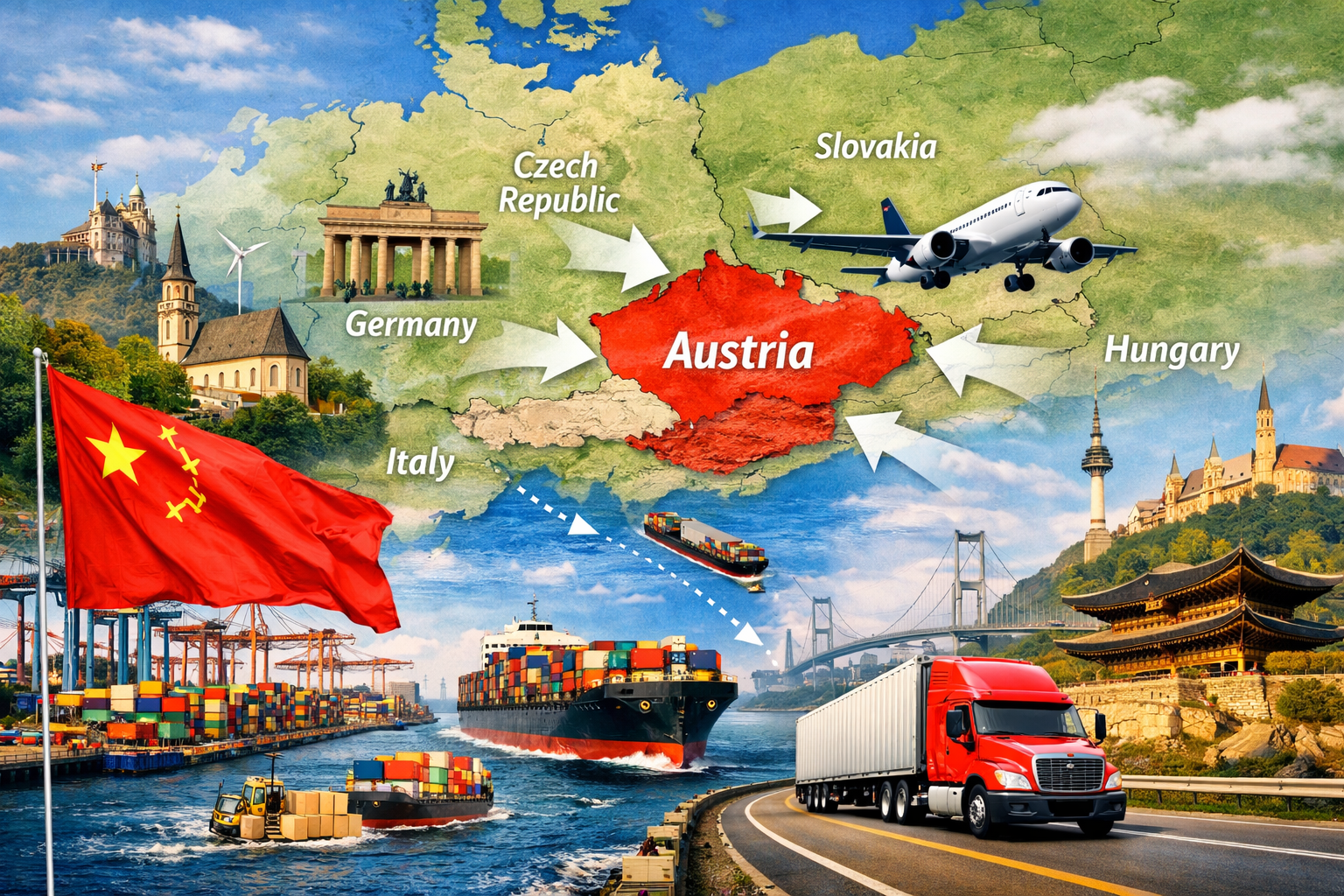
Austria and Its Role in Central European Logistics
Austria and Its Role in Central European Logistics
Austria holds a unique position on the logistics map of Europe. Despite its lack of a coastline, the country is considered one of the key transport hubs in Central Europe due to its geographical location, developed infrastructure, stable economy, and close ties with neighboring countries. Austrian territory is traversed by road, rail, and air routes connecting Germany, Italy, the Czech Republic, Slovakia, Hungary, Slovenia, Switzerland, and other European destinations.
For businesses and private clients, Austria is of interest as a starting point for international shipping. The country regularly dispatches documents, online orders, commercial cargo, personal belongings, and parcels to European Union states and beyond. Queries such as “shipping from Austria,” “parcel from Austria,” “shipping Austria Europe,” and “Austrian Post international” reflect a steady demand for Austrian logistics services.
Austrian logistics combines several advantages: a convenient location, a high level of digitalization, efficient postal operators, a developed network of sorting centers, and access to pan-European transport corridors. As a result, shipping from Austria can be carried out in various ways—via standard mail, express services, courier companies, freight forwarders, and specialized e-commerce operators.
Why Austria is Important for Central European Logistics
Geographical Location and Transport Corridors
The main advantage of Austria is its location in the center of the European continent. The country is situated at the intersection of routes connecting the western, northern, southern, and eastern parts of Europe. Major economic centers in Germany, Italy, the Czech Republic, Hungary, Slovakia, and Slovenia are located within a relatively short distance.
The proximity of Vienna to Bratislava, Budapest, and Prague plays an important role. These cities form one of the most active economic and logistics clusters in the region. From the Austrian capital, it is possible to quickly organize deliveries to neighboring countries and then utilize local distribution networks for further shipments to other European states.
Highways and railway lines passing through the Alpine passes are particularly significant. They connect Central Europe with Italy and the ports of the Adriatic Sea. Routes also run through Austria towards Germany and Eastern European countries. This structure allows the country to serve as an intermediate warehouse, transit, or distribution center.
Road and Rail Transport
Road transport remains one of the primary methods for delivering goods from Austria. It is suitable for transporting commercial shipments, pallets, consolidated cargo, and online orders. An extensive network of roads provides access to industrial zones, warehouses, shopping centers, and international terminals.
Rail logistics is also of great importance. It is in demand for transporting large shipments, heavy cargo, and goods over long distances. Railway routes help reduce the load on highways and optimize costs for regular shipments. This is particularly important for businesses that require stable delivery between Austria, Germany, Italy, Hungary, the Czech Republic, and other countries in the region.
Vienna as a Key Logistics Hub
Vienna is the main hub of Austrian logistics. The city and its surroundings house postal sorting facilities, warehouse complexes, transport terminals, an airport, and centers for processing international shipments. A significant portion of parcels sent from Austria to Europe and other regions passes through Vienna.
Vienna International Airport provides air delivery for documents, small parcels, and urgent cargo. Fulfillment centers are also important for online stores, where storage of goods, order picking, packaging, labeling, and handover of shipments to carriers are carried out.
Shipping from Austria: Main Shipping Options
Standard Postal Delivery
Standard delivery from Austria is suitable for sending documents, small boxes, clothing, souvenirs, books, and other moderately priced items. This option is typically chosen by private senders and small online stores that aim to reduce costs.
Delivery times depend on the destination country, type of shipment, congestion in the transport network, and the specifics of local postal services. Within the European Union, delivery often occurs faster, as complex customs clearance is not required for many destinations. However, even within the EU, delays can occur due to sorting, transportation, holiday periods, or content checks.
When choosing a standard service, it is important to pay attention to the allowable weight, package dimensions, availability of tracking, and compensation rules in case of damage or loss. For valuable items, it is recommended to use a service with registration and insurance coverage.
Express Delivery and Courier Services
If the shipment needs to be delivered quickly, you can choose an express carrier. Courier companies offer pickup of the package at your address, door-to-door delivery, enhanced tracking, and additional options for businesses.
Express delivery from Austria is in demand for urgent documents, product samples, components, medical materials, and goods with high commercial value. The main advantages are speed and predictability of the route. A disadvantage may be a higher cost compared to standard postal shipping.
When calculating the price, not only the actual weight is considered, but also the dimensional weight. If the box takes up a lot of space, the rate may be calculated using a formula that takes into account the length, width, and height of the package. Therefore, to optimize costs, it is important not to use overly large boxes and to properly secure the contents.
Delivery of Goods from Online Stores
Austria is a popular destination for online shopping. The country has stores for clothing, footwear, electronics, cosmetics, sports goods, furniture, and specialized products. After placing an order, the seller hands over the goods to a postal or courier service, and the buyer receives a tracking number.
The delivery scenario usually includes several stages:
confirmation of the order by the online store;
collection and packaging of the goods;
handing over the shipment to the carrier;
sorting at a regional or international terminal;
dispatch to the destination country;
customs procedures, if necessary;
handover to a local operator;
delivery to the recipient or to a pickup point.
Buyers should check in advance whether the store ships to the desired country, what taxes are included in the price, who pays for return shipping, and whether full tracking is provided.
Austrian Post International: International Services of Austrian Post
What is Austrian Post International
Austrian Post, or Österreichische Post, is the national postal operator of Austria. The international direction Austrian Post International combines services for sending letters, documents, parcels, and commercial shipments outside the country.
Austrian Post serves private customers, companies, online stores, and corporate senders. Depending on the chosen rate, you can arrange for standard shipping, registered mail, tracked parcels, express delivery, or services for regular commercial shipments.
Austrian Post International actively uses digital tools. Customers can receive notifications about the movement of their shipment, check statuses through the online service, and arrange individual operations remotely. For businesses, integrations with e-commerce systems, printing shipping labels, and bulk processing of shipments are available.
Advantages of Austrian Post International
One of the main advantages of Austrian Post International is its wide geography. Austrian Post operates with destinations in Europe and other regions of the world, using its own infrastructure and partner networks.
Advantages include:
availability of standard and expedited shipping options;
tracking capability for many types of shipments;
an extensive network of post offices and acceptance points;
clear packaging and documentation rules;
services for individuals and companies;
integration with international postal operators;
the possibility of delivery to an address or a pickup point;
electronic notifications about the status of the parcel.
However, before sending, it is important to clarify the specific conditions of the rate. Not all types of shipments have the same level of tracking, the same timelines, and the same compensation rules. For international delivery, restrictions on content, weight, dimensions, and value are especially important.
When is it Beneficial to Use Austrian Post International
Austrian Post International is suitable for senders who value accessibility, official postal infrastructure, and the option to choose between economical and expedited formats. This operator is convenient for private customers when sending personal items, gifts, documents, and small parcels.
Online stores use Austrian Post International for delivering orders to customers in other countries. With regular volumes, the company can obtain special rates, automate the creation of invoices, and connect data transfer to the store's system.
For urgent or particularly valuable shipments, it may sometimes be more appropriate to consider specialized courier companies. They can offer stricter deadlines, extended insurance, delivery within a specific time frame, and personalized support.
Shipping Austria Europe: delivery from Austria to Europe
Features of European delivery
The term shipping Austria Europe is used to refer to the shipment of goods and parcels from Austria to countries in Europe. This route includes both transport within the European Union and delivery to countries outside the single customs area.
Within the EU, delivery is usually simpler from an administrative perspective. Many goods move between countries without the classic import clearance at the border. This reduces the number of documents and makes timelines more predictable. However, the carrier may require a description of the contents, proof of value, and contact details of the sender and recipient.
When delivering to Switzerland, the UK, Norway, and other countries outside the EU customs territory, additional documents may be required. In this case, it is necessary to consider import taxes, duties, restrictions on certain categories of goods, and requirements for commercial invoices.
Popular destinations from Austria
The most sought-after destinations for Austrian delivery are Germany, Italy, the Czech Republic, Hungary, Slovakia, Slovenia, Poland, France, the Netherlands, and Belgium. This is explained not only by geographical proximity but also by intense trade relations.
Delivery to Germany often features a high frequency of flights and a developed distribution network. Shipments to the Czech Republic, Slovakia, and Hungary can be made via short land routes. Italy is connected to Austria by road and rail corridors through the Alpine passes.
When choosing a shipping method, it is worth comparing:
the cost of delivery;
the declared timeframe;
tracking options;
weight and size limits;
insurance conditions;
availability of door-to-door delivery;
return policies;
the need for customs clearance.
How to calculate shipping costs
The cost of delivery from Austria depends on several parameters. The destination country, weight, and dimensions of the parcel are the primary considerations. For some rates, dimensional weight is applied, so a large lightweight box may end up being more expensive than a compact heavy shipment.
Additionally, the price is influenced by urgency, type of service, delivery method, availability of insurance, declared value, and additional services. If the parcel is being sent to a country outside the EU, potential fees on the recipient's side must be taken into account.
To obtain an accurate calculation, it is necessary to prepare information about the contents, weight, dimensions, value, and delivery address in advance. Incorrect data can lead to a recalculation of the rate, delays, or the need to reissue documents.
Parcel from Austria: preparation, packaging, and documentation
How to properly package a shipment
Reliable packaging is an important part of international delivery. Even if the carrier handles the cargo carefully, the parcel goes through sorting, loading, unloading, and transportation through several hubs. Therefore, the packaging must withstand pressure, vibration, and possible movement inside the container.
A sturdy corrugated box is suitable for most goods. Any free space should be filled with paper, bubble wrap, foam, or other cushioning materials. Fragile items should ideally be wrapped separately and placed in a way that they do not touch the walls of the box.
Liquids must be sealed tightly and additionally placed in a protective bag. Electronics should be secured against impacts, and documents should be placed in a sturdy envelope or plastic protective bag. Old labels and barcodes should be removed to prevent automatic sorting from reading incorrect information.
What information should be included on the parcel
The packaging must clearly display the sender's and recipient's information. Typically, this includes the name or company name, street, house number, postal code, city, country, phone number, and email address. For international shipments, it is better to write the address in Latin letters if allowed by the carrier's rules.
The description of the contents should be specific. Phrases like «goods» or «personal items» can be too vague. It's better to specify the type of items, quantity, and purpose. If the shipment is commercial, an invoice, proof of value, product code, and origin information may also be required.
Content Restrictions
Before shipping, it is necessary to check the list of prohibited and restricted items. Usually, special attention is paid to weapons, explosives, narcotics, flammable liquids, certain batteries, animals, plants, medicines, and food products.
Specific categories may only be transported if special requirements are met. For example, lithium batteries, cosmetics, perfumes, and medical devices have specific packaging and labeling rules. If the sender is unsure about the acceptability of the item, it's best to contact the postal service or shipping company in advance.
Tracking Austrian Post: tracking your shipment
How tracking Austrian Post works
Tracking Austrian Post allows you to check where your package is and what delivery stages it has already passed. After the shipment is processed, the customer receives a unique number, which can be entered on the official Austrian Post website or in the partner service system.
Status updates may reflect different events:
electronic registration of the shipment;
acceptance at the post office;
transfer to the sorting center;
preparation for international shipping;
export from Austria;
arrival in the destination country;
transfer to the local operator;
customs clearance;
delivery to the courier;
attempted delivery;
received by the addressee.
Sometimes there may be a pause between status updates. This does not always indicate a problem. Updates may be delayed during international data transfer, transportation between countries, customs control, or when the package is handed over to the local postal service.
What to do if tracking is not updating
If tracking Austrian Post has not changed for a long time, the first step is to check the accuracy of the number. It is important not to confuse letters and numbers, as well as not to enter spaces and extra characters. If the number is new, information may not appear immediately: the carrier needs time to register the first scan.
If there are no updates for an extended period, it is necessary to determine whether the shipment is still in Austria, has been handed over to an international partner, or has already arrived in the destination country. Sometimes after being handed over to the local postal service, tracking may be displayed in more detail on their website.
If the delivery time is significantly exceeded, the sender can contact Austrian Post or the seller. Usually, it is the sender who has the right to initiate an official investigation regarding the international shipment. The recipient should keep the order number, correspondence, notifications, and all information about the package.
Why the status may be unclear
International postal systems use different wording. The same stage may be displayed as «shipment dispatched to the destination country», «processing at the international center», «handed over to the carrier», or «export processing completed».
Additionally, some events are only recorded at major sorting hubs. Between two scans, the package may physically move, although no new records appear in the system. Therefore, tracking does not show every action with the box, but rather key registered stages.
Customs and Documents for International Shipping
When customs clearance is required
Customs procedures depend on the destination. The movement of packages between EU countries is usually simpler than shipping to a country outside the customs union. When delivering to the UK, Switzerland, Norway, the Balkans, and other regions, additional information may be required.
Customs authorities evaluate the contents, value, origin, and purpose of the goods. If the information is inaccurately stated, the shipment may be delayed. For commercial shipments, an invoice, product description, quantity, price, delivery terms, and details of the parties involved are usually required.
For personal shipments, it is also important to honestly declare the contents and value. Attempting to undervalue the price may lead to additional checks, fines, or issues with obtaining compensation in case of loss.
Taxes and Duties
The recipient may encounter import VAT, customs duties, and administrative fees from the carrier. The amount of payments depends on the legislation of the destination country, the type of goods, their value, and the delivery conditions.
Some online stores include taxes in the order price in advance. In other cases, fees are paid upon receipt. Before making a purchase, it's advisable to check which party is responsible for import payments and whether delivery is provided under a model where all expenses are covered by the seller.
Logistics for Business and E-commerce
Fulfillment in Austria
Austrian fulfillment centers assist online stores in outsourcing logistics operations to an external operator. The company stores products in a warehouse, receives orders from the online store, picks purchases, packages them, and hands them over to Austrian Post International or a courier service.
This approach is convenient for sellers operating in multiple European countries. Instead of setting up separate warehouses in each state, one central facility in Austria can be used to ship orders as they come in.
Fulfillment also allows for the automation of returns, inventory management, label printing, and tracking the status of each order. As volumes increase, this reduces the burden on the online store's staff and decreases the likelihood of errors.
Consolidated Freight and Regular Shipments
For businesses that ship goods regularly, consolidated freight is advantageous. In this case, the cargo from different clients is combined into a single transport batch. The cost is shared among the shippers, making transportation potentially cheaper than an individual shipment.
Consolidated freight is suitable for pallets, boxes, components, and products that do not require a dedicated vehicle. However, the delivery time may be slightly longer than direct transport, as the cargo undergoes consolidation and deconsolidation.
Regular shippers can enter into contracts with carriers, receive corporate rates, establish pickup schedules, and integrate their logistics system with the order platform.
How to Choose the Optimal Delivery Method from Austria
Main Selection Criteria
The choice of carrier depends on the nature of the shipment and the sender's priorities. If minimizing cost is essential, standard postal service may be considered. If speed is a priority, it's better to compare express delivery and courier rates. For valuable goods, insurance, delivery confirmation, and enhanced tracking are necessary.
Other factors to evaluate include:
the distance to the destination country;
the urgency of delivery;
the dimensions and weight of the package;
the value of the contents;
temperature control requirements;
the need for door-to-door delivery;
the availability of returns;
the quality of customer support;
compensation policies;
the possibility of integration with the store.
Common Mistakes by Shippers
One common mistake is incorrectly specifying dimensions and weight. The second issue is inadequate packaging that does not match the nature of the product. The third is providing too vague a description of the contents, which can lead to delays during inspection.
Shippers also sometimes choose the cheapest rate without considering the lack of comprehensive tracking. This may be acceptable for inexpensive goods, but when shipping documents, electronics, or high-value products, saving money increases risks.
Another mistake is not allowing for buffer time. Even with stable logistics, delays can occur due to holiday periods, adverse weather, sorting center overloads, technical issues, or customs procedures.
Prospects for the Development of Austrian Logistics
Austrian logistics continues to evolve under the influence of e-commerce, digitalization, and sustainability requirements. There is a growing demand for automated sorting lines, electronic documents, pickup points, and forecasting systems.
A key focus is on reducing the carbon footprint. Carriers are using electric vehicles for last-mile delivery, optimizing routes, and increasing the share of rail transport. For businesses, environmental performance is gradually becoming part of the criteria for selecting a logistics partner.
Austria also maintains its significance as a link between Western, Southern, and Eastern European countries. The development of transport corridors, warehousing infrastructure, and digital platforms strengthens its position in regional logistics.
Austria is one of the most convenient logistics hubs in Central Europe. Its advantages are linked to its geographical location, quality roads, railway routes, developed postal systems, and proximity to important EU markets.
Delivery from Austria can be carried out through Austrian Post International, express courier services, transport companies, and fulfillment operators. The choice depends on the timeframe, budget, product characteristics, and tracking requirements.
For private clients, proper packaging, accurate address indication, checking restrictions, and using tracking from Austrian Post are especially important. For businesses, key factors include stable rates, automation, warehouse processing, returns, and integration with online stores.
Requests like "parcel from Austria," "shipping Austria Europe," "Central Europe logistics," and "international delivery" cover a wide range of services. With proper planning, Austria's infrastructure allows for reliable shipping of documents, goods, and commercial cargo both within Europe and beyond.