

 RU
 UA
 DE
 FR
 ES
 CN
 SA
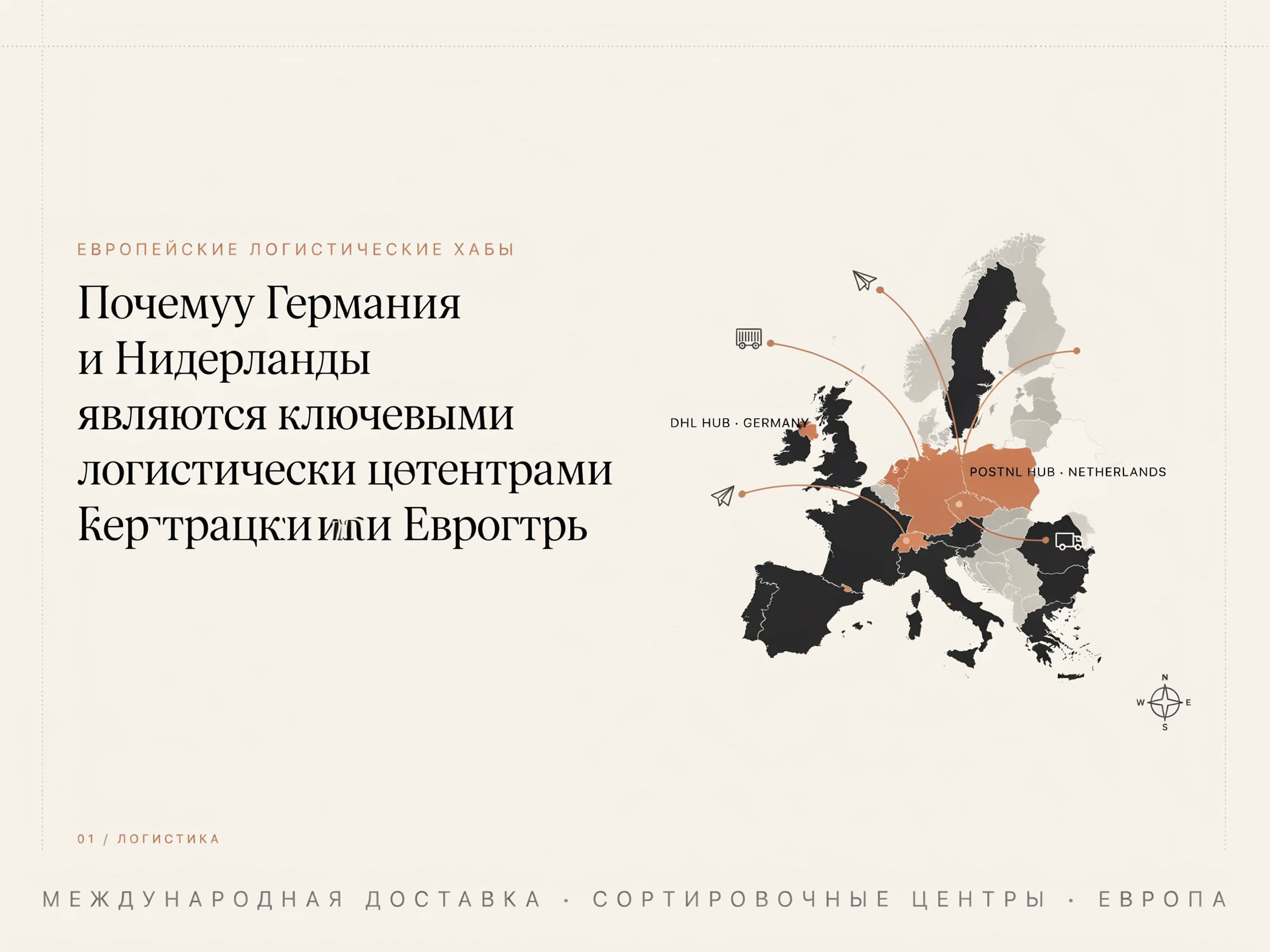
Germany and the Netherlands - Europe's Key Logistics Hubs
Why Germany and the Netherlands Are Key Logistics Hubs in Europe
Germany and the Netherlands are rightly considered the main logistics hubs in Europe. Their significance is determined not only by their advantageous geographical location but also by their developed transport infrastructure, high concentration of warehouses, sorting terminals, ports, railway hubs, and international courier services. Huge volumes of cargo pass through these countries, heading between European Union countries, the United Kingdom, Scandinavia, the Balkans, and other regions.
In European logistics, Germany is often seen as the central land hub connecting the western, eastern, northern, and southern parts of the continent. The Netherlands, in turn, plays the role of Europe's main maritime gateway. Thanks to the Port of Rotterdam, Amsterdam Schiphol Airport, and a well-developed network of road and rail routes, the country ensures the swift processing of international shipments arriving from various corners of the world.
This is why queries like «logistics hubs Europe», «Germany delivery center», «Netherlands logistics», «European sorting centers», «DHL hub Germany», and «PostNL hub Netherlands» remain relevant for online stores, carriers, marketplaces, and individual shippers. Understanding the role of these countries helps better navigate delivery times, tracking statuses, and the specifics of package transit through European infrastructure.
Geographical Location of Germany and the Netherlands
Geography is one of the main factors determining the logistical significance of Germany and the Netherlands. Both countries are located at the center of the European transport system and have convenient access to major markets. Germany shares borders with nine countries: Denmark, Poland, the Czech Republic, Austria, Switzerland, France, Luxembourg, Belgium, and the Netherlands. This makes it a natural land passage between various regions of Europe.
The Netherlands has a smaller territory; however, it compensates for this with access to the North Sea and the presence of the largest port complexes. Cargo from the UK, the USA, China, Asian countries, and other trade routes passes through Dutch infrastructure. Once they arrive at the port or airport, goods are distributed across European countries via road, rail, river, and air transport.
Germany as the Central Land Hub of Europe
Germany is located in the very center of the European continent, making it convenient to transport goods in any direction. From German logistics centers, shipments can quickly move to France, Belgium, the Netherlands, Austria, Poland, the Czech Republic, Italy, and other countries.
The highways of Germany are particularly significant. The country has one of the densest networks of highways in Europe. Major routes connect industrial areas, ports, airports, and distribution warehouses. This allows international carriers to build routes with minimal transshipments and stops.
Germany also has a developed railway system. Rail transport is especially important for containers, large shipments, and goods moving between ports and inland terminals. The combination of road and rail transport allows for optimizing costs and delivery times.
The Netherlands as the Gateway to International Trade
The Netherlands has become one of the most important entry points for goods arriving in Europe by sea and air. The Port of Rotterdam is the largest port in Europe and one of the busiest port complexes in the world. It handles containers, petroleum products, industrial raw materials, equipment, consumer goods, and cargo for further distribution across the EU.
The Amsterdam Schiphol Airport also plays a significant role. It serves passenger and cargo flights and is connected to an extensive network of European highways and warehouse complexes. Goods arriving in the Netherlands by air can be quickly directed to Germany, Belgium, France, Denmark, and other countries.
The Dutch logistics model is built on the principle of high processing speed. Cargo does not necessarily remain in the destination country; often, it passes through the Dutch terminal, is sorted, and sent further within one or two working cycles.
Major Logistics Hubs in Europe
European logistics hubs are large nodes where different modes of transport intersect and the processing of international shipments is organized. In such centers, cargo is received, scanned, sorted, consolidated, and directed to the next stage of the route.
A logistics hub can include a temporary storage warehouse, sorting line, customs terminal, loading platform, carrier offices, and points of interaction with rail, road, sea, or air companies. The larger the hub, the more destinations it serves and the higher its capacity.
Major Centers in Germany
Germany has several particularly important logistics zones. Among them, the Rhine-Ruhr region stands out, including the cities of Dortmund, Düsseldorf, Cologne, Essen, and other industrial centers. This region has a high population density, developed industry, and convenient access to road, rail, and river routes.
Frankfurt am Main is one of the most important air cargo centers in Europe. Frankfurt Airport handles a large volume of international shipments, including express parcels, pharmaceuticals, electronics, and documents. The presence of the airport, highways, and railway terminals makes the city a convenient location for cargo distribution.
Leipzig is also significant for international delivery. The region hosts one of the largest air logistics complexes, used by international courier operators. It handles night flights, express shipments, and cargo intended for quick delivery across Europe and beyond.
Hamburg serves as an important maritime and rail hub. Its port is connected to the interior regions of Germany and neighboring countries. It transports containers, industrial goods, and products for European distribution centers.
Key Centers in the Netherlands
The main logistics center in the Netherlands is Rotterdam. Its port is connected to railway lines, highways, and inland waterways. This allows goods to be shipped to Germany, Belgium, France, Austria, and other countries without prolonged storage.
Amsterdam and Schiphol Airport are important nodes in air logistics. Here, parcels, e-commerce goods, urgent correspondence, and high-value cargo are processed. Numerous warehouses, fulfillment centers, and offices of international companies are located in the vicinity of the airport.
The cities of Venlo, Eindhoven, Utrecht, and Tilburg are also significant. Venlo is located near the German border and serves as a convenient distribution center for supplies to both countries. Eindhoven is connected to technology and industrial enterprises, while Tilburg is known for its developed warehousing infrastructure and proximity to transport corridors.
Germany as a Delivery and Distribution Center
The concept of Germany as a delivery center refers not to a single specific location, but to an entire network of sorting terminals, warehouses, and transport hubs. When tracking information shows a shipment's location in Germany, it does not always mean that the parcel is intended for a German recipient. Often, the country serves as an intermediate link on the way to another state.
After a parcel arrives at a German terminal, it goes through several stages. First, the shipment is registered and scanned. Then, its destination, type of transport, need for additional checks, and final sorting route are determined. After sorting, the parcel may be handed over to a road carrier, airline, rail operator, or national postal service.
DHL hub Germany and its Importance
The term DHL hub Germany is typically used to refer to DHL's sorting and air hubs in Germany. DHL has a vast infrastructure in Germany, as a significant part of its European operations is located here. One of the most well-known centers is associated with Leipzig/Halle Airport, where a large international sorting complex operates.
In such hubs, shipments are processed around the clock. Parcels arrive from all over Europe and other regions, after which they are automatically distributed by destination. Sorting lines use barcodes, computer recognition systems, and automated conveyors. This allows for a large volume of shipments to be processed in a short time.
Depending on the route, a parcel may pass through several DHL centers. For example, a shipment from Asia may arrive at a German air hub, then proceed to a regional center in France or Poland, and only after that to a local branch in the recipient's country. Therefore, an intermediate location of the parcel in Germany is a normal part of international delivery.
Why Delivery Through Germany May Take Varying Times
The time taken for a shipment to pass through a German center depends on several factors. These include the type of service, flight and transport schedules, terminal congestion, customs procedures, and the accuracy of accompanying documents.
Express shipments typically move faster as they receive priority processing and pre-scheduled transport connections. Standard and economical packages may wait for consolidation, meaning they are grouped together for further transport. This helps reduce shipping costs, but can sometimes increase waiting times.
Additional delays may occur due to incomplete recipient information, address errors, incorrect product descriptions, or the need to pay import duties. If a shipment remains in sorting status for a long time, it does not necessarily indicate a problem. Sometimes, information in the system is updated with a delay, even though the package is already on the move.
The Netherlands and International Logistics
Logistics in the Netherlands relies on a combination of seaports, air terminals, roadways, rail networks, and inland waterways. This variety of transport allows carriers to choose the optimal route for different types of cargo.
The Dutch infrastructure is particularly efficient for e-commerce. Many international companies use local warehouses for storing goods, order fulfillment, packaging, and shipping to customers in various EU countries. As a result, an order can be delivered to the buyer without a separate shipment from the country of manufacture.
PostNL hub Netherlands and Processing International Packages
The PostNL hub Netherlands is a general term for the sorting and logistics centers of the Dutch postal service, PostNL. They handle both domestic and international shipments, including packages, letters, commercial cargo, and online store orders.
When a shipment arrives at the Dutch hub, it is registered, checked, and directed to the appropriate sorting line. If the package is destined for another country, it may be handed over to an international partner. Depending on the route, further delivery is carried out by the national postal service of the recipient country, a private courier, or a specialized transport operator.
The status of being in the Netherlands can indicate different stages: arrival in the country, sorting, preparation for export, transfer to customs authorities, or waiting for international transport. The exact meaning depends on the wording of the status and the tracking system of the specific carrier.
Why the Netherlands is Convenient for E-commerce
The Netherlands is strategically located for European fulfillment operations. A company can deliver a large batch of goods to a Dutch warehouse and then distribute individual orders throughout the EU. This reduces the distance to end customers and allows for faster service across multiple markets simultaneously.
Additionally, the country has well-developed warehousing technologies. Modern centers are equipped with automated storage systems, robotic picking lines, inventory management software, and integration with marketplaces. This is especially important for companies that process thousands of orders daily.
The Netherlands is also convenient for reverse logistics. Returned goods can be sent to a centralized regional center, where they are inspected, sorted, repaired, repackaged, or prepared for resale.
European Sorting Centers and Their Operations
European sorting centers serve as a link between the sender and the recipient. Their task is not just to store packages but to process and direct each shipment as quickly as possible along the correct route.
Main Stages of Shipment Processing
First, the cargo is accepted from the sender, online store, postal operator, or transport company. At this stage, the packaging, label, barcode, and basic shipping information are checked.
Next, the shipment is registered in the information system. It is assigned a unique identifier, which is used to track all subsequent movements. After this, the package is directed to the sorting line.
Automated equipment reads the address data and determines the direction. Packages are grouped by countries, regions, cities, and delivery types. After sorting, they are placed into containers, bags, or transport pallets and handed over for the next route.
If customs inspection is required, the shipment is directed to the appropriate zone. There, the product description, value, documents, and any import restrictions may be assessed. Once the procedures are completed, the cargo returns to the regular logistics flow.
Reasons for Multiple Intermediate Statuses
An international package rarely moves directly from sender to recipient. It may pass through a local warehouse, regional center, export terminal, international hub, import center, and national delivery branch.
Each movement is recorded with a separate scan. Therefore, multiple statuses related to Germany, the Netherlands, Belgium, or another country may appear in tracking. This does not mean that the package is lost or moving in the wrong direction.
Sometimes the same status remains for several days. This can be due to the absence of a new scan during transportation, a night transfer flight, weekends, holidays, or delays in data exchange between partner systems.
How Germany and the Netherlands Interact in European Logistics
Germany and the Netherlands do not compete solely as independent logistics markets. In practice, they form a closely linked transportation system. Freight trucks, containers, mail shipments, and commercial goods move between them daily.
Dutch ports and airports often receive cargo from other continents. After initial processing, some goods are directed to German distribution centers. In the opposite direction, German manufacturers and sellers use Dutch infrastructure to export products.
Transport Corridors Between Countries
One of the busiest routes is from Rotterdam through Venlo and further into the Rhine-Ruhr area. This corridor connects Europe's main seaport with major German industrial and consumer regions.
Road transport provides flexibility and "door-to-door" delivery. Rail routes allow for the movement of large volumes of containers over long distances. Inland waterways are suitable for transporting heavy or oversized shipments, especially between ports and river terminals.
The Importance of Border Regions
The border areas of Germany and the Netherlands feature a high concentration of warehouses and distribution centers. This makes it convenient to organize cross-border deliveries, as the distances between key cities are relatively short.
Companies establish warehouses in the border zone to serve both markets simultaneously. For example, goods can be stored in the Netherlands, while orders from German customers are delivered by road within one business day. Similarly, German distribution centers can serve Dutch, Belgian, and French customers.
Advantages of Using German and Dutch Hubs
The main advantage of these countries is the ability to quickly connect different modes of transport. A sea container can arrive in Rotterdam, then be sent to Germany by train, after which individual orders will be delivered by trucks to the final recipients.
The second advantage is advanced automation. Modern terminals use scanners, conveyors, robotic systems, route planning software, and electronic document exchange. This reduces the number of manual operations and minimizes the risk of errors.
The third advantage is a high density of demand. A large number of potential buyers live in Germany, the Netherlands, and neighboring countries, allowing logistics operators to establish regular routes and efficiently load transport.
The fourth factor is the presence of qualified specialists and a large number of logistics companies. Both countries host international carriers, national postal services, warehouse operators, customs brokers, and fulfillment providers.
Possible Delays in Logistics Centers
Despite their high level of development, even German and Dutch hubs can experience delays. Terminal operations are affected by weather conditions, strikes, technical malfunctions, transportation shortages, seasonal peaks, and changes in customs regulations.
Seasonal Load
The highest load is usually observed before Christmas, New Year, major sales, and periods of mass online shopping. During this time, the number of shipments sharply increases, and sorting centers operate at full capacity.
A package may arrive at the hub on time but wait for further dispatch due to a lack of transport or the need to consolidate it with other cargo. Such delays are more common for economical rates, as they do not receive priority processing.
Customs and Documentation Issues
If an international package crosses the EU border or is sent from a third country, accompanying documents are of great importance. An error in the product description, incorrect value, absence of an invoice, or data discrepancies can lead to additional checks.
Delays may also occur if the recipient needs to pay a tax, duty, or service fee. In such cases, the carrier usually sends a notification; however, the information may not appear in the tracking system immediately.
Prospects for the Development of Logistics in Germany and the Netherlands
In the coming years, the significance of Germany and the Netherlands in European logistics is likely to continue growing. The main drivers will be the development of e-commerce, an increase in cross-border purchases, warehouse automation, and a shift towards more environmentally friendly transportation methods.
Companies are investing in robotic sorting lines, artificial intelligence for demand forecasting, automated vehicles, and digital inventory management. This allows for faster order processing and reduced operational costs.
Great attention is being paid to sustainable logistics. In the Netherlands, electric trucks, low-emission water transport, and energy-efficient warehouse complexes are being developed. Germany is expanding rail transport and implementing eco-friendly technologies in road and air logistics.
The Role of Digitalization
Digital platforms connect sellers, carriers, customs authorities, and buyers. This enables participants in the supply chain to exchange information in real-time, track shipments, predict delays, and quickly change routes.
In the future, delivery statuses will become more detailed and accurate. Systems will be able to automatically report on the passage of checkpoints, forecast arrival dates, and alert about the need for additional documents.
Germany and the Netherlands are key logistics hubs in Europe due to their geographical location, developed infrastructure, high transport connectivity, and modern technologies. Germany serves as a central land and air hub, while the Netherlands provides Europe with access to international sea and air routes.
The Germany delivery hub includes a network of major DHL sorting complexes, rail terminals, airports, and road routes. Dutch logistics relies on the Port of Rotterdam, Schiphol Airport, PostNL centers, and numerous fulfillment sites.
Search queries for DHL hub Germany, PostNL hub Netherlands, and European sorting centers reflect the real role of these countries in processing international shipments. A package may pass through a German or Dutch hub even if the final recipient is in another country in Europe.
It is the close interaction of ports, airports, warehouses, railways, highways, and courier services that transforms Germany and the Netherlands into the foundation of the European logistics system. For businesses, this means the ability to serve customers quickly, and for buyers, it means receiving international orders with predictable timelines and convenient tracking.