

 RU
 UA
 DE
 FR
 ES
 CN
 SA
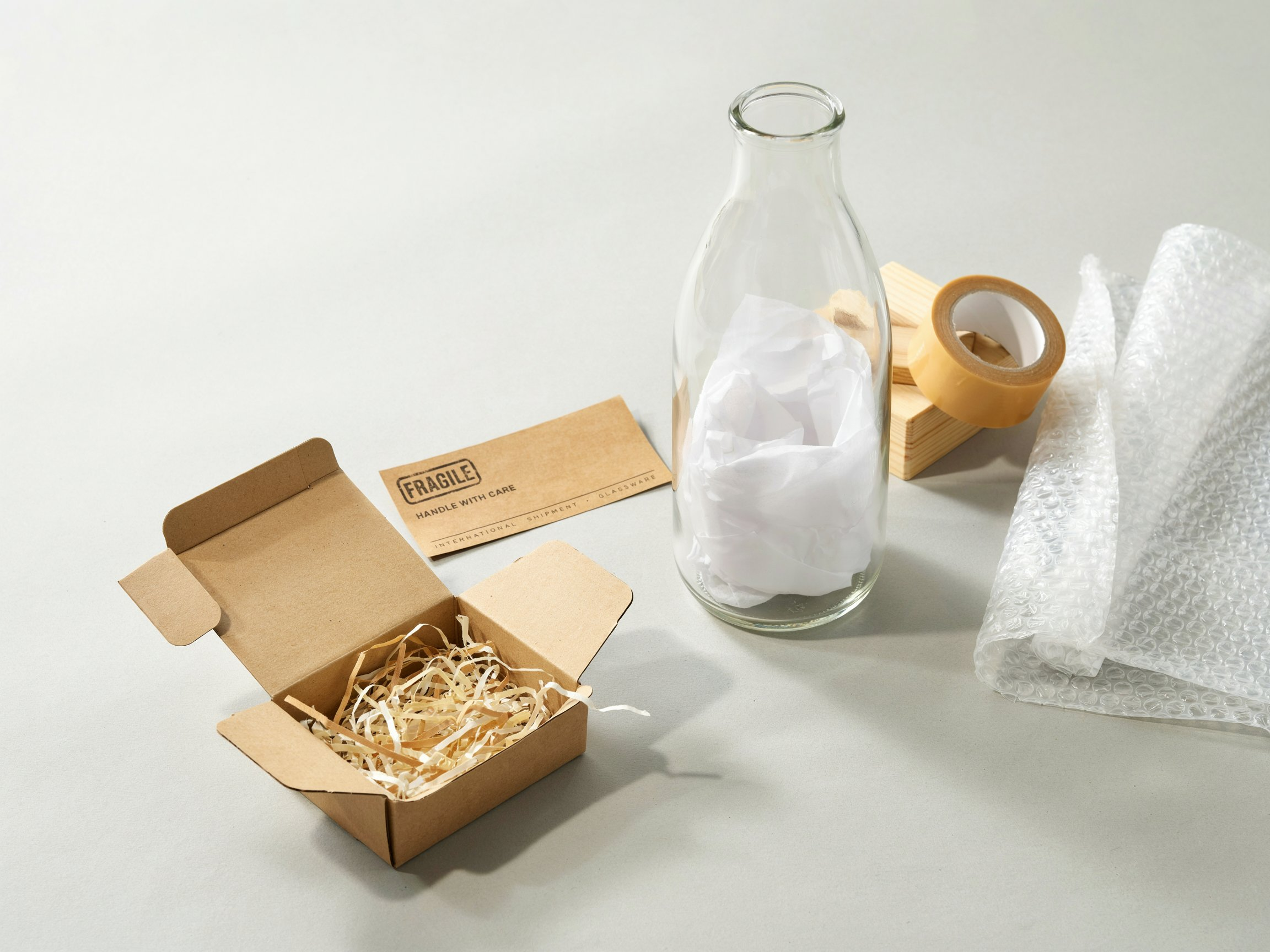
How to Properly Pack Glass Items
How to Properly Pack Glass Items for International Shipping
International shipping of glass items requires particularly careful preparation. Glass is considered a fragile material that can crack, shatter, or completely break even with relatively minor impacts. During transportation, the package goes through several stages: sorting at the warehouse, loading and unloading, movement between vehicles, customs control, and courier delivery. At each stage, the packaging is subjected to vibrations, pressure, tilting, and accidental collisions. Therefore, a regular cardboard box or a thin layer of paper is not sufficient.
Proper packing of glass must simultaneously address several tasks: securing the item inside the box, protecting it from impacts, compensating for vibrations, preventing contact between individual parts, and maintaining the stability of the entire package. The more complex the shape of the item, the higher its value, or the longer the distance of transportation, the more carefully one must approach the selection of protective materials and packaging design.
The principle of "box within a box" plays a crucial role. The glass item is first placed in an inner packaging with a soft cushioning layer, and then placed in an outer box with additional space for protective filler. This system helps to reduce the force of impact and prevents direct contact of the glass with the outer walls of the packaging.
Before starting the packing process, it is essential to inspect the item. It should not have any existing chips, micro-cracks, or weak spots. If a set is being sent, each piece should be packed separately. Glasses, bottles, vases, decorative items, and glassware require different approaches, but the general rules remain the same: no voids, tight fixation, multiple protective layers, and sturdy outer packaging.
Why Glass Items Get Damaged During Shipping
The main cause of damage is mechanical impact. Packages can fall, collide with each other, and be subjected to strong pressure or vibrations. Even if the box is labeled "Fragile," this does not guarantee careful handling. Special markings help draw the attention of the carrier's staff to the contents, but they do not replace proper protective packaging.
Glass is also sensitive to uneven loads. If an item is lying inside the box without being secured, it can move and hit the walls during sudden movements. Multiple items can collide with each other, leading to cracks and chips. Protruding parts are especially vulnerable: handles, legs, necks, thin edges, and decorative elements.
Pressure from above is also a danger. In international warehouses, boxes are often stacked on top of each other. If the outer packaging is not sturdy enough, the weight from above can be transferred to the glass item. Therefore, it is important to choose a box made of dense cardboard and ensure that the contents do not touch the lid or bottom of the box.
Temperature fluctuations can also affect the integrity of glass. When moving between a cold warehouse, transport, and a warm room, the material experiences thermal expansion. Most items can withstand normal temperature changes; however, already damaged or very thin glass may not endure a sudden shift. Wet items should not be sent: any remaining water can freeze, expand, and create additional internal pressure.
Preparing Glass Items for Packing
Before packing a glass item, it is necessary to prepare the workspace and all required materials. The surface should be clean, dry, and spacious enough. It is best to work on a table covered with a soft blanket, dense cardboard, or several layers of bubble wrap. This reduces the likelihood of accidental drops and protects the item from contact with a hard surface.
Dust, dirt, and moisture should be removed from the item. If there is water inside, it must be completely drained, and the inner surface dried. For bottles, jars, and vessels, it is important to separately protect caps, lids, and other removable parts. They should not be left to move freely inside the item or box. Removable elements should be wrapped in soft material and secured separately.
If the glass item has doors, movable parts, or decorative inserts, they should be secured with soft tape. Hard adhesive tape should not be used directly on the glass: when removed, it can leave marks or damage the coating. For securing, it is better to use painter's tape, paper tape, or special protective pads.
Each item should be wrapped in several layers of bubble wrap. However, one layer is usually not enough. It protects against scratches and partially cushions impacts, but it does not always prevent breakage from falls. Therefore, it is recommended to use sheet foam, polyethylene foam, or sturdy cardboard on top of the wrap. It is especially important to reinforce the edges and protruding parts.
For items with complex shapes, it is necessary to identify the most vulnerable areas in advance. For glasses, these are the stems and thin walls; for vases, the neck and base; for bottles, the bottom and cork; for glass frames, the corners. These areas should be protected with additional layers of cushioning material.
Strength Check Before Shipping
After preliminary packing, the item should be carefully checked. The protective layer should not shift, unravel, or leave exposed areas. When lightly pressed, the packaging should maintain its shape but not compress the glass. If movement is heard inside, additional filler should be added or the securing method should be changed.
A simple test can be helpful: gently lift the packaged item and slightly move it from side to side. There should be no impacts or noticeable movement inside. This test does not replace professional testing but helps identify the most obvious packaging flaws.
Protective Materials for Packing Glass
The choice of packaging materials directly affects the safety of fragile shipments. For international shipping, it is advisable to use not just one type of protection but several materials, each serving its purpose. One layer prevents scratches, another cushions impacts, a third secures the item, and the outer layer protects against moisture and pressure.
Bubble wrap is one of the most accessible materials. It is suitable for the initial wrapping of glass items and creating a soft layer. For fragile items, it is better to choose wrap with large air bubbles. The item should be wrapped in several layers, with the bubbles facing the item or outward depending on the packaging design. The edges of the wrap are secured with tape, but it should not be stuck directly to the glass surface.
Polyethylene foam has good cushioning properties and does not scratch surfaces. It is convenient for protecting flat items, tableware, frames, and decorative elements. Sheets can be cut to the shape of the item and used as spacers between individual parts.
Foam is used to make inserts and dividers. It holds the item well in place; however, regular fragile foam can crumble under heavy loads. For international shipping, dense sheets or specially molded inserts are preferable.
Kraft paper is used to fill voids. It should be crumpled well to spring back and hold the item. Flat sheets of paper without compression do not provide sufficient cushioning. Paper filler is suitable for lightweight items, but for heavy glass, it should be combined with foam materials.
Air bags can be used as additional filler. They quickly fill empty spaces but can lose shape under pressure. Therefore, relying solely on them is not recommended.
Materials to Avoid
It is not advisable to use sawdust, fabric, thin plastic bags, and newspapers as the only protection. Sawdust can shift and does not provide stable fixation. Fabric easily crumples, and thin wrap does not cushion impacts. Newspaper can sometimes leave ink stains on light or porous surfaces.
Boxes with damaged corners, signs of moisture, or deformed walls should not be used. Reused containers are acceptable only if they have retained their strength and do not have hidden defects. For expensive glass items, it is better to purchase a new five-layer box.
Step-by-Step Technology for Packing Glass Items
Packing should begin with the individual protection of each item. If there are several glass items in the package, they should not be stacked together without dividers. Even well-wrapped items can collide with each other during movement. There should be cardboard partitions, foam inserts, or dense layers of cushioning material between them.
First, the item is wrapped in a soft material. For smooth surfaces, polyethylene foam, bubble wrap, or several layers of soft paper can be used. Then, the corners, edges, and protruding details are especially carefully closed. If the item has handles or legs, additional protective pads should be made around them.
After this, the prepared item is placed in an inner box. Its size should allow for protective material to be placed around it on all sides. The minimum gap depends on the type of item, but for international shipping, it's better to allow enough space for cushioning. At the same time, the box should not be so large that the item can move freely inside.
Hollows are filled with crumpled paper, foam crumbs, air bags, or special cushioning inserts. The filler is laid evenly across the bottom, side walls, and top. After closing the inner box, the item should not move when gently shaken.
Then, the inner box is placed inside the outer box. A protective layer is created between the walls of the two boxes. This gap is necessary so that any impact on the outer container does not transfer directly to the item. The outer box should be sturdy, dry, and appropriately sized.
After filling all the voids, the box is closed and sealed with reinforced packing tape. The tape is applied along the central seam, side joints, and corners. For heavy shipments, the H-taping method is used: the tape runs along the central seam and perpendicular edges.
Packing Bottles, Glasses, Vases, and Flat Glass
Bottles are packed individually. Special attention is paid to the bottom, neck, and cap. Dividers are placed between the bottles to prevent them from touching. If liquid is being shipped, it is essential to check the cap's tightness and use an additional moisture-resistant bag. However, for some international carriers, the shipment of liquids may be restricted, so it's advisable to clarify the carrier's rules in advance.
Glasses are wrapped in soft material, and the inner space of the bowl is filled with paper or lightweight filler. The stem is protected with a separate layer, as it is often the part that breaks upon impact. Glasses are placed in a vertical or specially designed position, avoiding pressure from above.
Vases and decorative items require enhanced protection for the neck and base. If the shape is complex, it's better to create a custom foam insert. Flat glass, photo frames, and mirrors are first covered with cardboard sheets on both sides, then wrapped in bubble wrap and placed in a sturdy box. It's advisable to reinforce the corners with plastic or cardboard corner protectors.
Labeling Fragile International Shipments
Labeling helps the carrier identify the nature of the cargo, but it is not a substitute for quality packaging. Noticeable markings such as "Fragile," "Glass," "Do Not Drop," and, if necessary, "Top" are applied to the outer box. Arrows should indicate the correct orientation of the box if the contents are sensitive to tilting.
Information should be applied to several sides of the packaging, not just the top lid. Labels must adhere well, resist moisture, and remain legible during sorting. The address label should be placed on a flat surface, without covering barcodes and warning markings.
Do not overload the box with numerous inscriptions. The main information includes the recipient's address, contact phone number, sender's details, and necessary shipping markings. If the package is being sent abroad, documents should be attached according to the requirements of the carrier and customs authorities.
Documents and Description of Contents
In international shipping, it is important to accurately specify the contents of the package. It is not advisable to write overly general descriptions like "gift" or "goods." It's better to use precise wording: "glass vase," "decorative glass item," "set of glasses." If necessary, specify the material, quantity, and value.
An accurate description helps pass customs control and reduces the risk of delays. It is also important for insurance processing and claims consideration in case of damage. The value of the goods must correspond to the documents, receipts, or other confirmations.
Insuring Packages with Glass
Even perfect packaging does not eliminate all risks. Therefore, when sending expensive glass items, it is worth considering insuring the package. Insurance can compensate for the value of the item fully or partially if it is damaged or lost during transit. The conditions depend on the carrier, destination country, type of glass, and declared value.
Before arranging insurance, it is essential to carefully review the exclusions. Some companies do not accept claims for fragile items if they were packed by the sender themselves. Others require special packaging, photographic documentation, or a statement from the acceptance point staff.
To confirm the cost, keep receipts, contracts, product photographs, and purchase documents. Before sealing the box, it is advisable to photograph each stage of the packaging: the condition of the item, protective materials, the arrangement of fillers, and the appearance of the finished parcel. Such photographs can serve as evidence in case of a dispute.
Upon receiving the shipment, the recipient should check the integrity of the outer packaging. If the box is dented, wet, has tears, or signs of tampering, this should be documented with photos before opening. In case of damage to the item, it is necessary to create a report with the carrier and contact customer support within the specified time frame.
Common Mistakes When Packing Glass
One of the most common mistakes is using a box that is too large without sufficient filler. In such packaging, the item can move and hit the walls. The opposite problem is using a box that is too small, where the protective layers are compressed and cannot absorb the impact.
Often, senders wrap glass with only one layer of bubble wrap. This protects the surface from scratches but does not always save it from a hard fall. It is also risky to place multiple items in one box without dividers.
Another mistake is placing heavy items next to fragile ones. Under pressure from above, glass can break, even if it is well-wrapped. It is advisable not to combine glass items with metal, ceramic, or sharp objects in one shipment.
Do not leave empty space near the bottom and corners of the box. These areas often take the brunt of the impact. The protective material should cover all sides of the item evenly.
Incorrect sealing is also a mistake. If the tape only covers the central seam, the side flaps may open upon impact. It is more reliable to use an H-shaped scheme and additionally reinforce the corners.
Practical Recommendations for Safe International Shipping
To reduce the risk of damage, glass packaging should be planned in advance. Do not assemble the parcel at the last minute, especially if the item has an unusual shape or high value. In complex cases, it is better to order a custom foam insert or consult packaging specialists for fragile goods.
Before shipping, check the requirements of the specific carrier. Different carriers may have varying restrictions on size, weight, insurance, and acceptable types of glass items. Some services only accept fragile shipments if using their own packaging.
The optimal design usually includes four levels of protection: individual wrapping, an internal cushioning layer, a sturdy box, and an outer box with filled gaps. Such packaging takes up more space but significantly increases the likelihood of the item arriving safely.
It is important to consider the shipping season. In cold weather, moisture should be eliminated, and sharp temperature fluctuations should be avoided if possible. When shipping to hot regions, materials that do not lose shape when heated should be used.
If the glass item has collectible or artistic value, higher packaging standards apply. In this case, it is advisable to engage a professional packer, arrange for extended insurance, and use transport packaging made from durable multi-layer materials.
Properly packaging glass for international transport is not just about one material and a simple "Fragile" sticker. It is a comprehensive system that includes preparing the item, individual protection, securing, cushioning, double boxing, proper labeling, and insurance. The more carefully all stages are followed, the lower the likelihood of damage during transport and the higher the chance that the glass item will arrive at the recipient in its original condition.