

 RU
 UA
 DE
 FR
 ES
 CN
 SA
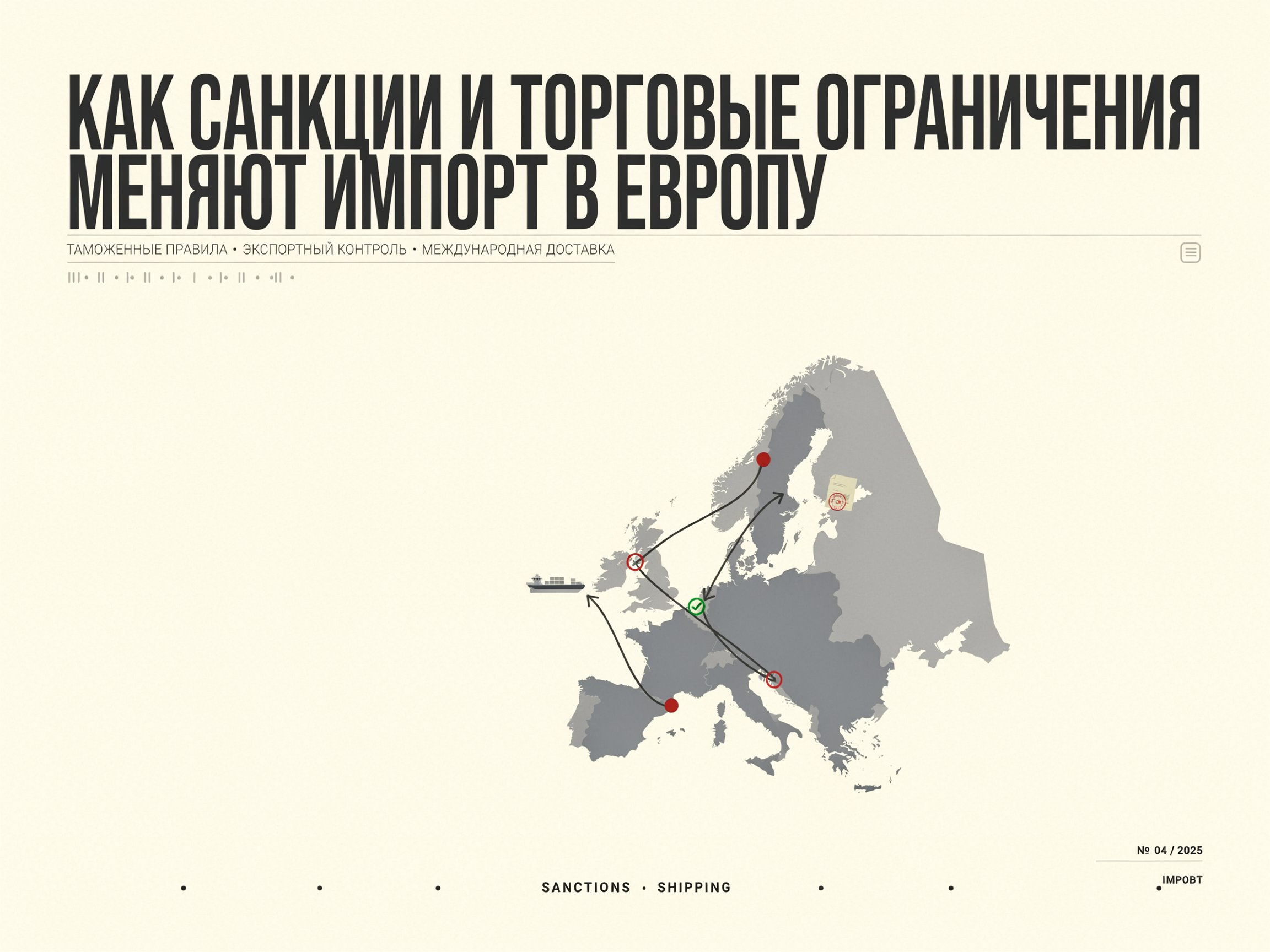
How Sanctions and Trade Restrictions Are Changing Goods Import to Europe
How Sanctions and Trade Restrictions Are Changing Goods Import to Europe
The import of goods to Europe has undergone significant changes in recent years. International trade is simultaneously influenced by sanctions regimes, export controls, new customs regulations, restrictions on financial transactions, restructuring of logistics routes, and increased requirements for counterparty verification. As a result, companies can no longer view international delivery solely as the organization of transportation from one country to another. Modern imports to Europe require a comprehensive analysis: from determining the product code and verifying the country of origin to studying the end recipient, route, payment terms, and compliance with technical standards.
The European market remains one of the largest and most attractive trading spaces in the world. However, access to it has become significantly more regulated. Even goods not directly subject to sanctions may face indirect restrictions: bans on the supply of certain components, increased documentation requirements, customs delays, banks refusing to process payments, or the need to confirm the absence of ties with sanctioned organizations.
For businesses, this means a shift from the familiar model of "buy, transport, and customs clearance" to a system of pre-emptive control. Successful international delivery now relies on legal transaction verification, risk assessment, a transparent supply chain, and the readiness to quickly change logistics solutions.
Why Sanctions Have Become One of the Main Factors for Importing to Europe
Sanctions are restrictions imposed by states and international organizations against specific countries, companies, organizations, industries, or individuals. They can affect the export and import of goods, financial transactions, transportation, insurance, technology, investments, and the provision of services. In European trade, sanctions are applied not only directly but also through the prohibition of circumvention schemes, restrictions on access to equipment, and control over the end use of products.
For importers, it is important to understand that the availability of a product for sale outside of Europe does not necessarily mean it can be legally imported into the European Union. Products may be prohibited for supply due to their intended use, composition, production technology, or connections to specific industries. For example, restrictions may apply to industrial equipment, electronic components, software, aviation parts, dual-use goods, products for the energy sector, and certain types of raw materials.
What Types of Sanctions Affect International Trade
Sanction measures can be conditionally divided into several categories. The first group consists of economic and trade restrictions. These include bans on the import or export of specific goods, restrictions based on countries of origin, the establishment of quotas, bans on providing certain services, and limitations in specific sectors of the economy.
The second category is financial sanctions. These may prohibit transactions with specific banks, companies, or government entities. Even if the product itself is allowed for import, payment may be blocked due to the involvement of a bank, carrier, insurer, or intermediary included in the sanctions lists. Therefore, it is necessary to verify not only the seller and buyer but also all participants in the transaction.
The third group consists of personal sanctions. Restrictions apply to executives, owners, beneficiaries, and related organizations. If a counterparty is not formally on the sanctions list but is controlled by a person subject to restrictions, the transaction may also be deemed risky.
Transportation sanctions hold particular significance. They may pertain to maritime vessels, airlines, railway operators, ports, and logistics companies. In some cases, restrictions extend to cargo insurance, freight, maintenance, and access to infrastructure.
How Sanctions Affect Importing Companies
The main consequence of sanctions is the increased complexity and cost of foreign economic activity. Companies have to spend more time verifying transactions, engage compliance specialists, change suppliers, and use alternative routes. Document approval times increase, insurance costs rise, and the likelihood of delays grows.
Companies often encounter what is known as the effect of excessive caution. Banks, carriers, insurance organizations, and customs representatives may refuse to work even with formally permitted goods if they consider the transaction potentially risky. This is due to concerns about secondary sanctions, reputational losses, fines, and the blocking of their own operations.
As a result, imports into Europe are becoming more selective. Businesses must prove the legality of the product's origin, the transparency of the route, and the absence of attempts to circumvent existing restrictions. The more complex the product and the longer the supply chain, the more documents and confirmations may be required.
Trade Restrictions and Their Difference from Sanctions
Trade restrictions are broader than sanctions. They can be imposed for economic, political, environmental, industrial, or protective reasons. States use tariffs, quotas, licensing, anti-dumping measures, special duties, bans on certain types of products, and technical requirements.
Sanctions are usually related to foreign policy decisions and are directed against specific countries, individuals, or industries. Trade restrictions can be applied to a wide range of market participants regardless of their political status. For example, imports may be restricted due to non-compliance with environmental standards, threats to domestic production, violations of competition rules, or failure to meet safety requirements.
Tariff and Non-Tariff Measures
Tariff measures involve the collection of customs duties. The amount of payment depends on the product code, its customs value, the country of origin, and the applicable trade regime. The duty can be ad valorem, meaning calculated as a percentage of the value, specific — a fixed amount per unit of product, or combined.
Non-tariff measures are not always related to direct payments. They include mandatory certification, licensing, sanitary and veterinary control, labeling requirements, packaging restrictions, quotas, product registration, and confirmation of compliance with technical regulations.
For importers, non-tariff requirements often turn out to be more complex than calculating duties. If a product does not comply with EU rules, it may be detained, sent for additional inspection, returned to the supplier, or destroyed. Additionally, violators may face fines, and information about the company may end up in the customs authorities' risk profile.
How Restrictions Change Supplier Selection
Previously, companies often chose suppliers based on price and production timelines. Today, these criteria have expanded to include the country of origin, supply chain transparency, the ability to provide a technical dossier, and willingness to undergo compliance checks.
Importers need to assess whether a supplier is being used as an intermediary to circumvent restrictions. A sudden change in route, lack of experience in international trade, discrepancies between the declared assortment and production capabilities, refusal to provide origin documents, and an opaque ownership structure may raise suspicions.
Companies must also analyze in advance whether a specific supplier can be replaced by another manufacturer. Diversification is becoming an important part of the foreign trade strategy: having multiple suppliers and logistics partners reduces dependence on a single direction and helps respond more quickly to new restrictions.
Customs Regulations for Importing Goods into Europe
Customs clearance in the European Union is based on unified rules; however, specific procedures may depend on the type of product, country of import, delivery specifics, and the status of the importer. The main elements of clearance include determining the product code, establishing customs value, confirming origin, and preparing accompanying documents.
Errors at any of these stages can lead to cargo delays, additional payments, fines, or the need to correct the declaration. Therefore, customs regulations should be considered before concluding a contract with a supplier, not after the cargo arrives at the border.
Product Classification by Commodity Code
Each product is assigned a code according to the EU Combined Nomenclature and the international classification system. The code determines the duty rate, the need for a license, the presence of restrictions, and the list of documents required for import.
Identical-looking products may have different codes due to differences in composition, production technology, purpose, or technical characteristics. For example, equipment may be classified based on its operating principle, power, area of application, and completeness. An electronic device may fall into different commodity groups depending on whether it includes communication, data processing, or signal transmission functions.
An incorrect code is often used as a basis for additional checks. Customs authorities may require technical descriptions, photographs, catalogs, instructions, certificates, and expert opinions. If it is determined that the code was chosen intentionally to reduce payments or circumvent restrictions, the consequences can be much more serious than a typical adjustment.
Customs Value and Payments
The customs value is usually determined based on the transaction price, but it may also include transportation costs, insurance, packaging, commission fees, and other expenses up to the point of import. If customs authorities consider the declared value to be inaccurate, they have the right to request additional documents or use alternative assessment methods.
When importing into Europe, customs duties, import VAT, and other fees may apply. The amount of obligations depends on the product category and delivery mode. Additionally, it is necessary to account for expenses related to customs representation, temporary storage, inspections, laboratory tests, and the preparation of permit documents.
To avoid unforeseen costs, the importer should prepare a comprehensive financial model for the shipment in advance. A low product price does not always mean a profitable import: the final cost can be significantly increased by freight, insurance, duties, VAT, storage costs, and additional inspections.
Documents for Customs Clearance
A standard document package includes a foreign trade contract, commercial invoice, packing list, transport waybill, certificates of origin, insurance policy, and technical description of the goods. Depending on the product category, certificates of conformity, declarations, licenses, sanitary conclusions, and export control documents may be required.
Particular attention is paid to the consistency of information. The product name in the invoice, packing list, contract, and declaration must match the actual product. Discrepancies in quantity, weight, value, or description can raise suspicions and lead to delays.
Export Control and Dual-Use Goods
Export control regulates the movement of goods, technologies, software, and equipment that can be used for both civilian and military purposes. Such goods are referred to as dual-use products. In the context of increasing international restrictions, export control has become important not only for the seller but also for the European importer.
Even if the goods are purchased for legitimate commercial purposes, their characteristics may fall under special regulations. For example, restrictions may apply to high-precision machinery, navigation equipment, telecommunications components, software solutions, sensors, materials, laboratory equipment, and certain types of industrial electronics.
End User and Product Destination Verification
When assessing a transaction, it is important to establish who the end user will be and for what purpose the product will be used. The supplier or government authority may request an end-user certificate, a letter of product designation, information about the production facility, and a commitment not to re-export the product without permission.
It is not enough to state a general phrase in the documents like "for industrial use." It is necessary to describe the specific process in which the equipment will be used, its functions, and the place of operation. The higher the potential sensitivity of the product, the more detailed the information should be.
Particular attention is paid to re-export. If the product is purchased by a European company but is then intended for transfer to a third country, it is necessary to check the restrictions on further movement. The contract may contain a prohibition on resale, a commitment to obtain permission, or a special clause regarding compliance with sanction legislation.
Importer’s Internal Compliance
Companies that regularly engage in imports should establish internal export control procedures. These may include counterparty verification, approval of sensitive goods, document storage, distribution of responsibilities, and regular updates of sanction lists.
It is helpful to implement a multi-level verification:
identification of the supplier, buyer, and end user;
analysis of company owners and executives;
product verification against classification lists;
assessment of the route and potential re-export;
verification of banks, carriers, and insurance organizations;
documentation of verification results.
This approach helps not only reduce legal risks but also demonstrate the company's good faith during checks by banks, customs, or regulators.
How Sanctions Change International Delivery and Shipping
International shipping is directly affected by political and economic restrictions. If a familiar route is closed, carriers must use longer paths, transship cargo at other ports, change modes of transport, and seek new insurance solutions. This increases shipping costs and makes delivery times less predictable.
Maritime transport is affected by access restrictions to ports, bans on servicing vessels, sanctions against shipowners, and insurance complexities. Air transport is influenced by airspace restrictions, bans on servicing aircraft, and a reduction in the number of available flights. Rail and road routes also depend on transit agreements, border crossing capacities, and national requirements.
Restructuring Logistics Routes
Companies are increasingly using multimodal schemes that combine road, sea, rail, and air transport. This model allows for adaptation to restrictions but requires more careful coordination. Each additional stage creates new risks: cargo damage, loss of documents, changes in the responsible carrier, or the need for re-customs clearance.
When choosing a route, it is essential to consider not only the distance. The sanction status of transit countries, transshipment requirements, the possibility of temporary storage, insurance availability, and the rules for processing transit documents are all important. A route that appears economical on the map may turn out to be legally or operationally unacceptable.
Rising Costs of Transport and Insurance
Sanctions and trade restrictions increase shipping costs for several reasons. First, routes are lengthening, and fuel consumption is rising. Second, expenses for transshipment, storage, and documentation are increasing. Third, carriers incorporate higher risks of delays, inspections, and withdrawal from certain destinations into their rates.
Insurance companies are also revising their terms. They may exclude sanction risks from coverage, require additional declarations, or refuse to insure cargo on specific routes. Importers need to read the policy terms carefully: wording regarding sanction exclusions may mean that the insurance company will not compensate for losses if the payout is related to a violation of restrictions.
How Companies Adapt Supply Chains
The modern supply chain must be flexible, transparent, and resilient to external changes. Companies are reassessing their procurement geography, creating backup warehouses, signing contracts with multiple carriers, and implementing digital control tools.
One of the main trends is regionalization. Businesses are trying to place part of their production closer to the market to reduce dependence on long routes and complex transit operations. Another approach is "China plus one" and similar strategies, where a company maintains a primary supplier while simultaneously developing an alternative direction.
Diversification of Suppliers
Dependence on a single manufacturer or country poses a significant risk. If new restrictions are imposed, a company may lose access to key goods, components, or raw materials. Therefore, importers proactively seek alternative suppliers, conduct audits of production capacities, and verify partners' ability to provide a complete set of documents.
However, a formal replacement of a supplier does not always solve the problem. It is crucial to ensure that the new partner can provide stable quality, the required volume, compliance with European standards, and transparent logistics. It is also important to check whether the new supply channels are part of a scheme to circumvent restrictions.
Digitalization of Supply Control
Digital platforms help track cargo movement, control documents, record route changes, and automatically verify counterparties. Supply management systems can integrate with sanction list databases, customs directories, and the company’s internal registries.
Implementing an electronic archive that stores contracts, invoices, permits, certificates, transport documents, and inspection results is beneficial. This speeds up customs clearance preparation and allows for quick confirmation of the legality of the operation.
However, automation does not replace expert assessment. The system may identify a company's name matching a sanction list, but a specialist must determine whether it refers to the same legal entity, a related structure, or a coincidence.
Practical Recommendations for Importers
To reduce risks when importing goods into Europe, companies should establish a systematic procedure for transaction verification. This process should begin before signing the contract and making payment for the goods. Correcting an error after the cargo has been dispatched is significantly more challenging and costly.
Step-by-Step Verification of Import Operations
The first step is to determine the characteristics of the product and its expected code. It is necessary to study the composition, purpose, technical parameters, presence of electronic components, and possible use in sensitive industries.
The second step is to check sanctions and export restrictions. It is important to analyze not only the supplier's country but also the country of origin of the goods, the manufacturer, the end user, the company owners, and the delivery route.
The third step is to study the requirements for permits. It is necessary to find out in advance whether certificates, licenses, conformity declarations, sanitary documents, or export and import permits are needed.
The fourth step is to assess the logistics scheme. It is important to check the carriers, the port of departure, transit countries, insurance options, and temporary storage conditions.
The fifth step is to calculate the total cost of delivery. The model should include the price of the goods, freight, insurance, duties, VAT, broker services, warehousing, inspection, certification, and possible expenses in case of delays.
The sixth step is to define the responsibilities of the parties in the contract. The agreement should specify who is responsible for the documents, sanctions checks, export licenses, delays, cargo returns, and additional expenses.
Common Mistakes
One common mistake is checking only the immediate supplier. In practice, risks may be associated with its owner, bank, carrier, manufacturer, or end recipient.
Another issue is overly general descriptions of the goods. Terms like “equipment,” “electronics,” or “spare parts” are insufficient for customs and export control. It is necessary to specify exact characteristics and purposes.
It is also risky to rely on verbal guarantees from the logistics intermediary. Responsibility for the legality of imports usually remains with the participant in the foreign trade operation. Therefore, all important conditions must be confirmed in writing, and relevant documents should be kept.
Import Prospects in Europe
In the coming years, the import of goods into Europe is likely to remain a complex and multi-layered process. Sanction regimes may change faster than companies can update contracts and routes. At the same time, requirements for product origin, supply chain sustainability, environmental characteristics, and digital traceability will strengthen.
European regulators are paying increasing attention not only to the fact of import but also to the entire history of the goods. Raw materials, components, production sites, intermediaries, and re-export conditions may be checked. This means that supply chain transparency is becoming a competitive advantage.
Companies that invest in compliance, automation, diversification, and document preparation in advance gain a more sustainable position. They adapt more quickly to new requirements, encounter delays less frequently, and can calculate costs more accurately.
Sanctions, trade restrictions, customs regulations, and export control are significantly changing imports into Europe. International delivery is no longer just about choosing a carrier and preparing transport documents. Each shipment requires checking the goods, transaction participants, origin, route, end use, and financial scheme.
To successfully operate in the European market, companies need to analyze sanction risks in advance, correctly classify products, prepare a complete set of documents, and use reliable logistics routes. Supplier diversification, digital control, insurance, and continuous updating of internal procedures play an important role.
Despite the complexity of the rules, importing into Europe remains possible for companies that operate transparently and systematically. The main condition is not to seek formal workaround solutions but to build a legal, verifiable, and sustainable supply chain. This approach helps reduce the likelihood of delays, financial losses, and claims from banks, customs authorities, and regulators.