

 RU
 UA
 DE
 FR
 ES
 CN
 SA
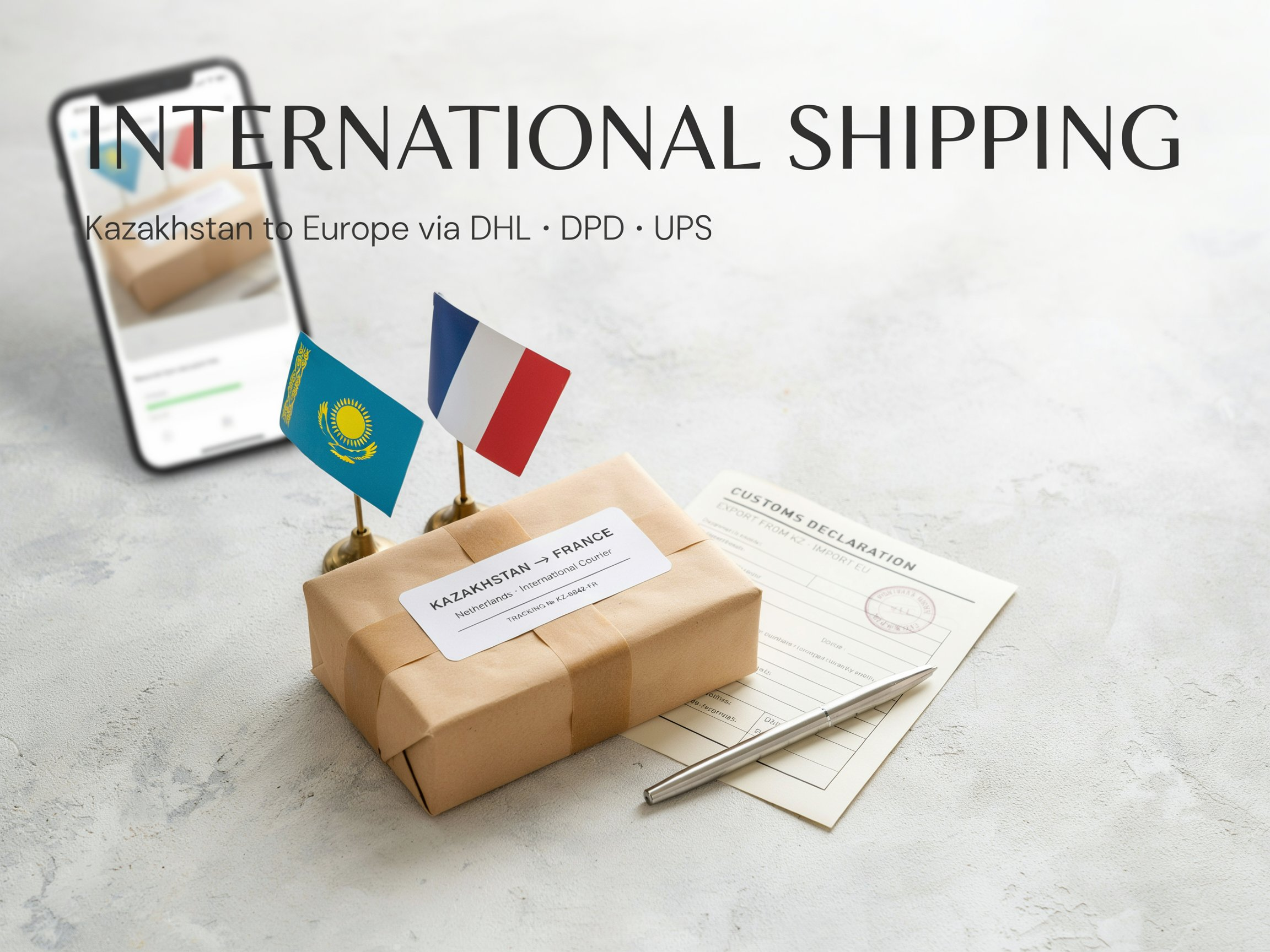
International Shipping from Kazakhstan to France and the Netherlands
Kazakhstan — Shipping Goods to France and the Netherlands via International Courier Services
International shipping from Kazakhstan to France and the Netherlands is in high demand among online stores, entrepreneurs, manufacturers, private senders, and companies working with European partners. With the help of courier services like DHL, DPD, and UPS, you can send documents, commercial samples, personal belongings, parcels, and various categories of goods with tracking available at all stages of the route.
Queries such as Kazakhstan France Netherlands shipping, "shipping from Kazakhstan to Europe," "international shipping from Kazakhstan," customs documents, parcel tracking, and shipping restrictions are not only related to the choice of carrier. For successful transportation, it is essential to properly prepare the cargo, complete customs documents, check restrictions, determine costs, and choose the appropriate delivery method.
France and the Netherlands are among the key destinations in European logistics. The Netherlands serves as a major transport and warehousing hub in Europe due to its ports, airports, and extensive road network. France has a large consumer market and a well-developed infrastructure for delivering goods to end recipients. Therefore, shipping from Kazakhstan to these countries can be organized for both single parcels and regular commercial shipments.
International Shipping from Kazakhstan to France and the Netherlands
Shipping goods from Kazakhstan to European countries typically involves several sequential stages: order placement, cargo preparation, packaging, filling out accompanying documents, handing over the parcel to the courier service, export clearance, international transportation, import inspection, and delivery to the recipient's address.
Delivery times and costs depend on the city of origin and destination, weight, dimensions, type of cargo, chosen carrier, and urgency. A parcel from Almaty or Astana may pass through transit hubs and sorting centers. The final route may sometimes change depending on the load of transport lines, weather conditions, customs situations, and availability of flights.
When choosing a service, it is important to determine in advance what exactly is being sent:
documents;
personal belongings;
product samples;
goods from online stores;
equipment;
souvenirs;
textiles;
cosmetics;
electronics;
spare parts;
business products.
Different categories have different rules. For example, documents are usually easier to process than commercial goods. For products containing batteries, liquids, chemical components, or plant materials, additional information and permits may be required.
Shipping from Kazakhstan to France
France is part of the European Union, so import shipments are subject to control in accordance with European and French customs requirements. When sending goods, it is necessary to provide an accurate description of the contents in English or French. Phrases like "gift," "items," or "samples" without details may lead to delays.
In the description, it is advisable to include:
the name of each item;
the quantity;
the material;
the purpose;
the value;
the country of origin;
the article or model;
the weight of each item.
If the parcel is sent by a legal entity, an invoice, packing list, information about the sender and recipient, as well as data for customs clearance may be required. For some goods, certificates of conformity, safety declarations, sanitary documents, or proof of origin are important.
Shipping from Kazakhstan to the Netherlands
The Netherlands is often used as a standalone destination and as a logistics entry point to other European countries. Thanks to its developed courier infrastructure, delivery to Amsterdam, Rotterdam, The Hague, Utrecht, and other cities is usually organized via standard international routes.
Special attention should be paid to the accuracy of the address. In the Netherlands, the street name, house number, postal code, locality, recipient's name, and contact phone number are important. An error in the postal code or house number may lead to redirection of the shipment or additional checks.
For commercial parcels, it is also necessary to determine who will pay the import fees: the sender, the recipient, or a third party. If this issue is not agreed upon in advance, the courier service may withhold delivery until VAT, duties, or customs clearance fees are paid.
DHL, DPD, and UPS: Which Courier Service to Choose
When it comes to international shipping from Kazakhstan to Europe, DHL, DPD, and UPS are often considered. Each service has its own network, pricing policy, cargo acceptance rules, and customs documentation procedures. There is no universal carrier for all situations, so the choice should be made based on the characteristics of the shipment.
DHL for Shipping Goods to Europe
DHL is widely used for express delivery of documents, parcels, and commercial cargo. The service is suitable for senders who prioritize speed, a developed notification system, and the ability to track shipments using a unique number.
The advantages of DHL may include:
express delivery to major cities;
detailed parcel tracking;
electronic document exchange;
door-to-door delivery;
the ability to send commercial cargo;
consultations on customs clearance.
Before shipping, it is important to check whether the chosen service accepts the specific type of goods, especially when it comes to cosmetics, batteries, medical products, food items, or liquids.
UPS for International Delivery
UPS offers solutions for both private and corporate senders. The service is particularly popular among companies that send goods to partners, clients, and branches in Europe. For regular shipments, commercial terms can be negotiated, access to a personal account can be obtained, and integration with an online store or order management system can be utilized.
UPS typically allows:
the creation of international waybills;
the generation of electronic documents;
notifications about statuses;
tracking the route;
adding additional services;
choosing delivery options for businesses.
The exact availability of services depends on the country of origin, city, product category, and existing restrictions.
French Route: From Almaty to Paris and Other Cities
France remains one of the prominent European destinations for Kazakhstani senders. The most in-demand route is Almaty — Paris, but carriers also operate with Lyon, Marseille, Toulouse, Nice, Bordeaux, and other cities. For businesses, the ability to deliver cargo directly to the recipient is particularly important, as the "warehouse to warehouse" scheme is not always convenient when the goods need to reach an office, store, production facility, or a specific customer address.
For small shipments, express delivery becomes the primary option. This involves pickup by a courier, international transportation, tracking, and delivery to the recipient. For example, TSM indicates an economic rate for European shipments from Kazakhstan starting at 57,135 tenge and an express rate starting at 94,799 tenge for the Almaty — Paris route. The economic option is estimated to take about five to six days, while express delivery takes about three to five days. However, the exact price depends on the characteristics of the shipment and the chosen service.
It is also important to note that international courier companies consider not only the actual weight. If the box is large but relatively light, volumetric weight is applied. DHL explicitly states that the cost is calculated based on the greater of the actual and volumetric weight. Therefore, before placing an order, it is necessary to measure the length, width, and height of each package. Sometimes reducing the size of the box can significantly lower transportation costs.
For urgent documents and small commercial shipments to France, DHL, FedEx, and UPS operate. These companies use international express services with tracking and various speed options. The final price is determined after specifying the city of origin, postal code, destination address, weight, and dimensions. This is why there is usually no public unified rate "from Kazakhstan to France": the cost of the same shipment can vary depending on the city and cargo parameters. DHL Kazakhstan offers to calculate the cost of international delivery directly based on the characteristics of the shipment.
For heavy cargo, the approach changes. If it involves hundreds of kilograms, equipment, or a batch of goods, it is more advantageous to consider it not as an ordinary parcel but as freight transportation. In this case, air, road, or multimodal solutions may be applied. International logistics companies working with Kazakhstan offer delivery of consolidated shipments, where one vehicle or transport route combines several cargoes from different clients. This allows transportation costs to be distributed among the senders.
An interesting option for businesses is road transportation. It is usually slower than air freight, but can be more economical for significant weights. For European destinations, Kazakh logistics operators indicate road transit times of about 15–25 days, while air delivery of large shipments can take around 5–8 days. These times are a guideline, not a guarantee: the specific route depends on the loading location, destination, transit sections, and customs clearance.
The Netherlands: Amsterdam as a Major European Logistics Hub
The Netherlands has a unique feature that many other European routes lack: the country is one of the largest transport and logistics centers in Europe. Amsterdam and the Schiphol airport area are connected to numerous international air routes, while Rotterdam plays a huge role in maritime and container logistics. Therefore, shipping from Kazakhstan to the Netherlands can not only be a final delivery for the recipient but also part of a broader European supply chain.
For private shippers and small companies, the most convenient option remains the "door-to-door" courier scheme. TSM for the Kazakhstan – Netherlands route claims delivery from door to door in approximately one to three days for express options, while economical shipments may take longer. In the reverse direction, the company publishes an example of delivering a document weighing 0.5 kg from Amsterdam to Almaty starting at 42,100 tenge with a timeframe of up to four working days, which helps to understand the pricing for small international shipments.
For cargo shipments, different pricing models emerge. On the AllCargo Market platform, a benchmark of $20 per kilogram is published for the Astana – Amsterdam route. This figure should not be perceived as a universal price for any shipment: it relates to the transportation option presented on the platform and depends on the specific cargo conditions. Nevertheless, such offers demonstrate why, for larger volumes, the calculation per kilogram can be significantly more attractive than standard courier pricing.
An important advantage of the Netherlands is the ability to organize further delivery across Europe. Cargo arriving in Amsterdam can be directed further to Germany, Belgium, France, Luxembourg, and other countries. Therefore, a Dutch address is sometimes chosen not as a final destination but as a logistics hub. For online stores and companies operating in several European markets, this scheme can be more convenient than direct delivery of each individual shipment from Kazakhstan.
Express shipments are serviced by DHL, FedEx, and UPS. FedEx, for example, offers international services with various speed levels, and the final deadline depends on the specific postal codes of the sender and recipient. The company emphasizes that the cost depends on weight, dimensions, and required speed. For shipments over 68 kg, special freight services are used, designed for larger volumes.
For businesses that regularly ship cargo to the Netherlands, it makes sense to compare not only the cost of transportation. Consideration should also include cargo pickup from the warehouse, packaging, export documents, insurance, customs support, last-mile delivery, and possible additional fees. Sometimes, an offer with a higher base price turns out to be comparable in total cost to a cheaper rate, to which separate services are subsequently added.
DHL, FedEx, and UPS: International Express for Urgent Shipments
The largest international courier companies remain one of the most straightforward options for sending documents, product samples, and small packages from Kazakhstan to France and the Netherlands. This category primarily includes DHL, FedEx, and UPS. Their main advantage lies in their developed international network, tracking system, standardized documentation, and the ability to choose a service based on speed.
DHL offers an online calculation for international delivery in Kazakhstan. When placing an order, the country and city of departure, destination, weight, and dimensions of the package are taken into account. The system allows for a calculation for a specific shipment, rather than an estimated price based solely on the destination country. For companies that regularly ship goods, this approach is particularly convenient, as it allows for advance comparison of several service options.
FedEx also uses a customized calculation. The European rates for 2026 include different categories of international delivery, including express services for small shipments and freight services for cargo over 68 kg. For European destinations, FedEx indicates delivery times ranging from one to several business days depending on the chosen service. The company warns that actual availability and timing depend on specific postal codes and cargo parameters.
An important feature of FedEx in 2026 is related to additional charges for international shipments. In the Netherlands, for example, starting from August 2026, an incoming processing fee is applied for shipments from non-European Union countries: €2.40 per shipment for a range of services and €0.90 for FedEx International Connect Plus. There are also fees for customs clearance and the payment of duties and taxes. Therefore, the base rate cannot be considered the final cost of delivery.
UPS also provides international rate guides for Kazakhstan and regularly updates the cost of services and additional fees. In the published tariff materials for Kazakhstan, the cost of international transportation depends on the destination zone, weight, and chosen service. For example, in the 2025 rate table, the price for UPS Expedited for shipments starting from one kilogram was approximately 53,745 tenge, but this figure pertains to a specific tariff zone and cannot be automatically used as the delivery price to France or the Netherlands.
For the end customer, the price of transportation is not the only important factor. DHL, FedEx, and UPS offer tracking, various delivery options, and additional services that can be critical for commercial cargo. All three operators have concepts of fuel, zonal, customs, and other additional charges. It is especially important to read the terms carefully when sending goods to the European Union, as the recipient or sender may incur import VAT, customs duties, and processing fees.
If the cargo is small, urgent, and expensive, an express operator is usually the most straightforward way to organize transportation. However, if the weight reaches dozens or hundreds of kilograms, it is worth simultaneously requesting a quote from freight forwarders. The difference between courier rates and specialized freight transport for such volumes can be significant.
TSM and Logistics Forwarders: When Door-to-Door Delivery Matters
In addition to global courier brands, specialized logistics companies operate on the Kazakhstan — France and Kazakhstan — Netherlands routes. Notable options include TSM, Ali Trans Group, Interlogcon, and aggregator services that feature offers from various carriers. Their model differs from traditional courier delivery: the client can order not just the shipment of a box but the organization of the entire logistics chain.
TSM specializes in the delivery of documents, parcels, and cargo to international destinations. The company indicates the possibility of working with shipments ranging from 100 grams to 1000 kilograms and offers several transportation methods: air courier delivery, express and economy courier delivery, as well as the transportation of oversized cargo by air, road, and sea. For European destinations, the company publishes benchmarks for costs and timelines, which is especially useful for preliminary comparison of options.
For large batches, freight forwarders become more interesting. Ali Trans Group, for example, offers B2B transportation from Europe to Kazakhstan by road and air and specifies a minimum batch of 100 kg or one cubic meter. For the road scheme, the company provides a timeframe of 15–25 days, while for air transport, it is about 5–8 days. This model is also relevant for reverse directions, where the carrier forms an individual logistics chain for commercial cargo.
Interlogcon primarily works with legal entities and offers the organization of international transportation, including consolidated cargo. For such shipments, the price is calculated individually based on the type of transport, loading city, destination point, volume, and weight. This approach is characteristic of B2B logistics: instead of a fixed price per box, the total cost of transporting the batch is calculated.
Logistics marketplaces hold a special place. Their advantage lies in the ability to compare offers from several carriers. For example, AllCargo Market features international routes from Kazakhstan and options for shipping to European cities. For the Astana — Amsterdam route, a benchmark of $20 per kilogram is published, while calculations based on weight or full truckload are available for some other European destinations.
When choosing a freight forwarder, it is essential to clarify whether the quoted price includes door-to-door delivery. Sometimes, the rate only applies to the main segment of the route, while separate charges are incurred for cargo pickup, warehouse handling, city delivery, customs brokerage, document processing, and insurance.
It is especially important to determine the delivery terms in advance. For commercial transactions, international Incoterms rules are used, which allocate responsibilities for transportation, insurance, customs procedures, and risks between the seller and the buyer. A mistake at this stage can lead to a situation where the cargo physically arrives in Europe, but the recipient is not prepared to pay the necessary fees or provide documents.
How much does delivery cost and why is one price rarely final
The cost of international shipping from Kazakhstan to France or the Netherlands cannot be accurately determined solely by the name of the country. A whole range of parameters influences the price. The main factors remain the actual weight, dimensional weight, dimensions, type of cargo, value of the goods, method of transportation, city of departure, city of destination, and urgency.
For a small package, you can refer to several price levels. Economic courier delivery to European destinations at TSM starts at approximately 57,135 tenge for the published example of Almaty — Paris, while the express option starts at around 94,799 tenge. These amounts are the starting rates for a specific offer and do not mean that a box of any weight will be delivered for this cost.
For cargo shipments, the rate is often expressed in the cost per kilogram. On the Astana — Amsterdam route, AllCargo Market offers a benchmark of $20 per kilogram. Depending on the volume, transport, and shipping conditions, the rate may vary. For larger shipments, pricing may also be based on pallets, cubic meters, or full trucks.
To understand the difference between formats, consider a hypothetical shipment weighing 5 kg. If it is a compact box with documents or product samples, the most logical option would be an express courier. If the five kilograms occupy a large box, the cost may be calculated based on dimensional weight. However, if the five kilograms are part of a regular shipment of several hundred kilograms, it is more advantageous to consolidate the shipment with other cargo in a group transport.
For cargo weighing 100–500 kg, the situation changes even more. The courier rate may be too high, so carriers offer air cargo, consolidated truck shipments, or multimodal schemes. In road transport, the price often becomes more attractive as the volume increases. For pallets and oversized cargo, it is necessary to consider the dimensions of each piece, the possibility of loading and unloading, the type of body, and packaging requirements.
The final cost is also influenced by customs factors. When importing goods into the European Union, import duties may arise. Their amount depends on the category of goods, customs value, country of origin, and applicable rules. Additionally, the carrier may charge its own fees for customs representation, payment of duties and taxes, or document processing. FedEx, for example, separately publishes additional fees related to import shipments and customs clearance.
Therefore, when comparing commercial offers, it is better to look not at the line "delivery from," but at the total amount. It is advisable to formulate the request to the carrier immediately with precise parameters: Almaty or Astana, a specific city in France or the Netherlands, number of pieces, weight of each box, dimensions, product description, cargo value, and desired delivery date. The more detailed the initial data, the lower the likelihood of unexpected additional charges.
Delivery times, customs, and documents: what determines the speed of the route
The speed of international delivery is determined not only by the time the cargo spends on the plane or truck. Even a very fast international route can take additional days due to document preparation, export clearance, cargo inspection, customs control, or delays at the final delivery stage.
For express shipping from Kazakhstan to Europe, a timeframe of several business days is quite realistic. TSM publishes an economic timeframe of about five to six days and an express timeframe of about three to five days for the Almaty — Paris route. For deliveries to the Netherlands, the company indicates an express format of one to three days depending on the specific shipment. These figures should be viewed as guidelines, as the actual timeframe depends on the addresses and characteristics of the cargo.
International express operators may offer even shorter timeframes for certain destinations and services. FedEx, for example, provides international services with delivery in one to three business days for a number of European routes, and expedited options are also available for freight shipments. The company emphasizes that timeframes depend on specific postal codes.
Road transport takes longer but becomes more attractive for heavy shipments. For cargo from Europe to Kazakhstan, logistics operators indicate about 15–25 days by road and about 5–8 days by air. For the return direction, timeframes may vary due to the route and current transport situation, so a specific date should be obtained from the carrier after calculation.
Documentation is crucial. For commercial shipments, an invoice or another document confirming the value of the goods, a description of the contents, and information about the sender and recipient is usually required. Depending on the category of the goods, additional permits, certificates, origin documents, or compliance information with the requirements of the destination country may be necessary.
Particular attention should be paid to the description of the goods. The terms "gift," "samples," or "goods" are not sufficiently informative for many commercial shipments. The more accurately the name, quantity, material, purpose, and value are specified, the easier it is to determine the customs category and avoid additional inquiries.
Packaging also affects speed. Fragile items must be protected from impacts, and boxes should withstand several stages of transshipment. Industrial packaging and cargo securing are used for pallets. If transporting equipment, machinery, or expensive products, it is advisable to agree on the carrier's packaging requirements in advance.
Ultimately, successful delivery from Kazakhstan to France or the Netherlands is not just about moving a box between two addresses. It is a sequential logistics chain involving the sender, carrier, freight forwarder, customs authorities, and recipient. The more accurately the data is prepared at the start, the easier it is to predict costs and timeframes.
What an Optimal Logistics Scheme Looks Like for Different Types of Shipments
For documents and small parcels, express delivery remains the most straightforward option. In this case, the sender hands over the cargo to the courier, the carrier organizes international transport, and the recipient receives the shipment directly at the specified address. This scheme is suitable for contracts, certificates, product samples, small components, personal items, and urgent shipments.
For medium-weight parcels, it is worth comparing several options. For example, a box weighing 10–30 kg can be shipped by express courier, an economical international service, or through a specialized service. The most important parameter here becomes the volume. Two boxes of the same weight can have completely different prices if one is compact while the other is oversized.
For regular commercial shipments, it is more sensible to enter into a contract with a logistics operator. A constant flow allows for the use of individual rates, planning consolidation, and reserving transport in advance. Instead of several expensive small shipments, batches can be combined and sent as one consolidated shipment.
For cargoes over 100 kg, it is advisable to request quotes from B2B freight forwarders. Ali Trans Group, for example, specifies a minimum volume of 100 kg or one cubic meter for its European B2B solutions. For such shipments, air transport, road transport, or a multimodal scheme can be considered.
For pallets and equipment, the possibility of road transport should be considered separately. If the timeframe is not critical, this option can provide significant savings compared to air transport. For urgent deliveries, on the other hand, air transport reduces time but increases costs.
For very large shipments, full truckload or container shipping can be used. In this case, the calculation is based not so much on weight, but on the loading of the vehicle, volume, route, and delivery conditions. Such solutions are especially relevant for manufacturers, importers, distributors, and companies that regularly move large volumes of products.
France and the Netherlands have a well-developed internal infrastructure, making it relatively easy to distribute cargo further across regions after crossing the European border. The Netherlands is particularly interesting as a logistics hub due to Schiphol and Rotterdam, while France boasts a large network of road, rail, and air routes.
The key when choosing a carrier is to compare the same conditions. If one company offers delivery for 100,000 tenge and another for 130,000, it does not necessarily mean that the first is cheaper. One rate may only include the international segment, while another may cover cargo pickup, document processing, customs clearance, and door-to-door delivery. It is essential to compare the total cost of the service.
In 2026, international shipping from Kazakhstan to France and the Netherlands remains a fairly flexible market. For small urgent shipments, express services from DHL, FedEx, and UPS are available, while specialized courier companies cater to parcels and relocations, and freight forwarders, consolidated shipments, and multimodal routes serve commercial batches. Published rates show a wide range: from tens of thousands of tenge for small European shipments to calculations in dozens of dollars per kilogram for cargo batches.
That is why there is no universal price for shipping from Kazakhstan to Paris or Amsterdam. For one parcel, an express service within a few days may be optimal, while for another, a consolidated truck transport taking several weeks may be more suitable. With the right choice of scheme, speed, cost, and reliability can be balanced already at the preparation stage of the shipment.
DPD and European Delivery
DPD is well-known in the European courier network and can be used at certain stages of international transportation, including delivery within Europe. However, the ability to accept shipments directly from Kazakhstan depends on the specific logistics scheme, partner network, and available service at the time of order placement.
DPD can be convenient for:
delivery within EU countries;
last mile delivery;
shipments from online stores;
delivery to pickup points;
regular parcels of standard size.
If the route from Kazakhstan to France or the Netherlands involves transferring the shipment between carriers, the sender should clarify in advance which tracking number is used and who is responsible for the customs part of the transportation.
Customs Documents for Shipping Goods
Correctly completing customs documents is one of the main factors for successful delivery. Customs must understand what is in the shipment, who owns the goods, what their value is, and for what purpose they are crossing the border.
For an international parcel, the following may be required:
commercial invoice;
proforma invoice for certain types of shipments;
packing list;
transportation waybill;
export declaration;
description of goods;
proof of value;
sender and recipient information;
documents of origin;
permits and certificates.
Commercial Invoice
A commercial invoice is used when shipping goods intended for sale, transfer to a company, or other commercial use. The document includes the invoice number and date, parties to the transaction, currency, delivery terms, description of goods, quantity, price, and total value.
The description should be specific. Instead of "accessories," it is better to write "leather belt," "polycarbonate case for mobile phone," or "cotton t-shirt." The more precise the information, the lower the likelihood of additional requests.
Proforma Invoice
A proforma invoice is used for shipments that are not typical commercial sales. These can be samples, gifts, warranty replacements, temporary exports, or shipments without payment. Even if the goods are not for sale, their customs value must be accurately stated.
You cannot declare a zero value just because the recipient does not pay the sender. Customs authorities may determine the value independently, which can lead to delays and additional inquiries.
HS Codes and Product Classification
Many commercial shipments require a commodity code. Proper classification affects the duty amount, the need for permits, and the ability to import into a specific country.
If the sender is unsure about the code, it is better to consult a broker or carrier. An incorrect code can lead to adjustments in value, changes in payments, and delays in processing.
Parcel tracking: how to track an international shipment
Parcel tracking — is a tracking system that allows you to monitor the movement of a shipment from the moment of acceptance to delivery to the recipient. After processing, the carrier assigns a unique tracking number to the parcel. It can be checked on the official website of DHL, UPS, DPD, or another logistics operator.
During transportation, the following statuses may be displayed:
shipment information received — shipment data received;
picked up — the parcel has been accepted;
in transit — the shipment is on its way;
customs clearance — customs clearance is in progress;
clearance delay — there was a delay in processing;
out for delivery — the parcel has been handed over to the courier;
delivered — the shipment has been delivered;
exception — an unusual situation has occurred.
Why the status may not update for a long time
The absence of new data does not always mean that the shipment is lost. Updates may be delayed during air transport, sorting, transfer between countries, or customs processing. In some cases, information appears only after arriving at the next logistics center.
If the status does not change for an extended period, you should check the accuracy of the tracking number, contact the carrier's support service, and clarify whether additional information is required from the recipient.
Notifications to the recipient
Most courier services send notifications via email or SMS. It is important to provide up-to-date contact information for this. The phone number should be accessible in the destination country, and the email address should be checked by the recipient.
If the carrier cannot contact the recipient, delivery may be postponed, and the parcel may be returned to the sender.
Shipping restrictions: limitations on international shipping
Before arranging delivery, it is necessary to check shipping restrictions, which are limitations on the transportation of specific categories of goods. These may be established by the carrier, customs authorities of Kazakhstan, EU countries, or the destination country.
Common restricted and prohibited categories include:
weapons and ammunition;
explosives;
narcotic and psychotropic substances;
counterfeit goods;
flammable liquids;
toxic chemicals;
certain types of batteries;
perishable goods;
live plants and animals;
medications without the necessary documents;
cash and securities;
precious stones and metals;
goods that violate intellectual property rights.
Electronics and Lithium Batteries
Electronics can only be shipped in compliance with safety regulations. Devices with built-in lithium batteries may have restrictions on battery power, device condition, and packaging method.
Damaged, swollen, or separately packaged batteries are often not accepted for transport. Before sending a laptop, phone, camera, or power bank, it is important to clarify the requirements of the specific carrier.
Cosmetics, Liquids, and Food Products
Cosmetics, perfumes, oils, and other liquids require particularly careful packaging. Containers must be tightly sealed, protected against leakage, and placed in a sturdy outer box.
Food products may be subject to sanitary, veterinary, and phytosanitary restrictions. Even a small parcel for personal use is not always exempt from inspection. Therefore, the composition, expiration date, and origin of the products should be clarified before shipping.
Packaging Goods for International Transport
Quality packaging protects the goods from impacts, vibrations, pressure, and temperature fluctuations. The parcel must withstand sorting at multiple terminals and transportation alongside other shipments.
It is recommended to:
use a sturdy corrugated cardboard box;
fill any empty space with cushioning material;
individually protect fragile items;
seal the box with quality tape;
remove old barcodes and labels;
clearly write the address;
include a copy of the documents inside the package;
check the weight and dimensions after packing.
For fragile goods, it is advisable to use a double box. Glass items, electronics, and laboratory samples should be secured inside the packaging to prevent movement during transit.
Conflicting information should not be placed on the outside. The labeling must correspond to the actual contents and documents.
Shipping Costs from Kazakhstan to France and the Netherlands
The price of international shipping is calculated based on several parameters. The main factors are not only the actual weight but also the dimensional weight. If the box is large but light, the carrier may apply the dimensional weight calculation.
The rate is influenced by:
the destination country and city;
the city of departure;
actual weight;
dimensions;
dimensional weight;
urgency;
type of service;
number of packages;
the need for courier pickup;
customs clearance;
insurance;
additional fees;
import duties.
When comparing DHL, UPS, and DPD, it is important to consider not only the base price. Sometimes a cheaper rate does not include door-to-door delivery, document processing, fuel surcharges, or handling of non-standard cargo.
For regular shipments, it is beneficial to request a corporate rate. Online stores should also consider integrating with a shipping cost calculation system to show customers prices and delivery times in advance.
International Shipping Times
Delivery times depend on the chosen rate and route. Express shipments may arrive faster; however, even urgent delivery does not exclude customs checks. Standard services are usually cheaper but take longer.
Delays may occur for the following reasons:
incomplete documents;
inaccurate product description;
incorrectly stated value;
absence of recipient contact;
need to pay duties;
seasonal load;
weather conditions;
route changes;
restrictions on specific goods;
additional customs checks.
To shorten delivery times, it is necessary to prepare documents before handing the package to the carrier, use accurate descriptions, agree on the payment of import costs in advance, and inform the recipient about possible contact from the broker.
Import Duties in France and the Netherlands
When importing goods into the destination country, VAT, customs duties, and broker fees may be charged. The amount of these payments depends on the category of the goods, their value, origin, and applicable regulations.
It is important to separate the cost of shipping, the cost of the goods, and any potential fees. The recipient may receive a notification about the need to pay charges before the package is delivered. If payments are not made on time, delivery will be suspended.
For businesses, it is advisable to define Incoterms conditions and responsibilities of the parties in advance. For example, one party may pay for transportation, while the other pays for import taxes and clearance. The more precisely the terms are agreed upon, the lower the likelihood of disputes.
How to Organize Shipping Goods from Kazakhstan to Europe
The practical algorithm for international shipping is as follows:
Preparing the Goods
First, check whether the goods are allowed for transport and import into the destination country. Then determine the quantity, weight, dimensions, and actual value of each item.
Choosing a Courier Service
Compare DHL, UPS, and DPD based on delivery times, routes, costs, acceptance conditions, and tracking systems. For urgent documents, an express service may be suitable, while for regular commercial shipments, a corporate rate is advisable.
Document Preparation
Prepare an invoice or proforma invoice, packing list, information about the sender and recipient, and if necessary, certificates, permits, and documents of origin.
Packaging and Labeling
Securely package the goods, affix the shipping label, check the accuracy of the address, and ensure that the description on the box matches the information in the documents.
Handing Over to the Carrier
You can drop off the package at a pickup point or request a courier pickup. After registering the shipment, you will receive a tracking number, which you should keep until delivery.
Delivery Tracking
Monitor the statuses through parcel tracking. If there is a request from the carrier or customs, provide the information as quickly as possible.
Common Sender Mistakes
The most common mistakes are related to insufficient document preparation and incorrect description of the contents. Senders often use overly general wording, undervalue the cost, or forget to mention the presence of a battery.
Other issues arise from:
incorrect postal code;
absence of a phone number;
poor packaging;
discrepancies between documents and contents;
incorrect product code;
lack of origin information;
ignoring restrictions;
non-payment of customs duties;
shipping goods without the necessary permits.
To avoid complications, it is essential to clarify the requirements of the carrier and the destination country in advance. For expensive or complex shipments, it is advisable to use insurance and consult a customs specialist.
Shipping goods from Kazakhstan to France and the Netherlands through international courier services requires careful attention to the choice of carrier, packaging, documentation, and customs regulations. DHL, UPS, and DPD can be used for various logistics tasks; however, the availability of specific services should be verified before placing an order.
Successful international shipping is based on several principles: accurate product description, correct customs documents, reliable packaging, checking shipping restrictions, up-to-date recipient contacts, and continuous monitoring through parcel tracking. By defining delivery conditions, allocating import payments, and clarifying responsibilities in advance, the risk of delays and additional costs can be minimized.
For a one-time shipment, it is sufficient to fill out the documents carefully and choose the appropriate rate. For regular deliveries, it is more advantageous to work with a corporate manager, customs broker, and a pre-agreed logistics scheme. This makes shipping from Kazakhstan to Europe more predictable, transparent, and convenient for both the sender and the recipient.