

 RU
 UA
 DE
 FR
 ES
 CN
 SA
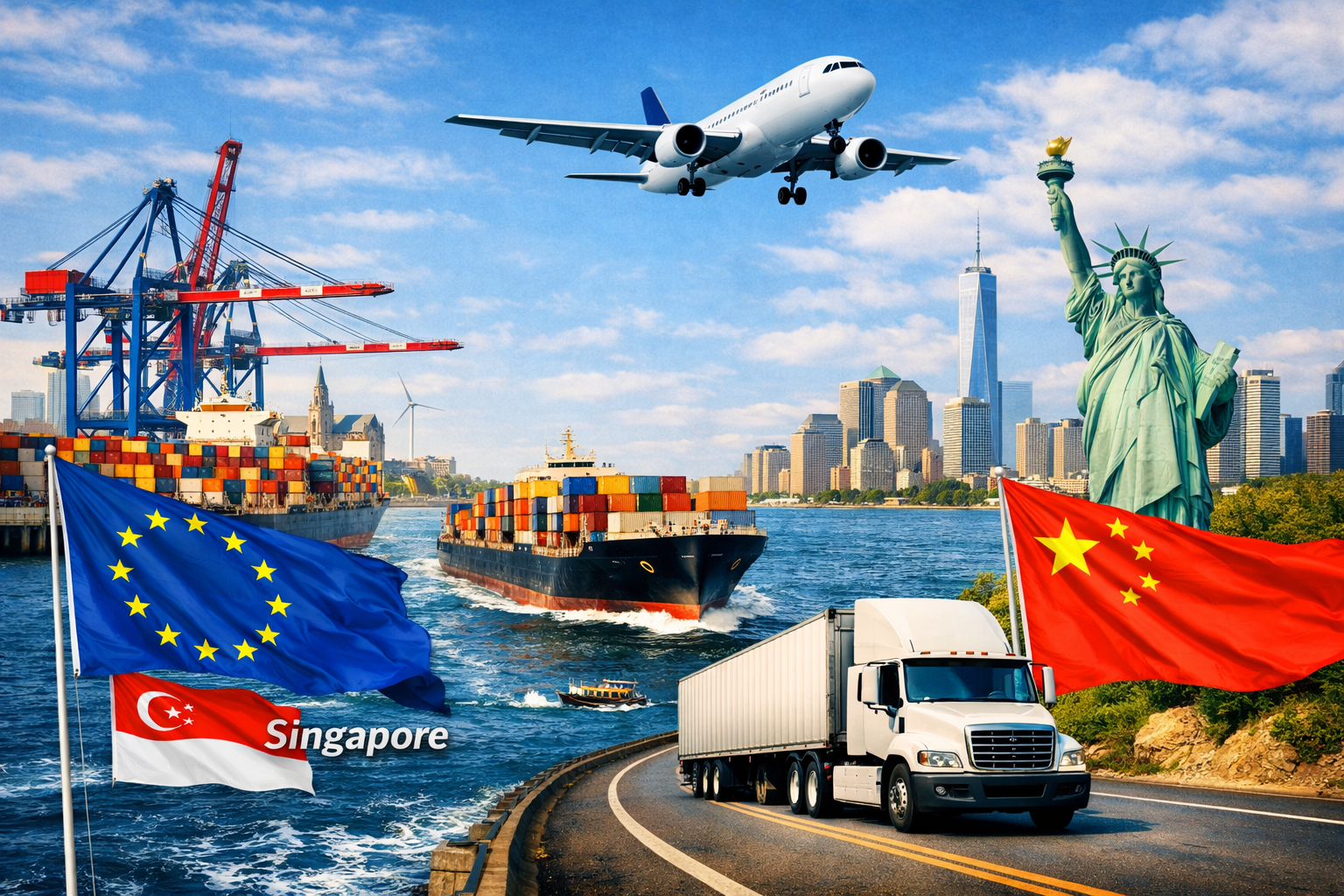
International Freight Shipping Between Europe, USA, and Asia
Freight Transportation Europe – USA – Asia: Global Logistics Routes
International freight transportation between Europe, the USA, and Asia represents a complex system that integrates maritime, air, rail, and road transport. These regions form the largest centers of global trade, where industrial enterprises, distribution warehouses, seaports, airports, and logistics hubs are concentrated. Through transatlantic shipments, Asia-Europe routes, and transoceanic trade corridors, millions of tons of raw materials, equipment, components, food, electronics, and finished products are moved daily.
Global logistics depends not only on the distance between countries. The cost and delivery times are influenced by the type of cargo, the chosen mode of transport, seasonality, port capacity, customs regulations, international sanctions, infrastructure conditions, and geopolitical situations. This is why organizing international delivery requires a comprehensive approach: from route analysis and document preparation to insurance, customs clearance, and cargo movement control.
Europe, the USA, and Asia are connected by a network of stable global trade routes. Key players in these routes include container lines, major seaports, air cargo terminals, rail corridors, and multimodal centers. Companies engaged in export and import choose between the speed of air delivery, the cost-effectiveness of maritime logistics, and the flexibility of combined schemes.
The Importance of Global Logistics Routes
Global logistics routes — are stable directions for the movement of goods between countries and continents. They include maritime lines, air corridors, railway highways, roads, and internal transport networks. Their task is to ensure uninterrupted communication between the manufacturer, supplier, carrier, customs authorities, warehouse, and end recipient.
Major Centers of Global Trade
The largest trade flows are concentrated around several regions:
Europe, including Germany, the Netherlands, Belgium, France, Italy, and Spain;
North America, primarily the USA and Canada;
East and Southeast Asia, including China, Japan, South Korea, Vietnam, Singapore, and Malaysia;
The Middle East, which serves as an important transit hub between Europe and Asia;
India and South Asian countries, actively developing export directions.
European ports such as Rotterdam, Antwerp-Bruges, Hamburg, Valencia, and Piraeus handle significant volumes of container cargo. In the USA, the key gateways for international trade are Los Angeles, Long Beach, New York, New Jersey, Savannah, Houston, and Charleston. In Asia, Shanghai, Ningbo-Zhoushan, Shenzhen, Hong Kong, Singapore, Busan, and the port complexes of Japan play a huge role.
How International Routes Are Formed
The choice of a logistics route is determined by several factors:
the place of departure and destination;
the characteristics of the cargo;
the required delivery times;
the available budget;
the need for temperature control;
the possibility of consolidating shipments;
the requirements for documentation and customs clearance;
current restrictions on specific routes.
The same shipment can be transported using several schemes. For example, cargo from China to Europe can be delivered by sea to a European port, then by rail or road to the recipient's warehouse. Urgent goods are sent by air, while large project cargo is transported using a multimodal scheme with special equipment.
Transatlantic Shipments Between Europe and the USA
Transatlantic shipments connect European countries with the eastern and southern coasts of the USA. This route carries industrial goods, automobiles, medical equipment, pharmaceuticals, electronics, chemical raw materials, food, and consumer goods. The transatlantic route remains one of the most important elements of global maritime logistics.
Maritime Delivery Europe – USA
The majority of cargo between Europe and the USA is transported by sea in containers. Container lines offer regular services between ports in Northern Europe and American ports on the Atlantic coast. The most popular routes include:
Rotterdam — New York;
Antwerp-Bruges — Charleston;
Hamburg — Baltimore;
Valencia — Miami;
Liverpool — Norfolk;
Le Havre — Houston.
Sea freight is suitable for shipments where the cost of delivery is more important than maximum speed. Standard goods, equipment, furniture, components, construction materials, and packaging products can be loaded into a container. For oversized items, flatbeds, open-top containers, and specialized vessels are used.
The duration of transatlantic sea freight depends on the port of departure, port of destination, number of transshipments, and the chosen container line. Direct services are usually faster but more expensive. A route with an intermediate transshipment may be more economical but increases the risk of delays, damage to packaging, and additional port charges.
Aerial Delivery Across the Atlantic
Aerial delivery between Europe and the USA is used for urgent, high-value, compact, or time-sensitive cargo. Aircraft transport product samples, spare parts, documents, pharmaceuticals, electronic components, jewelry, and goods with a short life cycle.
The main advantage of air logistics is speed. Depending on the route and chosen service, delivery can take from a few hours to several days. However, the high cost limits the use of air freight for heavy and low-margin goods.
In air freight, it is especially important to have a correct description of the cargo, accurate calculation of volumetric weight, adherence to packaging rules, and checking restrictions on hazardous materials. Airlines impose strict requirements on batteries, chemicals, aerosols, liquids, and temperature-sensitive cargo.
Road and Rail Delivery in the USA
After arriving at an American port, the container can be transported inland by road or rail. Rail is convenient for delivery to remote inland regions, especially for large shipments. Road transport provides door-to-door delivery to warehouses, stores, manufacturing plants, or distribution centers.
An effective scheme often combines sea and ground transport. The container arrives at the port, goes through the necessary procedures, and then is sent to a rail terminal or handed over to a truck carrier. This model is called intermodal or multimodal logistics.
Cargo Transportation Between Europe and Asia
European-Asian transport forms one of the largest global trade flows. Asia is a leading manufacturing region, while Europe is a major market, center of industrial production, and distribution of goods. Electronics, textiles, automobiles, equipment, industrial automation, chemical products, raw materials, and consumer goods are moved between the regions.
Sea Routes Asia – Europe
Sea freight remains the primary method of delivering cargo between Asia and Europe. Most container flows pass through the Indian Ocean, Suez Canal, Mediterranean Sea, and ports in Northern Europe. Key routes include:
Shanghai – Rotterdam;
Ningbo – Hamburg;
Shenzhen – Antwerp;
Singapore – Valencia;
Busan – Hamburg;
Ho Chi Minh City – La Spezia.
Sea logistics allows for the transportation of large shipments at competitive prices. Container lines offer various service formats: direct routes, transshipment transport, consolidation of groupage cargo, and delivery to an inland terminal.
When planning sea delivery, it is essential to consider seasonal peaks. Before national holidays, sales periods, and the New Year season, demand for container capacity sharply increases. This can lead to equipment shortages, rising rates, and longer waiting times for shipments.
Rail Routes
Rail delivery between Asia and Europe is used as an intermediate option between sea and air transport. It is faster than sea freight and usually cheaper than air delivery. Rail transport is particularly in demand for electronics, auto components, equipment, and goods that require a shorter delivery time.
However, rail routes depend on the political situation, technical condition of the infrastructure, border procedures, and transshipment capabilities. On certain routes, a change of gauge is required, complicating the process and increasing delivery time.
Road Transport on the Euro-Asian Route
Road transport is used for delivery between neighboring regions, completing the first and last stages of the route, as well as transporting cargo from the terminal to the warehouse. International road delivery provides flexibility and allows for organization of transport on a "door-to-door" basis.
For road transport, it is necessary to consider permits, transit documents, weight and size restrictions, driver work regulations, and border crossing rules. Incorrectly prepared documents can lead to delays at border crossings and additional costs.
Logistics Routes Between Asia and the USA
The Asia-America route is one of the busiest in global trade. It carries consumer electronics, clothing, footwear, furniture, household appliances, auto parts, industrial equipment, and goods for online commerce.
Trans-Pacific Sea Freight
The main flow of goods from Asia to the USA passes through the Pacific Ocean. Vessels head to ports on the West Coast, including Los Angeles, Long Beach, Oakland, Tacoma, and Seattle. After that, cargo can be delivered to central and eastern states by rail or road transport.
To reach the East Coast, a route through the Panama Canal is used, or delivery through West Coast ports followed by ground transportation. The choice depends on port congestion, freight costs, timelines, container equipment sizes, and the final destination.
East Coast and Alternative Routes
The ports of New York — New Jersey, Savannah, Charleston, and Houston handle significant volumes of Asian imports. Delivery through these ports can be more convenient for consignees located in the eastern and southern USA. In some cases, direct arrival at an East Coast port reduces the domestic leg of transportation.
Alternative routes become important in the event of congestion, weather restrictions, container shortages, or rising rates on specific routes. Logistics operators analyze several options simultaneously to maintain supply chain resilience.
Aerial Delivery Asia – USA
Air freight from Asia to the USA is in demand for urgent and high-tech goods. Air cargo routes are particularly active for delivering products from the electronics industry, components, medical devices, samples, fashion brand products, and e-commerce orders.
Aerial logistics requires careful planning. It is necessary to choose the departure and arrival airports, check for direct flights, determine cargo handling rules, and calculate volumetric weight. For international air delivery, export declarations, commercial invoices, packing lists, certificates, and information about the country of origin of the goods are also important.
Multimodal Transport Europe – USA – Asia
Multimodal transport involves using several modes of transport within a single logistics process. For example, cargo can be transported by truck from the factory to a Chinese port, by sea to Europe, by rail to a distribution center, and then by truck to the final recipient.
Advantages of Multimodal Logistics
The main advantages include:
the ability to find the optimal combination of speed and cost;
delivery to regions where direct transport connections are absent;
reduced dependence on a single mode of transport;
flexible replacement of individual sections of the route;
organization of "door-to-door" delivery;
centralized control of transportation.
The multimodal scheme is especially useful for international companies with a distributed network of suppliers and customers. One logistics operator can coordinate transport, warehousing, customs clearance, insurance, and cargo tracking.
Main Challenges
The main challenge of multimodal delivery lies in coordinating schedules. A delay in one segment can affect the entire route. Therefore, it is essential to plan a time buffer in advance between the arrival of one transport and the departure of another.
Another important issue is the responsibility for cargo safety. Depending on the terms of the contract, liability may shift between carriers at different stages. To avoid disputes, it is advisable to document the condition of packaging, the number of packages, and seals at each transfer.
Container Shipping and the Work of Shipping Lines
Container shipping is considered the foundation of modern international trade. Standardized equipment allows for the movement of cargo between ships, rail platforms, and trucks without reloading the contents. This reduces processing time and minimizes the risk of damage to goods.
Types of Containers
The most common types of containers are:
20-foot standard containers;
40-foot containers;
40-foot high-capacity containers;
refrigerated containers;
open-top containers;
platforms for oversized cargo;
specialized containers for liquids.
The choice depends on the volume, weight, shape, and characteristics of the goods. For perishable products, a refrigerated container with a specified temperature regime is necessary. For equipment that exceeds standard dimensions, platforms and special fastening systems are used.
Full and consolidated loading
In full container loading, one sender uses the entire container. This format is suitable for large batches and reduces the number of operations with the cargo. Consolidated shipping allows combining goods from several clients into one container. It is convenient for small batches, but involves additional consolidation and deconsolidation operations.
When choosing consolidated delivery, it is important to check how warehouse operations, labeling of places, document control, and cargo protection are organized. Errors at the consolidation stage can lead to misdelivery or delays in release.
Cost of sea transportation
The final price consists not only of sea freight. It may include:
cargo acceptance at the terminal;
container delivery;
port fees;
documentation costs;
customs clearance;
expediting;
delivery to the warehouse;
insurance;
storage;
demurrage and detention;
additional charges for overloading or route changes.
To compare offers from different carriers, it is necessary to analyze the total cost of the logistics chain, not just the basic freight rate.
Aviation delivery in global logistics
Aviation delivery plays a crucial role in international trade when speed is essential. Airplanes allow for quick connections between production centers in Asia, Europe, and the USA. With a well-developed network of cargo airports, companies can organize delivery to almost any point in the world.
When to choose air transportation
Aviation delivery is justified in the following cases:
the cargo needs to be delivered urgently;
the product has a high value per unit weight;
delivery delays lead to production stoppages;
the product is perishable;
there is a need to quickly send spare parts;
the shipment is small;
samples need to be delivered for exhibitions or negotiations.
For large heavy cargo, air transport is often economically unfeasible. In such situations, sea, rail, or combined schemes are used.
Calculation of air freight rates
Airlines consider both actual and volumetric weight. If the cargo takes up a lot of space with a low weight, the rate is calculated based on the volumetric indicator. Therefore, compact packaging, proper placement, and accurate dimensions of each item are very important.
The cost of air delivery may also include fuel and security fees, terminal handling, document processing, delivery to the airport, and subsequent transportation to the recipient.
Customs clearance for export and import
Customs clearance is a mandatory part of international transportation between Europe, the USA, and Asia. The accuracy of documents affects the speed of goods release, the amount of payments, and the absence of claims from regulatory authorities.
Main documents
In international trade, the following documents are usually used:
commercial invoice;
packing list;
transportation waybill;
bill of lading for sea transport;
air waybill for air delivery;
export declaration;
import declaration;
certificate of origin;
permits and licenses;
compliance documents for the products;
insurance certificate.
The list of documents depends on the type of goods, the country of departure, the destination country, and the terms of the foreign trade contract.
Product classification
For the calculation of duties and determination of requirements, a commodity nomenclature code is assigned to the product. Incorrect classification can lead to additional payments, delays in release, fines, and the need to correct the declaration.
Before shipping, it is important to check the product description, composition, purpose, brand, country of origin, and classification code. Special attention should be paid to electronics, chemical products, medical goods, food products, and dual-use equipment.
Delivery terms
Incoterms conditions define who organizes transportation, insurance, export and import clearance, as well as when risks transfer. Common terms include EXW, FCA, FOB, CIF, CPT, CIP, DAP, and DDP.
Choosing the wrong delivery term can lead to unexpected costs. For example, a buyer may expect delivery to a warehouse, while the seller is only obligated to transfer the cargo at their premises or the port of departure.
Insurance for International Cargo
During transportation, cargo can be damaged due to packaging issues, accidents, fire, flooding, improper loading, theft, or delays. Insurance helps mitigate financial risks, especially when transporting expensive and fragile goods.
Factors Considered in Insurance
The insurance premium depends on:
the type of goods;
the value of the cargo;
the route;
the chosen mode of transport;
the nature of the packaging;
the likelihood of damage;
the coverage conditions;
the presence of transshipments;
the requirements of the insurance company.
The policy may cover a full range of risks or only specific events. Before signing a contract, it is essential to review exclusions, deductibles, notification procedures for incidents, and the list of supporting documents.
Packaging and Securing
Even quality insurance cannot replace proper preparation of the goods. Cargo must be packaged considering the duration of transport, humidity, temperature fluctuations, vibration, and multiple handling.
Wooden crates, cushioning materials, moisture-resistant films, fastening elements, and anti-slip coatings are used for equipment. Fragile items are marked with special signs, and temperature-sensitive cargo is equipped with transport condition recorders.
Digital Technologies in Global Logistics
Modern logistics actively utilizes digital tools. They allow for tracking cargo movement, exchanging documents, predicting timelines, and reducing errors.
Shipment Tracking
Tracking systems provide information about the location of the container, the status of the vessel, arrival at the port, passing through the terminal, and transfer to the next carrier. For high-value goods, GPS sensors, electronic seals, and temperature sensors may be used.
Tracking is especially important in multimodal transport, where cargo changes transport several times. Clients have the opportunity to prepare the warehouse, customs representative, and transport for the final stage in advance.
Electronic Document Flow
Electronic documents speed up data exchange between the sender, carrier, broker, bank, and government authorities. This reduces approval time and minimizes the risk of losing originals.
Digital platforms also allow for comparing rates, booking containers, generating requests, monitoring timelines, and receiving notifications about any changes in the route.
Risks and Challenges of International Routes
Global supply chains are subject to various risks. Even a well-planned route can face delays due to external circumstances.
Main Sources of Risks
These include:
congestion at seaports;
container shortages;
strikes by terminal workers;
adverse weather conditions;
changes in customs regulations;
sanction restrictions;
military conflicts;
closure of channels and straits;
rising fuel costs;
currency fluctuations;
warehouse space shortages;
document errors.
To mitigate risks, companies prepare alternative ports, backup carriers, and contingency routes in advance. Diversifying suppliers and distributing inventory across multiple warehouses plays a crucial role.
How to Reduce the Likelihood of Delays
For stable delivery, it is recommended to:
book transport in advance;
check the reliability of the carrier;
allow for buffer time;
use correct product codes;
prepare documents in advance;
monitor packaging and labeling;
analyze seasonal load;
track changes in legislation;
insure high-value shipments;
consider alternative routes.
How to Choose a Logistics Operator
A reliable logistics partner should have experience in international shipping, a well-developed network of agents, and the ability to organize deliveries across multiple continents. It is important to evaluate not only the price but also the quality of service.
Selection Criteria
When comparing transportation companies, pay attention to:
the geography of operations;
access to container lines;
availability of own warehouses and terminals;
customs clearance experience;
multimodal delivery capabilities;
transparency in pricing;
quality of customer support;
availability of a tracking system;
insurance coverage;
customer reviews;
willingness to work with non-standard cargo.
A competent operator should provide a detailed commercial proposal outlining all expenses. If port, terminal, or documentation fees are missing from the calculation, the final price may significantly increase after the transportation begins.
Economic Efficiency of International Delivery
Optimizing transportation is not about finding the lowest rate, but about reducing the total costs across the entire logistics chain. A cheap route may turn out to be unprofitable if it involves long storage times, numerous transshipments, or high risks of delays.
Cost Optimization Methods
Costs can be reduced by:
consolidating small shipments;
choosing the right type of container;
making advance bookings;
optimizing packaging;
selecting the appropriate port;
utilizing backhauls;
switching to a multimodal scheme;
automating document flow;
reducing container idle time;
long-term contracts with carriers.
It is important to consider not only the transportation tariff but also the costs of inventory, storage, insurance, customs clearance, production downtime, and potential penalties for delivery delays.
Prospects for Global Trade Routes
International logistics continues to evolve under the influence of e-commerce, automation, environmental requirements, and changes in manufacturing geography. Companies strive to make supply chains more flexible, transparent, and sustainable.
New Trends
Key development directions include:
growth in online commerce;
increased demand for fast delivery;
warehouse automation;
use of artificial intelligence for forecasting;
transition to electronic transport documents;
development of port robotics;
expansion of railway corridors;
use of low-carbon fuels;
diversification of suppliers;
formation of regional production centers.
In the future, companies will focus more on not only speed and cost but also the sustainability of routes. Important indicators will include the ability to quickly switch to another port, carrier, or mode of transport, as well as having accurate data on the status of the cargo.
Transporting goods along the Europe – USA – Asia routes is a multi-layered system involving maritime shipping, air delivery, rail, and road transport. Transatlantic routes provide trade links between Europe and North America, while Pacific lines connect Asia with the USA, and Euro-Asian corridors support the movement of goods between manufacturing and consumer centers.
The choice of the optimal scheme depends on the nature of the cargo, deadlines, budget, route, and control requirements. Sea logistics is suitable for large shipments, air delivery is for urgent and expensive consignments, rail transport occupies an intermediate position, while multimodal solutions allow combining the advantages of several transport modes.
Successful international delivery requires precise planning, competent customs clearance, reliable packaging, insurance, and constant monitoring. Companies that utilize digital tools, analyze risks in advance, and work with a professional logistics operator achieve a more resilient supply chain and reduce total costs for exports and imports.