

 RU
 UA
 DE
 FR
 ES
 CN
 SA
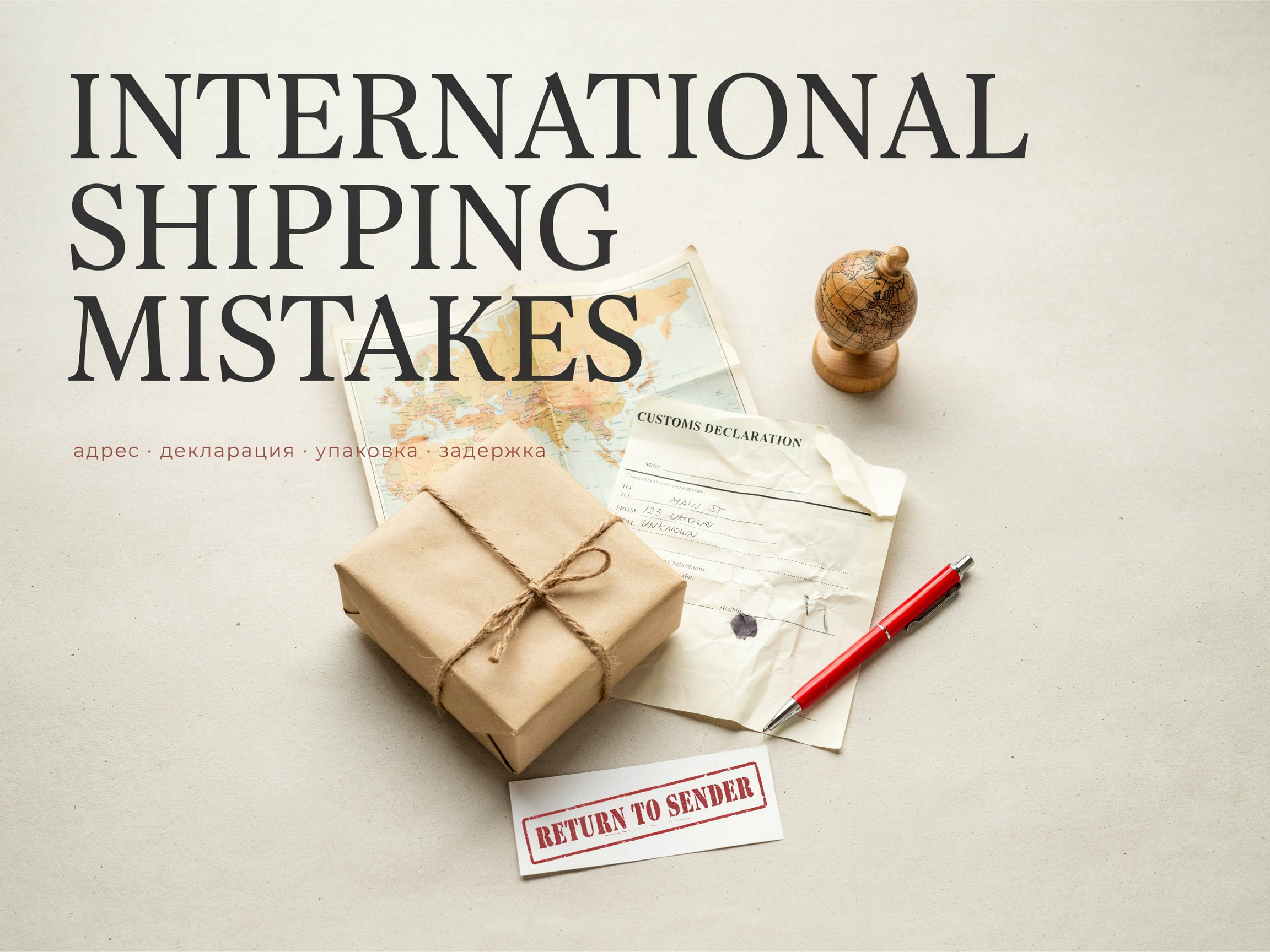
Mistakes When Sending International Packages
Common Mistakes Made When Sending International Packages
International shipping allows you to send documents, gifts, personal belongings, and commercial cargo to almost any corner of the world. However, crossing borders comes with additional requirements that are not present in regular domestic shipping. The sender must correctly specify the recipient's address, prepare the packaging, fill out the customs declaration, check the list of permitted contents, and choose the appropriate shipping method. Even a small inaccuracy can lead to shipping delays, return of the shipment, additional costs, or complete confiscation of the package.
Most problems arise not from the complexities of international logistics, but from the sender's carelessness. People provide incomplete information, incorrectly describe the contents, undervalue the items, use unsuitable packaging, or ignore the rules of the destination country. Sometimes a package passes through the sorting center without issues but gets delayed at customs due to one incorrectly filled line. Therefore, it is essential to study the requirements of the carrier and the country to which the cargo is being sent in advance.
The most common mistakes in international shipping. How to avoid problems with incorrect addresses, why the customs declaration is crucial, what the packaging of the package should be like, and what to do if the shipment is delayed. Following simple recommendations will help make shipping predictable, reduce delivery times, and lower the risk of additional charges.
Incorrect or Incomplete Recipient Address
One of the most frequent causes of problems in international shipping is errors in address data. Unlike domestic shipping, an international package passes through several logistics systems, where the address may be processed by employees from different countries and automatically read by sorting equipment. If it lacks a postal code, has an incorrect locality, or the house number is mixed up, the shipment may end up in the wrong sorting center, be delayed for inspection, or returned to the sender.
It is particularly important to provide the address in the format used in the destination country. In some countries, the house number is written first, followed by the street name, while in others, it is the opposite. Different variations of writing regions, provinces, and administrative districts may also be used. If the sender only uses Russian transliteration, it can be difficult for foreign postal employees to match the data with the official address system.
What Information to Include
An international package typically includes the recipient's full name, street name, house number, and apartment or office number, locality, region, postal code, country, and contact phone number. If the delivery is handled by a courier service, the phone number and email are especially important: the carrier may need to contact the recipient to clarify details or arrange a delivery time.
The recipient's name should ideally be provided as it appears on their official documents or in the delivery service profile. For legal entities, the company name, department, and contact person's name should also be included. If the package is being sent to a hotel, dormitory, business center, or temporary residence, the name of the establishment and room number must be added.
How to Verify the Address Before Shipping
Before preparing the shipment, ask the recipient to send the address in a ready format. Do not rewrite it from memory or translate it yourself if you are unsure of the correct format. Verify the postal code through the official website of the postal service in the destination country or confirm it with the recipient. Double-check the city name, region, and house number separately.
It is helpful to print the address label; however, even in this case, it is worth checking whether the program displayed all the characters correctly. Some systems do not support certain symbols, diacritical marks, or national alphabets. For international shipping, the Latin alphabet is most commonly used if permitted by the carrier's rules. It is recommended to duplicate the address inside the packaging: if the external label is damaged, staff will be able to identify the shipment.
Errors in Filling Out the Customs Declaration
The customs declaration is one of the most important documents for an international package. It contains information about the contents, quantity of items, value, weight, and purpose of the shipment. Based on this data, the customs authority determines whether the cargo can be allowed through the border, if additional inspection is required, and whether duties need to be assessed. Any inaccuracy can lead to shipping delays, requests for documents, or return of the package.
A common mistake is providing too general a description of the contents. Phrases like “gift,” “items,” “samples,” or “personal belongings” do not give customs authorities the necessary information. It’s better to specify exact names: “cotton t-shirt – 2 pcs,” “children's book – 1 pc,” “ceramic mug – 1 pc.” The description should be clear, truthful, and correspond to the actual contents of the package.
Do not undervalue the shipment
Some senders intentionally declare a minimal value to reduce the likelihood of customs duties. This is a risky practice. If customs officials find the declared price implausible, they may request a receipt, payment documents, or a link to the product. In the absence of confirmations, they will determine the value themselves, and the package will be held until the circumstances are clarified.
Undervaluing can also lead to financial losses in case of damage or loss of the shipment. Compensation is usually calculated based on the declared value. If the amount stated in the declaration is significantly lower than the actual value, obtaining full reimbursement will be impossible.
Errors in the designation and quantity of goods
It is important to correctly specify the purpose of the shipment in the declaration: gift, personal items, commercial shipment, return of goods, or product samples. You cannot declare commercial cargo as a gift if it contains several identical new items intended for sale. Customs may interpret this as an attempt to conceal business activities.
The quantity of items must match the actual contents. If the document states two items, but five are found during inspection, questions will arise for the sender. For each item, it is advisable to specify the name, quantity, unit price, and total value. This approach simplifies verification and reduces the likelihood of delays for international packages.
Improper packaging of international shipments
Reliable packaging of the shipment is crucial, as international delivery involves long transportation, transfers, sorting, and exposure to temperature fluctuations. The shipment may be moved multiple times between trucks, planes, warehouses, and sorting lines. If the box is not sturdy enough or lacks protective material inside, the contents may be damaged even with careful handling.
A common mistake is using an old, soggy, or deformed box. Reusing packaging is acceptable only if it maintains rigidity and is undamaged. Old stickers, barcodes, and address labels must be removed to prevent the automated system from reading outdated information. The outer surface should be clean and suitable for new labeling.
How to choose a box and protective materials
The size of the packaging should match the contents. A box that is too large increases the dimensional weight and shipping cost, and creates empty space that allows items to move around inside. A box that is too tight increases the risk of damage due to compression. It is advisable to leave a small gap between the product and the walls of the box for cushioning material.
For protection, use bubble wrap, foam, corrugated cardboard, paper filler, air pillows, and other materials. Fragile items should be wrapped separately, and voids should be filled to prevent movement during shaking. Glass and ceramic items are best placed in the center of the box, avoiding contact with each other and the walls.
Sealing and labeling
The box should be sealed with strong packing tape, covering all seams and joints. For heavy shipments, reinforced tape or additional strapping materials should be used if permitted by the carrier. Do not rely solely on thin office tape or decorative wrapping tape.
If the contents require special handling, appropriate labeling should be placed on the box: “Fragile,” “Top,” “Keep Dry.” However, such markings do not replace quality internal protection. An international package should be prepared to withstand normal transportation even without ideal handling.
Ignoring content restrictions
Another common mistake in shipping is including items that are prohibited or restricted for international mailing. The list of such goods depends on the country of origin, destination country, and the chosen carrier. Regulations may vary across different jurisdictions, so one should not rely solely on the experience of previous shipments.
Prohibited categories often include explosives and flammable substances, weapons, narcotics, certain types of medications, toxic chemicals, gas cylinders, specific types of batteries, perishable goods, and counterfeit products. Restrictions may also apply to seeds, plants, animal products, cosmetics, liquids, and electronic devices.
Why you shouldn't hide prohibited items
Sometimes senders attempt to disguise the contents or fail to declare them in the customs declaration. This can lead not only to delays in the package but also to administrative or criminal liability depending on the nature of the violation. Additionally, the carrier has the right to refuse delivery, destroy dangerous items, or report the information to the relevant authorities.
Even if an item is allowed to be shipped from one country, it does not mean it will be permitted for import into another. For example, medications may require a prescription, food products may need veterinary or phytosanitary documents, and electronics with batteries may require special packaging and labeling. Before shipping, it is essential to review the current regulations of the carrier and the customs of the destination country.
Incorrect choice of international shipping method
Not every shipping method is suitable for a specific shipment. Express delivery is usually faster but more expensive and may have stricter documentation requirements. Standard postal shipping is cheaper, but its delivery time can be less predictable. Courier services are convenient for door-to-door delivery, while national postal services often offer more options for small packages.
An error occurs when the sender chooses a rate based solely on price, without considering delivery times, the type of contents, the need for tracking, and weight or size limits. For urgent documents, a delay of even a few days can be critical. For fragile items, the quality of handling and insurance is more important than the lowest cost.
What to consider when choosing a carrier
Before placing an order, it is necessary to compare weight limits, size restrictions, product categories, and customs clearance rules. It is important to find out whether door-to-door delivery is included, who pays the import fees, whether insurance is provided, and how compensation is calculated in case of loss or damage.
You should also check if the carrier offers comprehensive tracking. International tracking should show key stages of the shipment's journey: acceptance of the shipment, export from the country, arrival in the destination country, customs inspection, transfer to the local service, and delivery. If tracking is limited to just a few statuses, it will be more challenging to determine the cause of any delays.
Shipping delays: main reasons
Delays in international packages can be caused by many factors. Sometimes the issue lies with the sender: documents are improperly filled out, the postal code is missing, the label is damaged, or the contents do not match the declaration. In other cases, delivery times are affected by weather conditions, congestion at sorting centers, holiday periods, transportation restrictions, strikes, and increased customs controls.
The longest delays usually occur during customs clearance. A package may be sent for additional inspection if its value seems suspiciously low, the description is insufficiently detailed, or the contents fall into a restricted category. Sometimes customs may be waiting for documents from the recipient: proof of payment, passport details, import permits, or licenses.
What to do if your package is delayed
First, check the latest status using the tracking number on the carrier's official website. If it indicates that the shipment is with customs, the recipient should check their email, messages, and personal account: a request for documents may arrive there. It is important to respond to requests quickly, as the storage time for the package at the warehouse is limited.
If the status does not change for an extended period, you should contact the carrier's customer support. When reaching out, provide the tracking number, shipping date, sender and recipient details, and a description of the issue. It is not recommended to arrange for a reshipment until the circumstances are clarified: the first package may be under inspection and continue its journey later.
Lack of documents and confirmations
For some international shipments, a customs declaration alone is not sufficient. Commercial shipments may require an invoice, packing list, contract, certificate of origin, export license, or documents confirming the safety of the goods. Certain categories of products need sanitary, veterinary, phytosanitary, and other permits.
Even when sending personal items, it may sometimes be necessary to confirm the value or purpose of the items. For example, when returning a purchase, an order, receipt, and documents from the online store may be required. If the recipient cannot prove that the item is a return or personal property, customs may impose fees as if it were a regular import.
How to Prepare Documents
All documents must contain consistent information. The name of the item, quantity, value, weight, and details of the parties must match in the declaration, invoice, and shipping label. A discrepancy in even one figure can raise additional questions.
Documents should be placed in a special transparent pouch on the outside of the package or uploaded to the carrier's electronic system if provided. It is advisable for the sender to keep a copy of each document. If originals are needed by the recipient, it should be clarified whether sending copies is allowed and how the original documents will be transmitted.
Errors in Specifying Weight, Dimensions, and Value
Some senders provide approximate parameters of the package without checking them after packing. This can lead to a recalculation of costs. Carriers often use not only actual weight but also dimensional weight. If the box is large and light, the price will be determined by its dimensions. Incorrectly specified sizes can result in additional charges or denial of the selected rate.
The package should be weighed after complete packing, including the box, protective material, documents, and external binding. Dimensions are measured at the most protruding points. If the packaging has an unusual shape, it is better to clarify the rules of the specific delivery service in advance.
Why Accurate Declared Value is Important
The declared value affects customs clearance, insurance, and potential compensation. A value that is too low raises suspicions, while an excessively high value increases the likelihood of duties and fees being charged. It is necessary to indicate the actual market value considering the purpose of the shipment and the requirements of the destination country.
If the package consists of used items, their value may differ from the original purchase price. In such cases, it is helpful to keep confirmations, photographs, or other information that explains the stated amount. The main rule is that the information must be accurate and logically correspond to the contents.
How to Avoid Common Mistakes in International Shipping
To ensure international delivery goes smoothly, preparation should begin well in advance. It is not advisable to arrange the shipment at the last minute, especially if it contains restricted items or is being sent to a country with complex customs regulations. The more time there is to check the documents, the lower the likelihood of accidental errors.
Practical Checklist for Senders
Check the rules of the carrier and the destination country.
Clarify whether each item in the package is allowed to be sent.
Obtain a complete and up-to-date address from the recipient.
Verify the postal code, phone number, email, and spelling of the name.
Weigh and measure the package after final packing.
Use a sturdy box and protective materials.
Remove old labels and barcodes.
Fill out the customs declaration in detail and truthfully.
Indicate the actual value, quantity, and purpose of the contents.
Prepare invoices, receipts, permits, and other documents if needed.
Keep a photograph of the packaging and copies of all documents.
Write down the tracking number and regularly check the delivery status.
Before handing over the package to the carrier, it is useful to open the completed application once more and check each line. Pay special attention to the destination country, postal code, phone number, currency of value, weight, and description of the items. If there are any doubts, it is better to contact customer support in advance than to correct a mistake after shipping.
Shipping errors in international delivery are most often related to incorrect addresses, inaccurate customs declarations, weak packaging, violations of restrictions on contents, and incorrect choice of shipping method. Each of these issues can lead to delays in transportation, additional costs, returns, or loss of the ability to receive compensation.
A reliable international package starts with careful preparation. The sender must verify the recipient's address, learn the rules of the destination country, honestly describe the contents, indicate the correct value, and choose packaging that can withstand long transportation. It is equally important to keep documents and track the status of the shipment after handing it over to the carrier.
If you adhere to the established requirements and do not attempt to hide information from the carrier or customs, most issues can be prevented even before shipping. A properly completed declaration, correct packaging, and a complete address help reduce international shipping times and make the entire process as safe and predictable as possible.