

 RU
 UA
 DE
 FR
 ES
 CN
 SA
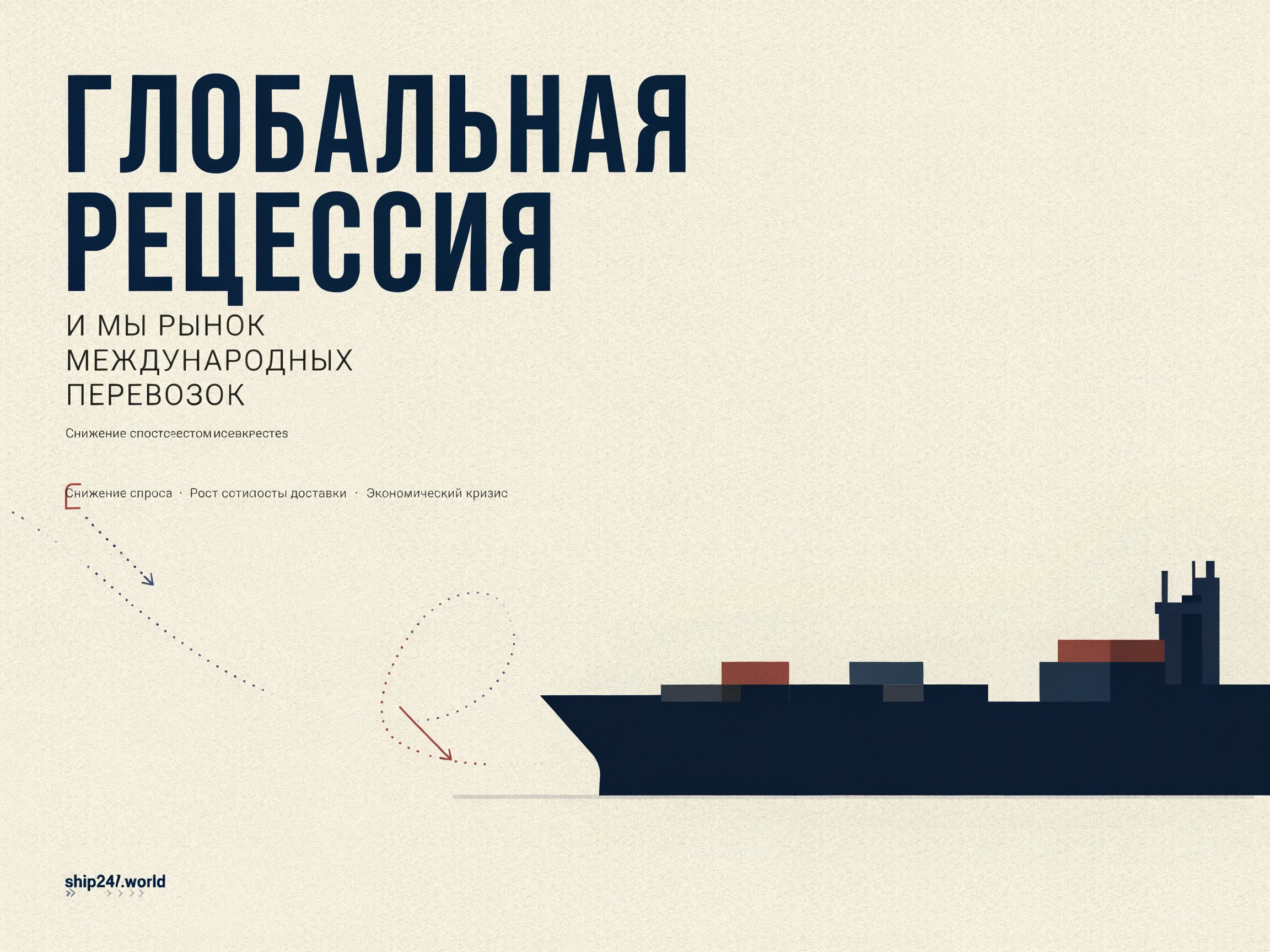
How the Global Recession is Changing the International Shipping Market
How the Global Recession is Changing the International Shipping Market
The global recession has a significant impact on the economy, industry, trade, and consumer demand. One of the first areas to feel the effects of the economic crisis is international logistics. As companies cut production, reduce inventory, and postpone investments, the freight market faces a decline in order volumes, changes in routes, and increased competition among carriers.
For businesses, international shipping is no longer just an operational task. It has become an important tool for managing costs, risks, and supply chain resilience. In an environment of unstable currency exchange rates, rising fuel costs, changing customs requirements, and declining purchasing power, companies are forced to rethink their logistics strategies.
Modern international logistics is evolving under the influence of several factors: fluctuations in demand, geopolitical restrictions, port disruptions, container shortages, rising insurance costs, and the digitalization of transport processes. In this situation, participants in the freight market are striving not only to retain customers but also to enhance the efficiency of each shipment.
What is a Global Recession and Why Does it Affect International Logistics
A global recession is a prolonged period of slowing global economic activity, characterized by a decline in business activity, investment, industrial production, and consumption. Unlike a local crisis, it affects multiple countries and regions, disrupting established trade connections and financial flows.
International logistics is directly dependent on the state of the global economy. The more companies produce and sell, the greater the need for the delivery of raw materials, components, and finished products. During a recession, this relationship works in reverse: businesses reduce production volumes, buyers purchase goods less frequently, and international freight services receive fewer orders.
Main Reasons for the Recession's Impact on the Freight Market
One of the main reasons is the decline in industrial production. Manufacturing enterprises reduce their purchases of raw materials, equipment, and components. This leads to a decrease in road, sea, rail, and air freight.
The second factor is the drop in consumer demand. Retailers order fewer goods to avoid tying up funds in inventory. As a result, the number of container shipments, consolidated cargo batches, and urgent air freight decreases.
The third factor is related to the deterioration of businesses' financial positions. Companies strive to cut fixed costs, renegotiate contracts with logistics operators, and often choose cheaper delivery options. For carriers, this means intensified price competition.
Additionally, a recession may be accompanied by currency exchange rate instability, rising loan costs, and increased insurance expenses. All these changes raise the cost of international shipping and complicate the forecasting of final delivery prices.
The Role of International Trade During an Economic Crisis
Despite the decline in activity, international trade does not come to a complete halt. Even during a major economic crisis, companies continue to procure products, maintain export channels, and seek new markets. However, the structure of shipments changes.
Essential goods, medical products, food, energy resources, components for critical industries, and equipment for infrastructure projects come to the forefront. At the same time, the volume of shipments of durable goods, premium products, and categories dependent on discretionary spending decreases.
This means that the freight market is not just shrinking but restructuring. Carriers and freight forwarders who can quickly adapt routes and services to new needs gain a competitive advantage.
How Demand for International Shipping is Changing
The decline in demand is one of the most noticeable consequences of the global recession. When manufacturers and trading companies reduce their activity levels, logistics operators face a decrease in the number of orders. However, the drop in demand is uneven: some routes sharply lose volumes, while others remain stable or even grow.
Typically, the most sensitive shipments are those related to consumer electronics, furniture, automobiles, clothing, industrial equipment, and premium goods. These categories depend on the income levels of the population and the investment activity of businesses.
Reduction in Freight Volumes and Changes in Order Structure
In times of recession, companies strive to avoid creating excess inventory. Previously, businesses could order large batches of goods to secure discounts or protect themselves from potential disruptions. During an economic crisis, such a strategy becomes risky: capital gets tied up in warehouses, and products may lose their relevance.
As a result, customers are increasingly shifting towards smaller and more frequent shipments. This impacts the structure of the international logistics market. There is a growing demand for consolidated cargo, batch consolidation, cross-docking, and flexible warehousing solutions.
For carriers, this format can be more challenging from an operational standpoint. It is necessary to combine multiple shipments, coordinate different timelines, consider the requirements of various clients, and ensure documentation accuracy. However, it is precisely these comprehensive services that allow for maintaining profitability even amid an overall decline in volumes.
Reorientation to Regional and Alternative Markets
Global recession often accelerates the regionalization of trade. Companies are seeking suppliers and buyers closer to their main markets to reduce transportation distances, decrease dependence on long routes, and minimize delay risks.
At the same time, businesses are increasingly working with alternative supplier countries. If a company previously relied on one region, the crisis forces it to diversify its sourcing. This leads to the emergence of new transportation routes and changes the roles of specific ports, hubs, and warehouse centers.
The growth of regional supply chains does not mean the disappearance of global shipments. Rather, international logistics is becoming more flexible and multilayered. Companies are using a combination of long-distance sea routes, rail delivery, road transport, and local distribution centers.
Why Forecasting Accuracy is Important
During periods of stable growth, errors in demand forecasting can be compensated by increased sales. In a recession, such compensation disappears. An incorrect assessment of volumes leads to overpayment for transport, product shortages, or the accumulation of unsold inventory.
Therefore, companies are paying more attention to analytics. They track seasonality, delivery times, fuel costs, route congestion, and currency dynamics. Logistics platforms, including digital services for calculating and organizing shipments, help compare delivery options and make decisions based on current data. In this context, online tools like ship247.world can be used as part of a digital approach to managing international logistics.
How Recession Affects Delivery Costs
Delivery costs are influenced by a multitude of factors. Among them are the mode of transport, distance, volume and weight of the cargo, seasonality, fuel prices, port fees, customs duties, insurance, currency fluctuations, and the level of demand on a specific route.
At first glance, a decrease in demand should automatically lead to lower transportation costs. However, in practice, the situation is more complex. Some expense items decrease, while others continue to rise. Therefore, the final cost of international transportation may decrease on certain routes but simultaneously increase due to external factors.
Why Transportation Prices Do Not Always Fall with Demand
When the number of orders decreases, carriers face underutilization of transport. An airplane, ship, train, or truck incurs costs even when not operating at full capacity. To compensate for lost revenue, the operator may raise rates or introduce additional fees.
Moreover, transport companies incur fixed costs: maintaining a fleet, renting terminals, paying staff, technical maintenance, insurance, and digital infrastructure. A reduction in transport volumes does not eliminate these obligations.
The cost of fuel plays a separate role. If energy resources become more expensive, carriers adjust their rates regardless of demand levels. A similar situation arises when port fees, transit charges, or the cost of traversing specific routes increase.
Impact of Currency Exchange Rates and Financial Conditions
International shipments are often calculated in multiple currencies. A company may pay for sea freight in dollars, warehousing services in euros, and domestic delivery in the national currency. With sharp currency fluctuations, the final cost of an order changes even without revising the base rate.
Rising interest rates also affect logistics. For carriers, financing for fleets and equipment becomes more expensive. For clients, the cost of working capital increases, especially if the cargo is in transit for several weeks. This compels businesses to analyze delivery times more carefully and choose solutions that reduce financial burdens.
How Companies Can Optimize Costs
To reduce shipping costs, companies use several tools. The first is cargo consolidation. Combining multiple shipments allows for more efficient use of transport space and reduces costs per unit of goods.
The second tool is choosing the right mode of transport. Sea freight is usually cheaper than air freight but takes longer. Rail transport can be a compromise between speed and cost. Road transport is convenient for regional deliveries and organizing "door-to-door" routes.
The third method is planning. Urgent shipments often come at a significantly higher cost. If a company establishes a delivery schedule in advance, it can choose more favorable rates and avoid additional fees.
The fourth approach is digital comparison of offers. Online platforms help analyze routes, timelines, and prices from different operators. This is especially relevant for businesses that regularly organize international freight and seek to reduce dependence on a single supplier.
Changes in Maritime Transport Operations
Maritime transport remains a crucial part of global logistics. It accounts for a significant share of international trade, especially in the transportation of raw materials, industrial products, equipment, and large shipments. However, the global recession is noticeably affecting container flows, vessel loading, and port operations.
When demand decreases, carriers may withdraw some vessels from operation, reduce the number of trips, or consolidate services. This helps lower operational costs but may simultaneously increase delivery times and reduce the availability of certain routes.
Container Shipping and the Imbalance Problem
One typical issue is the imbalance of container flows. There may be too many containers in one direction and not enough in the opposite direction. This leads to additional costs for repositioning—moving empty containers.
In conditions of weak demand, carriers plan loading very carefully. Some routes become unprofitable, prompting operators to change schedules, revise port calls, and consolidate several services.
For customers, this means the need to check container availability in advance, reserve space on vessels, and account for possible schedule changes. Having an alternative route becomes especially important.
Increasing Role of Port Infrastructure
Ports and terminals are also adapting to the crisis. A decrease in cargo flow may reduce the load on infrastructure but simultaneously lower operators' revenues. Companies are beginning to optimize personnel, equipment, and warehouse space.
Automation and digital document processing become significant advantages. Electronic bills of lading, pre-booking systems, automatic container tracking, and integration with customs platforms help reduce cargo processing time and lower the likelihood of errors.
Risks of Delays and Changes in Delivery Times
Even with decreased demand, maritime transport times do not always shorten. They are influenced by weather conditions, port congestion, restrictions on certain routes, the technical condition of vessels, and changes in schedules.
Companies must build in time reserves and identify critical points in the supply chain in advance. If cargo is needed by a specific date, it is important to consider a multimodal scheme where maritime transport is combined with road or rail delivery.
Road and Rail Transport in Crisis Conditions
Road and rail transport play an important role in regional and interregional logistics. They ensure the delivery of goods from the manufacturer to the port, terminal, distribution center, or end recipient. During a recession, both modes of transport face changes in volumes but respond to the crisis differently.
Road transport is characterized by flexibility and the ability to organize "door-to-door" delivery. Rail is suitable for large shipments, stable routes, and goods for which lower costs compared to air transport are important.
State of the Road Freight Market
With decreasing demand, carriers may face an excess of transport capacity. More free vehicles appear on the market, intensifying competition and sometimes leading to lower rates. However, the risks of downtime, increased defaults, and deteriorating financial conditions for small transport companies also rise.
The cost of road transport depends on fuel, road tolls, driver wages, maintenance, and border conditions. If the route passes through several countries, it is necessary to consider the requirements for documents, permits, and driver work regulations.
In times of crisis, clients are more likely to choose not the cheapest carrier, but an operator that can provide predictability, transparent tracking, and adherence to deadlines. A low rate without guarantees can lead to additional costs due to delays, fines, or cargo damage.
The Importance of Rail Logistics
Rail transport can be an attractive alternative to sea and road transport on certain routes. It allows for the movement of large volumes of cargo with relatively stable timelines and less dependence on road conditions.
However, rail logistics requires developed infrastructure, schedule coordination, and the presence of terminals. On certain routes, there may be capacity constraints, gauge changes, transshipment, and documentation issues.
A recession encourages companies to seek more rational transport combinations. For example, part of the journey can be by rail, while road delivery is used for the initial and final segments. This multimodal scheme allows for balancing cost, speed, and reliability.
Hybrid Solutions for Business
Modern international logistics increasingly relies on a combination of different modes of transport. Multimodal transport allows for adapting routes to changes in demand, tariffs, and infrastructure constraints.
For effective organization, it is essential that all participants in the chain exchange up-to-date data. A unified transport plan, agreed documents, transshipment control, and clear responsibilities are important. Digital platforms enable the consolidation of information about orders, cargo status, timelines, and payments in one interface.
Changing Client Requirements for Logistics Companies
The global recession is changing not only the volume of shipments but also customer expectations. Clients are becoming more demanding regarding transparency, timelines, payment terms, and service quality. They want to understand the components of delivery costs, the location of their cargo, and the risks that may arise along the route.
Whereas previously a company could choose a logistics partner primarily based on rates, reliability and the ability to respond quickly to non-standard situations are now coming to the forefront.
Transparency in Calculations and Absence of Hidden Fees
In an economic crisis, businesses closely monitor their budgets. Unexpected charges for storage, document processing, transport downtime, or route changes can significantly impact the profitability of a deal.
Therefore, carriers and freight forwarders must provide a detailed tariff structure. It is important for clients to know in advance the base cost of transportation, the list of additional services, possible surcharges, and the conditions under which they may arise.
Digital services help make calculations clearer. Online calculators, electronic commercial proposals, and automated notifications reduce the number of disputes and speed up decision-making.
Real-Time Cargo Tracking
Tracking has become a standard service in international freight transport. Clients need to see when the cargo has been accepted, dispatched, arrived at the terminal, cleared customs, and handed over to the next stage.
Location information allows for proactive responses to delays. The company can adjust production schedules, notify the buyer, or choose another delivery method for the final segment.
For large clients, integration of the carrier's systems with internal ERP, WMS, and CRM platforms is particularly important. This enables automatic data updates and reduces manual work for employees.
Flexible Payment and Contract Terms
During a recession, companies strive to preserve working capital. Therefore, there is an increased interest in deferred payments, phased settlements, fixed rates, and contracts with pre-established price revision conditions.
Carriers that can offer a flexible financial model gain a competitive advantage. However, such conditions must be balanced: the logistics operator also needs timely funding for fuel, maintenance, and wages.
Digitalization of International Logistics
Digitalization is becoming one of the key responses of the market to economic instability. Technologies help companies obtain information faster, compare routes, control costs, and reduce operational errors.
During a recession, digital tools are especially valuable as they enable more efficient operations without a proportional increase in staff and administrative costs.
Online Booking and Freight Calculation
Digital platforms allow shippers to independently specify cargo characteristics, choose a route, obtain a preliminary estimate, and submit requests. This reduces communication time between the client and the logistics operator.
Services like ship247.world can be seen as an example of a digital approach to organizing international shipments. The main value of such solutions lies in integrating several stages: route search, cost calculation, application submission, and cargo status tracking.
At the same time, it is important for businesses to assess not only the convenience of the interface but also the actual reliability of carriers, the availability of support, the completeness of tariffs, and the accuracy of information regarding delivery times.
Analytics and Forecasting
Transportation management systems gather information on tariffs, delivery times, route load, delays, and order volumes. Based on this data, companies can forecast transportation needs and proactively identify problematic routes.
Analytics helps determine which routes have become too expensive, where delays frequently occur, and which carriers provide the most stable results. In crisis conditions, this allows for decision-making based on actual metrics rather than assumptions.
Electronic Document Management
Paper documents increase processing times and create the risk of information loss. Electronic document management speeds up the exchange of invoices, waybills, certificates, declarations, and transport documents.
Automation is especially important in multimodal transport, where different companies and jurisdictions are involved. A unified digital environment reduces the likelihood of discrepancies and helps expedite control procedures.
Warehouse Operations Automation
A recession forces companies to pay closer attention to warehouse costs. Automated systems help monitor inventory, plan product placement, reduce downtime, and expedite shipments.
Together with transportation analytics, warehouse automation creates a more resilient supply chain. The company gains the ability to synchronize purchasing, storage, and delivery without creating excess inventory.
How Companies Can Adapt Their Logistics Strategy
In the context of a global recession, there is no one-size-fits-all solution. Each company must consider the specifics of its products, the geography of suppliers, customer requirements, available modes of transport, and financial capabilities. However, there are several general directions that can help enhance the resilience of international logistics.
Diversification of Suppliers and Routes
Dependence on a single supplier or route makes a business vulnerable. Any delay, political restriction, border closure, or tariff increase can disrupt supplies.
Diversification allows for risk distribution. Companies can work with multiple suppliers from different regions, use alternative ports, and pre-arrange backup transport schemes.
However, it is not enough to merely have a second supplier. It is essential to verify their production capabilities, product quality, documentation, timelines, and actual transport accessibility.
Inventory Planning
Excessive inventory reduction can lead to production stoppages or product shortages. Conversely, overly large inventories tie up working capital and increase storage costs.
The optimal strategy involves calculating safety stock based on actual delivery times and the likelihood of delays. The inventory level should differ for various categories of goods. Critical components require more protection than low-demand products with long storage times.
Reviewing Transport Contracts
A crisis is a suitable time to analyze existing contracts. Companies should check tariff conditions, the process for changing rates, liability for delays, insurance rules, and the list of additional fees.
It is useful to compare fixed rates and floating models. A fixed price offers predictability but may be higher than the market rate. A floating rate allows for benefiting from rate reductions but increases budget risks.
Creating Multiple Delivery Scenarios
The logistics plan should include not only the primary route but also backup options. For each scenario, it is advisable to determine the timeframe, cost, available modes of transport, and potential restrictions.
For example, when there are issues with maritime transport, a railway route can be used, and when full replacement is not possible, the most urgent part of the shipment can be transported using expedited methods. This approach helps avoid a complete halt in the supply chain.
Data and Performance Management
To assess the effectiveness of international shipments, it is essential to track key performance indicators: delivery cost per unit, adherence to deadlines, number of damages, downtime, share of urgent shipments, and percentage of unplanned expenses.
Regular analysis allows for the identification of weak points and the implementation of measures before problems become critical. In times of recession, performance management becomes not just an additional function but a mandatory part of operational activities.
Market Prospects for International Shipping Post-Recession
The economic crisis not only reduces current demand but also establishes new operational rules. After the global economy recovers, the international logistics market is unlikely to return fully to its previous model.
Companies are already reassessing their requirements for resilience, data exchange speed, and supply diversification. Even after demand increases, businesses will strive to avoid excessive dependence on individual countries, ports, and carriers.
Acceleration of Regionalization and Localization
In the future, many companies will continue to develop regional supply chains. Production may be partially relocated closer to markets, and strategic reserves may be positioned within key regions.
This will change the structure of international freight transport. Long-distance routes will remain significant but will be complemented by shorter regional shipments, distribution centers, and local manufacturing sites.
Increased Demand for Comprehensive Services
Clients increasingly require not just a separate transportation segment but a complete solution. They expect their logistics partner to organize cargo pickup, export documentation, international transport, customs support, warehousing, and delivery to the final recipient.
As a result, freight forwarders are developing a comprehensive supply chain management format. Competition is shifting from the price of individual shipments to the quality of the entire service.
Development of Digital Platforms
Digital logistics will expand. Clients will more frequently book shipments online, receive automated calculations, and track cargo through their personal accounts.
Platforms will be able to integrate data from carriers, terminals, warehouses, customs representatives, and insurance companies. This will reduce the number of manual operations and increase transparency in international logistics.
Priority on Resilience and Flexibility
Companies will evaluate logistics not only based on minimal cost but also on the ability to withstand external shocks. Important criteria will include the availability of backup routes, speed of switching between transport modes, quality of analytics, and accessibility of operational support.
Thus, the global recession intensifies the shift from the "cheapest delivery" model to the "optimal balance of price, speed, and reliability" model.
The global recession significantly alters the international shipping market. Decreased demand, reduced production, cautious procurement policies, and lower inventory levels lead to a decline in freight volumes on certain routes. However, at the same time, there is a growing need for flexible, transparent, and technology-driven logistics solutions.
The cost of delivery during an economic crisis is influenced not only by demand but also by fuel prices, currency fluctuations, port fees, transportation capacity shortages, and additional risks. Therefore, businesses need to analyze the entire supply chain rather than relying solely on the base rate.
International logistics is becoming more digital and analytical. Online booking, electronic document flow, cargo tracking, automated calculations, and route comparisons help reduce costs and respond more quickly to changes. Platforms, including ship247.world, reflect the overall trend towards simplifying access to transportation services and increasing market transparency.
Companies that diversify suppliers, prepare alternative routes in advance, utilize multimodal transport, and monitor key performance indicators achieve a more resilient position. In the long term, the freight transport market will evolve towards regionalization, digitalization, and comprehensive supply chain management.
A recession creates serious challenges, but at the same time, it stimulates the industry to innovate. Those players in international logistics who can quickly adapt, ensure delivery predictability, and offer clients not just transportation, but a reliable system for managing international goods movement will succeed.