

 RU
 UA
 DE
 FR
 ES
 CN
 SA
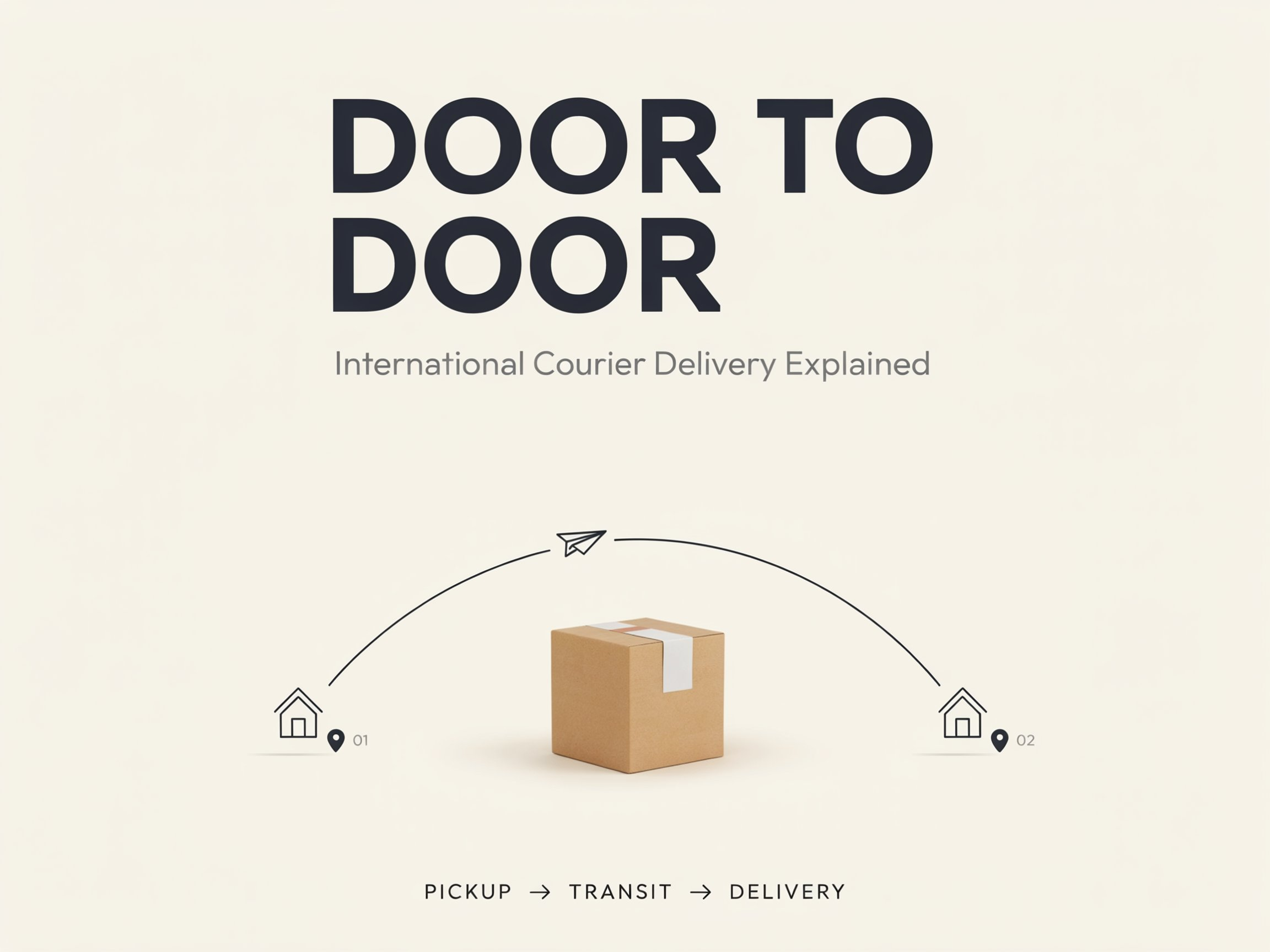
How International Shipping Works
How Door-to-Door International Shipping Works Through Courier Services
Door-to-door international shipping is a comprehensive logistics service where the sender hands over the package to a courier at their address, and the recipient receives it directly at home, in the office, or another specified location. The client does not need to visit sorting centers, international terminals, post offices, or customs points themselves. All major operations—from pickup to delivery—are organized by the courier company.
The modern door-to-door delivery system combines local courier delivery, international transportation, customs clearance, sorting, tracking, and last-mile delivery. This service is suitable for individuals as well as online stores, manufacturers, distributors, and corporate clients.
International courier delivery is particularly in demand for sending documents, product samples, personal belongings, small commercial shipments, gifts, and e-commerce goods. Unlike the traditional scheme where the client delivers the cargo to the acceptance point themselves, the international courier pickup delivery format involves the courier picking up the shipment directly from the sender.
What Does Door-to-Door Delivery Mean?
Door-to-door delivery literally translates to "from door to door." In practice, this means that the carrier accepts the shipment at the sender's address and delivers it to the recipient's address, including all necessary intermediate transportation stages.
The standard service may include:
application for transportation;
pickup of the package by the courier;
checking packaging and accompanying documents;
transportation to the sorting center;
international transportation by air, road, or combined transport;
customs clearance;
transfer of the shipment to a partner service in the destination country;
delivery to the recipient;
notification of delivery.
The main advantage of this model lies in the unified management of transportation. The client interacts with a single operator or coordination center, even if the actual transportation is carried out by multiple divisions and partner companies.
The home delivery logistics system is built around the principle of maximum convenience for the recipient. The courier coordinates the delivery time, can send a notification in advance, clarify the address, or suggest an alternative delivery location. Depending on the country, delivery on weekdays, express delivery, redelivery attempts, and signature collection are available.
It is important to understand that "door-to-door" does not always mean delivery directly to an apartment or office. In some buildings, the courier hands over the shipment at the reception, security service, or entrance. The exact conditions depend on the carrier's rules, the specifics of the address, and the legislation of the destination country.
Main Stages of International Courier Delivery
Application Submission and Cost Calculation
The process begins with providing information about the shipment. Usually, the carrier needs the country and city of origin, recipient's address, weight, package dimensions, description of contents, and estimated value of the goods. For commercial shipments, additional information about the seller, buyer, and cargo destination is required.
The price depends not only on the actual weight. Courier services often use dimensional or volumetric weight, which applies to light but bulky boxes. Therefore, it is important to measure the length, width, and height of the package correctly before placing the order.
The final cost is also influenced by:
urgency of delivery;
selected route;
type of shipment;
presence of cash on delivery;
need for insurance;
customs clearance specifics;
remoteness of the address;
fuel and seasonal surcharges.
After the calculation, the client receives an application number, waybill, or transport document. This must be kept until confirmation of delivery is received.
Pickup of the Shipment from the Sender
The global parcel pickup system allows you to schedule a courier pickup for a specific date. Depending on the operator, you can choose a time window or agree on a specific interval.
Before the courier arrives, the sender must:
prepare the contents;
securely package the goods;
check transportation restrictions;
print the necessary documents;
remove old labels from the box;
make sure that the recipient's address is entered correctly.
The courier may check the number of packages, the condition of the packaging, and the accuracy of the information in the application. If the packaging is damaged or does not adequately protect the contents, the carrier has the right to refuse acceptance or suggest repackaging.
Documents are usually sent in a special envelope. Fragile items are placed with cushioning materials, and liquids are transported only if they meet the requirements for tightness and labeling.
Sorting and International Transportation
After collection, the package arrives at a regional sorting center. There, it is scanned, weighed, sorted by destination, and consolidated with other shipments. The cargo is then sent to an international hub.
Transportation can be carried out by:
air;
road transport;
rail;
sea transport;
multimodal methods.
For urgent shipments, air transport is more commonly used. For less urgent and heavier cargo, ground or combined routes may be applied.
All movements are recorded in the information system. Scanning occurs upon acceptance, sorting, dispatch, arrival in the destination country, transfer to customs, and delivery to the courier. This creates a transparent control chain.
How UPS, DHL, and FedEx Operate in Door Service Format
Major international operators, including UPS, DHL, and FedEx, use a similar operational model but differ in rates, route networks, delivery times, and additional services. Their UPS DHL FedEx door service typically includes pickup, international transportation, tracking, and delivery to the address.
UPS
UPS offers various options for international delivery: from economical solutions to express shipping. Corporate clients have access to integration with online stores, bulk invoice processing, automatic label printing, and return management.
The tracking system is particularly important. Clients can see the status of their shipment, the date of the last scan, the estimated delivery time, and any potential delays. In certain destinations, it is possible to change the address, delivery date, or choose a pickup point.
DHL
DHL is widely known for its extensive international express delivery network. The company handles documents, parcels, commercial samples, and freight for businesses. DHL's services are often chosen for their wide country coverage, reliable customs procedures, and convenient digital tools.
For online stores, solutions for delivering orders to end customers, processing returns, and API integration are available. This helps automate the creation of shipments and transfer order data directly into the logistics system.
FedEx
FedEx offers international express and standard services for both private and corporate shippers. The company focuses on air logistics, tracking, and handling commercial documentation.
When choosing FedEx, it is important to check the availability of the destination, the list of prohibited items, and the invoicing rules in advance. Some categories of cargo may require additional permits, certificates, or proof of product origin.
Regardless of the brand, the final cost and delivery time depend on the specific route. Therefore, it is essential to compare not only the base rate but also fuel surcharges, additional fees for remote areas, customs clearance, insurance, and redelivery.
Customs Clearance for International Shipments
Customs is one of the most important stages of international delivery. Even if the package is small and sent by a private individual, it may require document verification, determination of the product's destination, and calculation of payments.
For commercial shipments, an invoice is usually required. It should include:
product name;
quantity;
price of each item;
total value;
currency;
country of origin;
commodity code;
sender and recipient information;
purpose of the shipment.
The description must be specific. The wording "gift" or "sample" is not always sufficient. It is better to specify the exact name: for example, "cotton t-shirt," "printed advertising materials," "plastic part for equipment."
Customs authorities may request proof of value, contracts, payment documents, recipient's passport details, or import permits. If the documents are incomplete, the package may be delayed.
Depending on the legislation of the recipient's country, they may need to pay:
import duties;
value-added tax;
excise tax;
brokerage fee;
storage fee;
charges for additional customs procedures.
Payment terms should be clarified before shipping. Sometimes the recipient pays the fees, while other times the sender can choose a delivery service that includes taxes and duties in advance.
Tracking Shipments and Managing Delivery
Modern courier end to end shipping involves tracking the shipment at all stages. After placing an order, the client receives a unique tracking number. This can be entered on the carrier's website or in the mobile app.
Typical statuses include:
request created;
courier assigned;
shipment picked up;
received at the sorting terminal;
shipped from the country of origin;
arrived in the destination country;
handed over to customs;
customs clearance completed;
handed over to the courier;
delivery attempt made;
delivered to the recipient.
The status "information received" usually means that the waybill has been created, but the package may still be with the sender. If there are no updates for several days, it is not always necessary to consider the shipment lost immediately: data can sometimes appear with a delay after arriving at the next sorting center.
Issues may arise due to an incorrect address, absence of the recipient, non-working phone number, customs inquiry, or adverse weather conditions. In such cases, the carrier may send a notification with instructions.
Packaging International Shipments
Proper packaging reduces the likelihood of damage, returns, and delays at sorting. The box should match the size of the contents: too much empty space increases the risk of movement inside, while overly tight packaging can become deformed.
For safe packaging, use:
sturdy corrugated box;
bubble wrap;
foam or cardboard inserts;
paper filler;
moisture-proof bag;
reinforced tape;
protective corners;
additional inner boxes.
Fragile items should not touch each other or the walls of the outer box. Liquids should be placed in airtight containers and protected against leakage. Electronics should be additionally protected from static electricity and moisture.
Do not leave old barcodes and address labels on the packaging. The new shipping label should be clearly visible, and the information should be easy to read. Important documents should be placed in a transparent pocket on the outside and duplicated inside.
Prohibited and Restricted Items
Before ordering international delivery, it is necessary to check the list of prohibited and restricted items. This varies by carrier and depends on the legislation of the country of origin and destination.
Commonly prohibited categories include:
explosives;
weapons and ammunition;
narcotics;
flammable liquids;
toxic and radioactive materials;
certain chemicals;
counterfeit products;
live animals;
certain types of plants and seeds;
perishable goods.
Restrictions may apply to batteries, medications, cosmetics, food products, jewelry, cash, and identification documents.
It is prohibited to provide false descriptions of items or artificially lower their value. This can lead to delays, confiscation, fines, denial of insurance claims, and return of the shipment.
If the item falls under a special category, it is advisable to request the carrier's requirements for packaging, labeling, certificates, and permits in advance.
International Delivery Times
The duration of delivery depends on the distance, chosen service, and route conditions. Express shipments can be delivered within a few business days, standard ones take longer, while economical options require additional time.
Factors affecting the duration include:
country and city of destination;
availability of a direct route;
seasonal load;
weekends and public holidays;
customs clearance;
remoteness of the settlement;
weather conditions;
correctness of documents;
need for redelivery.
The specified timeframe is usually approximate. It can be calculated from the moment the package is picked up, handed over to the transport network, or customs clearance is completed. Therefore, it is important to clarify what exactly is included in the stated timeframe.
If the shipment is critically time-sensitive, it is advisable to choose an express service, prepare documents in advance, and not send the package at the last minute. For regular business, it is recommended to allow a buffer for customs and operational delays.
Cost of door to door shipping
The price of international delivery consists of several components. The base rate is usually calculated based on the destination, weight or dimensional weight, and level of urgency.
Additional charges may include:
fuel surcharge;
remote area surcharge;
customs processing;
brokerage services;
insurance;
repackaging;
storage;
re-delivery attempt;
return to sender;
taxes and duties.
To compare offers from different services, it is necessary to use the same initial data. The difference in the base rate may disappear after adding ancillary fees.
For businesses, contractual rates, shipment consolidation, and document flow automation become advantageous. Online stores can connect special solutions for bulk order shipping and receive reports on delivery, returns, and claims.
Delivery for online stores and businesses
International courier services play a crucial role in e-commerce. Customers expect not only a wide selection of products but also a clear delivery timeframe, convenient tracking, and the ability to receive orders at home.
For an online store, an effective logistics system should include:
automatic generation of shipping labels;
transmission of order data to the carrier;
label printing;
customer notifications;
tracking display in the personal account;
status monitoring;
returns processing;
analysis of timelines and costs.
Integration with the courier service's API allows for automatic calculation of shipping costs during order placement. The customer can choose between standard or express options, and the store immediately receives data for shipment preparation.
The last mile is particularly significant—the stage from the local sorting center to the customer's address. This is where issues often arise, such as the absence of the recipient, incorrect address, and changes in delivery time. Therefore, it is helpful to offer the customer notifications, a choice of time slots, and alternative pickup points.
What to do in case of delays, damage, or loss
If delivery is delayed, the first step is to check the latest status and any messages from the carrier. Sometimes, additional documentation or customs fees may be required.
In the case of damaged packaging, the recipient is advised to:
inspect the package before signing;
document damages with photos and videos;
make a note in the courier's documents;
keep the packaging;
contact the sender and carrier;
file an official claim within the specified timeframe.
If the shipment cannot be found, the investigation is usually initiated by the sender, as they are the ones who entered into the transportation contract. To make a claim, tracking number, description of the contents, value of the goods, shipping documents, and proof of payment will be required.
Insurance may compensate for the value of the contents, but the payout depends on the policy conditions, declared value, and availability of evidence of damage or loss. Items prohibited for transport are generally not covered by insurance.
How to choose an international courier service
Before arranging international courier pickup delivery, it is important to compare not only the price but also the entire set of conditions. The main selection criteria include:
availability in the required country;
delivery timeframe;
pickup options at the address;
tracking quality;
customs clearance support;
availability of insurance;
delivery rules for remote areas;
ability to change the address;
return conditions;
availability of Russian-speaking or prompt support.
For documents, speed and proof of delivery are crucial. For online stores—integration, stable rates, and handling returns. For fragile or expensive items—packaging quality, insurance, and the option to request special services.
Before sending a package, it is important to check reviews about the carrier's performance specifically for the desired route. The same company may demonstrate different delivery times and service quality in different countries.
Door-to-door international delivery is not just a separate transportation service, but a complete logistics chain that includes cargo pickup, sorting, international transit, customs clearance, tracking, and delivery to the recipient. The door-to-door delivery system makes shipping convenient, as the customer does not need to monitor each stage independently.
The reliability of delivery depends on proper packaging, accurate addressing, correct description of contents, and timely preparation of documents. When choosing between UPS, DHL, FedEx, and other carriers, it is essential to consider the total rate, product restrictions, delivery times, customs conditions, and quality of last-mile delivery.
For individual shippers, the main advantage remains convenience, while for businesses, it is the ability to build a scalable international logistics system. With proper organization of home delivery logistics and the use of modern tracking tools, courier delivery becomes transparent, predictable, and convenient for both the sender and the recipient.