

 RU
 UA
 DE
 FR
 ES
 CN
 SA
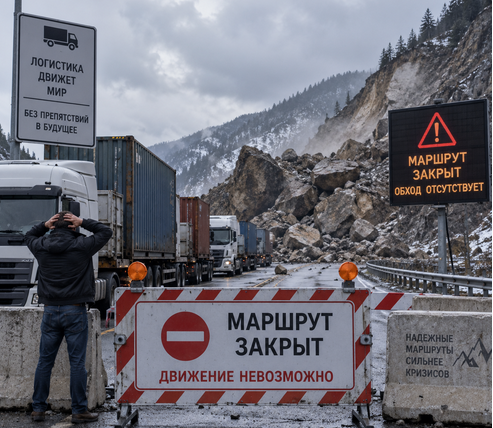
How to Manage Shipments During Sudden Route Closures
How to Manage Shipments When a Logistics Route Suddenly Closes
In international logistics, even a carefully planned route can unexpectedly become unavailable. The reasons can include natural disasters, military conflicts, political restrictions, strikes, accidents, port closures, sanctions, epidemiological risks, cyberattacks, and other circumstances. As a result, the carrier faces the urgent need to change the delivery scheme, organize cargo rerouting, revise timelines, and inform all participants in the supply chain.
A route closure is not just a physical impossibility of transporting goods in a certain direction. It can mean a ban on using a specific border crossing, port, airport, railway corridor, highway, or transit country. Sometimes a route may formally remain open, but actual delivery along it becomes too risky, expensive, or unpredictable.
In such conditions, managing shipments requires a systematic approach. It is important to quickly assess the situation, locate the cargo, identify available alternative routes, check documents, and coordinate further actions with the carrier, freight forwarder, shipper, and recipient. The quicker decisions are made, the less likely there will be prolonged delivery delays, additional costs, and cargo damage.
Monitoring and transportation management platforms, including ship247.world, help obtain up-to-date information about the shipment status, track route changes, and coordinate the actions of logistics chain participants. However, digital tools are effective only when combined with a pre-prepared response plan and professional oversight.
Why Route Closures Become a Serious Problem
Under normal conditions, international transportation is built on a sequential chain of operations: cargo pickup, consolidation, terminal passage, transportation, customs clearance, transloading, and delivery to the final recipient. Disruption of one link can affect the entire logistics system.
If a route suddenly closes, the cargo may end up at an intermediate point with no possibility of further movement. For example, a container has already arrived at the port, but maritime communication has been temporarily suspended. A truck has crossed part of the territory, but the border crossing has been closed. A train is heading to a transit station that no longer accepts trains. In each case, a separate strategy is required.
Main Consequences of Sudden Route Closure
The most obvious consequence is delivery delay. However, the actual damage is usually broader and can include:
increased storage costs at the terminal or warehouse;
payment for vehicle downtime;
changes in transportation rates;
additional costs for transloading;
the need to prepare new documents;
changes in customs procedures;
increased insurance risks;
disruption of production schedules;
penalties for failing to meet contractual deadlines;
loss of clients and reputational costs.
Transporting perishable goods, pharmaceuticals, hazardous materials, live plants, electronics, and expensive equipment is particularly sensitive to route closures. For such shipments, even a small delay can lead to a loss of consumer properties or a significant decrease in value.
Why You Can't Wait Too Long
Sometimes transportation participants hope that the problem will resolve itself. This approach is dangerous. When a key transport corridor closes, available capacities on alternative routes quickly diminish. Freight rates rise, the number of available containers and vehicles decreases, and queues at terminals increase.
Therefore, the decision to reroute cargo should be made not after the situation worsens, but immediately upon receiving reliable information about the risk. Even if the initially chosen route opens soon, having a backup option will help maintain control over the delivery.
Initial Actions After Receiving Information About Route Closure
The main task at the first stage is to avoid chaotic decisions. Any mistake made in the first hours can lead to additional costs and complicate subsequent processing. It is necessary to form an operational group, designate a responsible coordinator, and document all actions.
Verification of Information Accuracy
Information about route closures can come from various sources: the carrier, terminal, broker, government authorities, insurance company, driver, or partner in the transit country. Not all information is complete and up-to-date.
It is essential to check:
which specific section is closed;
whether the restriction applies to all types of transport;
if it is a temporary ban or indefinite;
whether it affects only entry or also exit;
whether transit of goods already on the territory is allowed;
if there are restrictions for specific categories of goods;
whether there are official recommendations for detours;
what the estimated duration of disruptions is.
It is advisable to obtain confirmation from at least two independent sources. It is important to keep official notifications, letters, messages from the carrier, and documents confirming the occurrence of an emergency. This may be required for insurance claims, negotiations with the client, or the application of contract provisions.
Determining the Location of the Shipment
Without accurate information about the cargo's location, it is impossible to choose the correct course of action. It is necessary to establish:
the current terminal or warehouse;
the vehicle's coordinates;
the container or vehicle number;
the customs clearance status;
whether control points have been passed;
whether there is any transshipment or consolidation;
the condition of packaging and seals;
the temperature regime, if required;
the possibility of temporary storage.
If the transportation is monitored through ship247.world or another tracking system, it is necessary to review the movement history, the last update, and the forecast for further movement. In the absence of automatic tracking, information should be requested from the carrier and confirmed in writing.
Documenting the Condition of the Cargo
Before making a decision about redirecting, it is important to ensure that the cargo is in proper condition. If necessary, request photographs, inspection reports, temperature sensor data, and information about the integrity of packaging and seals.
If damages, shortages, or violations of storage conditions are identified, they must be documented before further transshipment. Otherwise, it will be difficult to determine at which stage the problem occurred.
How to Choose an Alternative Route for International Transportation
An alternative route cannot be evaluated solely based on distance. A shorter path is not always the fastest, safest, or most economical. When choosing, it is necessary to consider a comprehensive set of factors: transport infrastructure, customs regulations, availability of capacities, documentation requirements, risks of delays, and the specifics of the cargo.
Criteria for Evaluating an Alternative Route
First and foremost, the following parameters are analyzed:
Actual availability of the route.
It is essential to ensure that the alternative route is indeed open and accepting the required type of cargo.
Capacity.
Even an open corridor can be congested. Queues at borders and terminals can negate the advantages of a new route.
Delivery time.
Consider not only the travel time but also waiting, transshipment, document processing, and possible storage.
Total cost.
The calculation includes freight, fuel charges, terminal services, storage, documentation, insurance, and possible fees for route changes.
Customs requirements.
Crossing new borders may require additional permits, certificates of origin, licenses, and transit declarations.
Safety.
It is necessary to assess political, criminal, climatic, and infrastructure risks.
Compatibility with the type of cargo.
There are fewer options available for hazardous, temperature-sensitive, oversized, and valuable shipments.
Reliability of partners.
It is important to check the carrier's experience, availability of transport, insurance coverage, and ability to operate in crisis conditions.
Possible Options for Redirecting Cargo
Depending on the circumstances, various solutions are used:
detouring the closed section by road;
changing the port of departure or arrival;
switching from sea transport to rail;
using a multimodal scheme;
temporary storage in a warehouse;
returning the cargo to the sender;
shipping a partial shipment via a different channel;
changing the border crossing;
consolidation with another shipment;
delivery to an intermediate hub with subsequent transfer.
Sometimes, the optimal solution is not a single route, but a combined strategy. For example, the urgent part of the shipment is sent by air transport, while the main volume is transported by sea or rail. This approach helps maintain a balance between speed and cost.
Redirecting Cargo: Step-by-Step Procedure
Redirecting cargo is not just instructing the driver to go in a different direction. Changing the route may require adjustments to the contract, shipping documents, customs declaration, insurance certificate, and delivery instructions.
Agreeing on a New Plan
First, a new transport plan is created. It includes:
the point where the route changes;
the new destination;
type of transport;
list of transshipments;
responsible parties;
estimated timelines;
storage procedures;
safety requirements;
cost of additional services;
procedure for informing the recipient.
The plan must be agreed upon with the sender and recipient. If the cargo is under customs control, a customs representative must be involved. When transporting hazardous goods or products requiring special conditions, specialized professionals are additionally engaged.
Document Verification
Before sending in the new direction, it is necessary to check:
the transport waybill;
the bill of lading or railway waybill;
commercial invoice;
packing list;
certificates;
permits;
transit documents;
insurance policy;
documents for transshipment;
instructions for the carrier.
Changing the transit country may affect labeling requirements, product origin, classification codes, and permits. Insufficient verification can lead to cargo being stopped at the border and increased delivery delays.
Control of Transshipment and Storage
If the shipment is transferred to another mode of transport, it is necessary to reserve the terminal, warehouse, or site in advance. It should be determined who is responsible for counting the items, checking the packaging, photo documentation, maintaining seal integrity, and adhering to temperature conditions.
With each change in physical location, data in the control system must be updated. At ship247.world, you can use information about the current status of the shipment and the sequence of operations to reduce the risk of losing sight of the cargo.
How to Minimize Delivery Delays During a Logistics Crisis
Completely eliminating delays due to sudden route closures is usually impossible. However, their duration and financial consequences can be significantly reduced. To achieve this, it is necessary to prepare response scenarios in advance and quickly transition from analysis to practical actions.
Creating Backup Routes
For each significant direction, it is advisable to have at least two alternative options. They should not be formal but verified: with preliminary assessments of rates, timelines, documents, and available carriers.
It is useful to identify in advance:
backup ports and terminals;
alternative border crossings;
backup freight forwarders;
warehouse facilities;
options for changing modes of transport;
delivery procedures for the urgent part of the shipment;
contact persons in transit countries.
Having such a database reduces decision-making time and helps avoid working under complete uncertainty.
Segmenting Cargo by Urgency
Not all goods require the same approach. The shipment can be divided into categories:
critically urgent goods;
products with a limited shelf life;
valuable items;
standard goods;
cargo that can be temporarily stored.
Urgent items are sent via the fastest route, even if it is more expensive. The rest of the shipment can follow a more economical method. This allows avoiding overpaying for the transportation of the entire volume.
Constant Communication
During a crisis, silence creates more problems than the delay itself. The sender and recipient must understand what is happening with the cargo, what decisions are being considered, and when the next checkpoint will be.
It is recommended to establish a regular update schedule:
confirmation of route closure;
notification of cargo location;
description of available options;
calculation of timelines and costs;
confirmation of the agreed decision;
information about transshipment;
new arrival forecast.
Information must be accurate and verified. Do not promise timelines that are not confirmed by the carrier or terminal.
Using Digital Systems for Shipment Monitoring
Modern logistics is impossible without digital tracking. In non-standard situations, tracking systems allow for quicker understanding of where the cargo is, how long it has been stationary, and what operations have already been completed.
Key Data to Monitor
For effective shipment management, it is essential to see:
the last geolocation;
time taken to pass checkpoints;
status of the vehicle;
planned and actual schedule;
information on downtime;
temperature and humidity;
seal conditions;
route changes;
documents and comments from participants.
Integrating data into a single system reduces the risk of errors associated with disparate spreadsheets, emails, and phone messages. The platform ship247.world can be used as one of the tools for monitoring shipment movements and coordinating actions when the logistics scheme changes.
Benefits of Digital Monitoring
The main benefits include:
early detection of deviations;
automatic notifications;
transparency for the client;
quick route comparisons;
deadline control;
reduction of manual operations;
report generation;
recording of transportation history.
However, the digital system does not replace the work of specialists. If data is delayed or the carrier does not update the status, manual verification is required. A reliable management model combines automatic monitoring, document control, and direct communication with transportation participants.
Working with Clients During International Shipping Delays
Delivery delays are not only an operational issue but also a commercial one. The quality of communication determines whether the client will maintain trust in the carrier or freight forwarder.
How to Communicate the Problem
Information should be conveyed immediately after confirming a significant risk. The message should ideally include:
the reason for the delay;
the affected segment;
current location of the cargo;
status of the shipment;
possible courses of action;
preliminary impact on timelines;
additional costs;
date of the next update.
Avoid vague phrases like “the situation is being clarified” if specific facts can be provided. Even the absence of a final decision can be explained openly: for example, indicate which routes are being checked and when a new estimate will be ready.
Agreeing on Additional Costs
Redirecting cargo often requires additional payments. These may include:
new freight;
terminal handling;
storage;
transshipment;
customs clearance;
changes in insurance coverage;
vehicle downtime;
express delivery of part of the shipment.
All expenses should be justified and agreed upon before they arise, if the situation allows. In emergencies, subsequent documentation is crucial: requests, acts, invoices, correspondence, and confirmations of actual services.
Managing Expectations
The main mistake is to specify an exact delivery date without sufficient grounds. It is better to present several scenarios:
optimistic;
baseline;
unfavorable.
For each scenario, specify the conditions under which it is possible. This approach helps the client adjust warehouse, production, and sales plans in advance.
Insurance and Liability When Closing a Route
A logistics crisis can lead to damage, loss, or total destruction of cargo. Therefore, insurance issues must be considered simultaneously with organizing a new route.
What to Check in the Insurance Policy
It is important to review:
the list of insured risks;
the coverage territory;
conditions for route changes;
notification procedure for the insurer;
storage requirements;
transloading rules;
exclusions for military and political risks;
application submission deadlines;
list of supporting documents.
Unauthorized route changes without notifying the insurance company may affect the ability to receive compensation in some cases. If a decision is made to redirect, the insurer must be informed of the cargo's location, the reason for the route change, and what security measures are being implemented.
Documenting Circumstances
To protect the company's interests, it is essential to keep:
official notifications of route closures;
letters from carriers;
monitoring data;
inspection reports;
photographs;
documents regarding downtime;
storage confirmations;
new transport documents;
invoices and receipts;
correspondence with the client.
The more comprehensive the evidence base, the easier it is to determine responsibility and justify additional costs.
How to Prepare for Future Logistics Crises
The reliability of international shipping is determined not only by the ability to respond quickly but also by the level of prior preparation. Companies that model crisis scenarios in advance recover their deliveries faster and are less dependent on random decisions.
Developing a Transportation Continuity Plan
The plan should outline actions for different types of disruptions:
port closure;
border blockage;
inaccessibility of the railway corridor;
transport shortages;
sudden tariff increases;
terminal shutdown;
cargo damage;
information system failure;
introduction of new restrictions.
For each scenario, responsible individuals, decision-making timelines, backup carriers, available warehouses, and client notification procedures should be specified.
Diversifying the Logistics Network
Dependence on a single route, supplier, or mode of transport increases business vulnerability. It is advisable to spread risks across:
multiple carriers;
different ports;
several transit countries;
road, sea, rail, and air transport;
multiple warehouse locations.
Diversification may slightly increase regular expenses, but during a crisis, it allows for the continued movement of goods and avoids a complete halt in deliveries.
Regular Route Review
An alternative route that existed a year ago may no longer be available due to changes in legislation, tariffs, infrastructure, or political situations. Therefore, routes need to be reviewed regularly.
Aspects to be checked include:
actual timelines;
rates;
capacity;
document requirements;
quality of terminal handling;
reliability of partners;
delay statistics;
availability of insurance coverage.
A sudden closure of a logistics route can disrupt even a well-organized international shipment. However, a competent management system can mitigate the consequences and maintain control over the shipment. Key actions include verifying information, establishing the exact location of the cargo, assessing its condition, selecting an alternative route, coordinating documents, and continuously informing the client.
Redirecting cargo should not be done spontaneously but according to an approved plan. It is essential to consider transport, customs, financial, insurance, and commercial factors. For urgent goods, a multimodal scheme or splitting the shipment by importance is justified. For standard shipments, a more economical but longer option can be chosen.
Digital tools, including ship247.world, help track shipment status, identify deviations, and coordinate the actions of logistics chain participants. However, maximum effectiveness is achieved when monitoring is complemented by backup routes, verified partners, quality documentation, and a pre-developed action plan.
The main principle of transportation management in crisis conditions is to act quickly, transparently, and consistently. The sooner a company receives reliable information and initiates a redirection scenario, the higher the likelihood of meeting deadlines, reducing costs, and ensuring safe delivery of the cargo.