

 RU
 UA
 DE
 FR
 ES
 CN
 SA
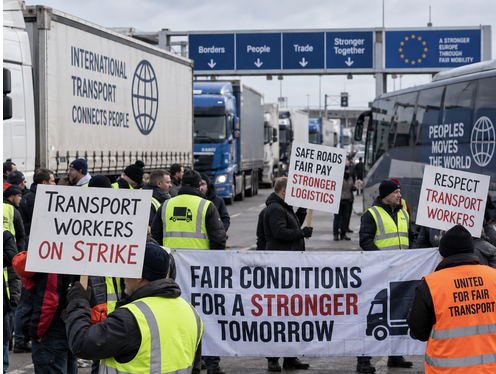
How Transport Workers' Strikes Affect International Shipping
How Strikes by Transport Workers Affect International Shipping
International freight transportation depends not only on the condition of transport, weather conditions, and the work of customs services. One of the most serious risk factors is strikes by transport workers. Truck drivers, port employees, railway workers, airline staff, dispatchers, warehouse operators, and terminal workers ensure the movement of goods at every stage of the logistics chain. If even one link temporarily stops working, the consequences quickly spread to carriers, freight forwarders, manufacturers, retail chains, and end customers.
Strikes can be local, affecting a single terminal; regional, spreading to several transport hubs; or large-scale, paralyzing the operations of an entire industry or multiple countries. In the context of global trade, even a brief halt leads to cargo accumulation, a shortage of transport capacity, increased shipping costs, and longer delivery times.
For companies that regularly use international freight transportation, it is important to assess logistics risks in advance, monitor news, and have backup routes. Planning is especially relevant for urgent, perishable, high-value, and seasonal goods. Tracking services, including ship247.world, help provide up-to-date information on cargo movements, route changes, and potential delivery delays.
Why Strikes by Transport Workers Are a Serious Problem
A strike is an organized cessation or limitation of work activities aimed at achieving specific demands. In the transport sector, the reasons for protests can include issues related to wages, working conditions, working hours, safety, social guarantees, pension provisions, or changes in labor legislation.
Unlike a production halt at a single enterprise, strikes in the transport sector affect many market participants at once. Transport workers service the infrastructure through which international freight flows pass. If port employees stop working, maritime vessels cannot be loaded and unloaded on time. If drivers strike, cargo remains in warehouses or terminals. When railway services are halted, the delivery of containers between ports, distribution centers, and industrial zones is disrupted.
The transport sector is characterized by its high interdependence. Road, sea, rail, and air transport are interconnected. A container arriving at a port must be delivered by truck or train to a warehouse. Then, the product can be shipped to another city or country. If one segment of the chain stops working, the schedule for all subsequent operations changes.
Main Reasons for Strikes in the Transport Sector
The most common reasons include:
demand for wage increases;
disagreement with increased working hours;
lack of rest for drivers and crews;
unsatisfactory working conditions;
increased workload without appropriate compensation;
job cuts;
implementation of automated systems;
disputes over pension reforms;
demand for enhanced safety;
disagreement with changes in tariffs and transportation rules.
A strike can be pre-announced or sudden. In the first case, logistics companies have the opportunity to redistribute cargo flows and adjust shipping schedules. Sudden protests create much more problems: carriers do not have time to prepare alternative routes, and consignees learn about delays only after the schedule has been disrupted.
How Strikes Affect International Freight Transportation
The consequences of strikes depend on the location, duration, and number of workers involved. Sometimes a work stoppage lasts only a few hours and has little impact on transportation. However, even a short protest at a strategically important port or a major border crossing can cause delays for several days.
International shipments are particularly vulnerable because they involve a large number of operations: booking transport, document processing, customs clearance, loading, transshipment, warehousing, and delivery to the final recipient. When one stage is disrupted, subsequent operations must be postponed.
Delivery Delays and Increased Shipping Times
The most obvious consequence of a strike is delivery delays. Cargo may remain at the port, terminal, railway station, temporary storage warehouse, or in the vehicle. In this case, the carrier may not always be able to provide an exact date for the resumption of operations.
Shipping times increase for several reasons:
previously arrived cargo accumulates;
the number of available transport options decreases;
queues form for loading and unloading;
the schedules of ships, trains, and planes change;
the operations of customs and warehouse services are disrupted;
a new route needs to be coordinated;
additional checks of documents and cargo arise.
Even after the strike ends, the transport system does not return to normal operation immediately. Terminals require time to process the accumulated containers and restore the standard schedule. Therefore, the actual delivery delay often turns out to be significantly longer than the duration of the strike itself.
Increase in Freight Costs
When part of the transport capacity becomes unavailable, the demand for alternative options increases. Carriers may raise rates for road, sea, rail, and air transportation. Additional costs also arise from storage, vehicle downtime, re-documentation, transloading, and route changes.
Companies may face the following expenses:
payment for cargo storage;
fines for container downtime;
additional port fees;
cost of expedited shipping;
payment for alternative transport;
insurance costs;
compensation to clients for missed deadlines;
costs for reissuing documents.
For expensive or urgent goods, air delivery is sometimes used instead of sea or rail transport. This reduces transit time but significantly increases the logistics budget. If the company has not set aside a reserve fund, unforeseen expenses can substantially reduce the profitability of the deal.
Impact of Strikes on Different Modes of Transport
Strikes affect road, sea, rail, and air transport differently. In practice, they are often interconnected: when one mode of transport stops, the load on the others increases.
Road Transport
Truck driver protests can lead to road blockages, border checkpoints, logistics centers, and distribution warehouses. Even if only part of the workforce is on strike, traffic can slow down due to increased checks, closures, and a lack of available crews.
Transport in Europe is particularly sensitive to such disruptions, where trucks cross several borders daily. A delay on one segment of the route disrupts the schedule for further deliveries. A driver may run out of allowed working hours, necessitating an additional stop or crew change.
Road transport is characterized by the following consequences:
queues on roads and at checkpoints;
increased border crossing times;
cancellations of trips;
driver shortages;
increased freight rates;
temperature control violations;
additional costs for parking and crew meals.
Challenges are particularly evident when transporting perishable goods, medications, flowers, and other items that require strict adherence to timelines and storage conditions.
Sea Transport and Port Operations
Port strikes are considered one of the most dangerous for global logistics. The port is a major hub through which thousands of containers, vehicles, ships, and trains pass. If terminal staff stop working, ships cannot be unloaded on time, and containers begin to accumulate at the anchorage and docks.
Even with partial port operations, congestion occurs. Shipping lines are forced to change schedules, skip the port, or redirect ships to another terminal. This leads to route changes, increased transit times, and additional costs.
Possible consequences of a port strike include:
cancellations of ship calls;
redirecting containers;
increased sea freight costs;
container shortages;
document delays;
increased unloading times;
cargo accumulation in warehouses;
disruptions in the operations of rail and road terminals.
The problem may persist even after the protest ends. Terminals have to handle a large volume of accumulated containers, so the schedule for ships and ground transportation is gradually being restored.
Rail Transportation
Rail strikes disrupt the supply of raw materials, industrial equipment, containers, and bulk cargo. Railroads are often used to transport goods between ports, manufacturing centers, and distribution hubs. When operations are halted, cargo may end up in the port without the possibility of further dispatch.
Protests on international highways pose a particular danger. If a train does not cross the border on schedule, it disrupts the timing for wagon deliveries, alters container processing windows, and causes congestion at stations.
Companies are forced to choose between waiting for operations to resume and switching to road transport. The latter option may be faster, but it is usually more expensive, and the available capacity is limited.
Air Transportation
Strikes by airport workers, airline staff, ground services, and control centers affect the transport of urgent and high-value cargo. The cancellation or rescheduling of a flight can disrupt the delivery of components, medical devices, electronics, and other high-value products.
Air transportation has limited capacity, so after flight cancellations, a shortage of available space quickly arises. Cargo has to be transferred to subsequent flights, sent through another airport, or combined with road delivery.
Logistical Risks for Businesses
Transport worker strikes are considered external logistical risks that cannot be completely eliminated. A company cannot directly control the actions of unions, government agencies, or terminal employees. However, businesses can mitigate the impact through preparation and diversification.
The main risks include:
breach of contractual deadlines;
production stoppage due to raw material shortages;
disruption of deliveries to customers;
increased cost of goods;
damage or loss of cargo;
increased inventory levels;
decreased customer trust;
contract penalties;
cash flow disruptions;
loss of competitive advantages.
Risk of Cascading Delays
The most challenging situation arises when one delay triggers a chain of new problems. For example, if a container is not unloaded from a ship, the truck does not receive the order. As a result, the delivery of goods to the warehouse is disrupted, and the warehouse cannot fulfill the shipment to the customer. Consequently, production plans, retail deliveries, and marketing campaigns are shifted.
Cascading delays are particularly dangerous for companies operating on a "just-in-time" model. With minimal inventory levels, even a slight deviation from the schedule can halt production.
How Companies Can Prepare for Strikes
It is impossible to completely eliminate the impact of strikes, but it can be reduced. To do this, it is necessary to develop a logistics risk management plan in advance. This plan should consider potential failure points, alternative routes, switching timelines, and financial constraints.
Diversification of Routes and Carriers
It is not advisable to build the entire logistics chain around a single port, carrier, or border crossing. It is preferable to have several delivery options:
an alternative port;
a backup rail terminal;
another border crossing point;
a reserve road carrier;
the possibility of temporarily using air delivery;
a warehouse in another region.
Diversification may increase current costs, but during a large-scale strike, it helps maintain the continuity of supplies.
Creating a Safety Stock
For critical goods, it is necessary to calculate a safety stock. Its volume depends on the stability of the route, production time, product shelf life, and the potential duration of delays.
A safety stock does not completely solve the problem, but it allows businesses to survive the initial days of disruption without halting production or facing product shortages. It is important to regularly review its size, as transportation situations and international trade conditions change.
Monitoring the Transportation Situation
Companies should monitor not only the fact of a strike's onset but also its potential impact on specific cargo. It is essential to know where the goods are, whether they have passed through the terminal, if the route has changed, and if there is a risk of deadline violations.
Monitoring platforms, including ship247.world, can be used to track cargo movements and obtain up-to-date information on shipment status. The sooner a company learns about a delay, the more opportunities it has to change the route, notify the client, and prepare warehouse operations.
The Role of Digital Services in Transportation Management
Modern logistics increasingly relies on digital tools. They allow for the integration of information about orders, transportation, documents, routes, and delivery times into a single system. This is especially important during strikes when standard schedules change rapidly.
Digital solutions help:
track the location of cargo;
monitor transportation stages;
identify deviations from the route;
receive notifications about delays;
analyze carrier performance;
compare alternative routes;
plan warehouse operations;
calculate estimated arrival times.
Services like ship247.world can be beneficial as part of a comprehensive system for monitoring international freight transportation. However, digital monitoring does not replace the work of logistics professionals. The information obtained must be analyzed and used for decision-making.
Why It’s Important to Receive Information in Advance
A late response significantly increases the cost of mitigating consequences. If a company learns about a problem after the cargo has arrived at a blocked port, the options for alternatives will be limited. However, if the information is received during the planning stage of the shipment, it is possible to change the loading port, select a different route, or postpone the shipping date.
Being forewarned allows for:
coordinating new timelines with the client;
redistributing goods between warehouses;
ordering additional transportation;
modifying insurance conditions;
avoiding penalties;
preparing documents;
choosing the optimal delivery method.
How Strikes Affect Shipping and Cargo Receipt Times
The shipping timeline includes not only the time taken for the goods to move but also the preparation of documents, transportation submission, loading, passing through terminals, and customs clearance. A strike can impact any of these stages.
If a protest begins before loading, the shipment is postponed. If the cargo is already in transit, it may stop at an intermediate terminal. If a problem arises before delivery to the recipient, the storage time increases and the unloading date changes.
It is important to consider several time intervals:
the period of the actual strike;
the time to form a queue;
the recovery period;
the time required to process accumulated cargo;
the time for rescheduling;
the potential period of transportation shortages.
Therefore, assessing the consequences solely based on the duration of the protest is incorrect. A strike that lasted two days can affect deliveries for a week or even longer.
Contracts, Liability, and Insurance
International freight transportation is accompanied by contracts that specify delivery timelines, the responsibilities of the parties, and force majeure circumstances. A strike may be recognized as a force majeure event, but this depends on legislation, the terms of the contract, and the specific situation.
It is important for companies to check in advance:
whether strikes are included in the list of force majeure events;
who bears the cost of delays;
how storage costs are allocated;
whether the carrier is obligated to offer an alternative route;
the timeframe for notifying the counterparty;
which documents confirm the fact of the delay.
Cargo insurance also requires careful examination. Not every insurance policy covers losses caused by delivery delays, strikes, or political risks. Sometimes such conditions are arranged separately.
Proper contractual work helps reduce financial losses and avoid disputes between the shipper, carrier, and recipient.
Practical Recommendations for Shippers
To minimize the impact of transportation worker strikes, shippers should:
Before Shipping
check the situation at ports, airports, and borders;
assess the reliability of the chosen route;
have at least one backup option;
build in a time buffer;
coordinate acceptable timelines with the client;
check insurance coverage;
prepare a complete set of documents;
use monitoring systems.
During Transportation
regularly track the status of the cargo;
maintain communication with the carrier;
respond promptly to alerts;
inform the recipient of any potential changes;
consider redirecting the cargo;
monitor the temperature conditions;
document all additional expenses.
After the Strike Ends
clarify the actual processing schedule;
not expect an immediate return to normal operations;
book transportation in advance;
check the condition of the cargo;
analyze the reasons for delays;
update the internal risk management plan.
Strikes by transport workers are one of the most serious factors affecting international shipping. They can disrupt the operations of ports, airports, railways, road routes, and warehouse terminals. The main consequences include delivery delays, extended shipping times, increased freight costs, transportation shortages, and the emergence of additional logistics risks.
Even after the protest ends, shipments do not always return to the normal schedule immediately. Accumulated cargo, queues, altered schedules, and a shortage of transport capacity can continue to be influenced by the strike for several days or weeks.
Companies engaged in international trade must prepare in advance for such scenarios. Diversifying routes, maintaining safety stock, having backup carriers, clear contracts, and constant monitoring help mitigate damage. Digital control services, including ship247.world, play an important role by allowing for cargo tracking and quicker responses to changes.
Well-organized logistics do not eliminate external threats but make the business more resilient. The sooner a company receives information about a strike and potential delivery delays, the more opportunities it has to maintain timelines, control costs, and ensure stability in international freight transportation.