

 RU
 UA
 DE
 FR
 ES
 CN
 SA
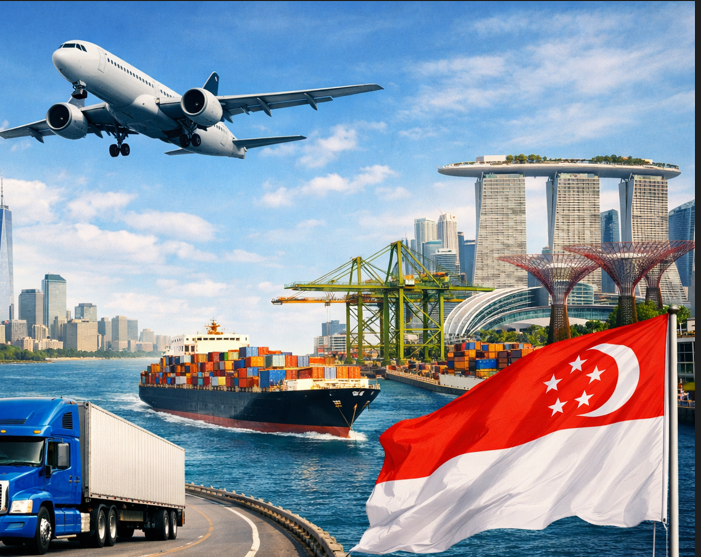
Delivery Logistics from Singapore
Logistics of Delivery from Singapore and Its Role in Asian Trade
Singapore is considered one of the most significant logistics hubs in the world. Despite its small territory, the country occupies a strategic position at the crossroads of major sea and air routes connecting East Asia, Europe, the Middle East, and other regions. With its developed infrastructure, digital technologies, high port capacity, and international airport, delivery from Singapore has become a sought-after solution for both businesses and individual shippers.
Large flows of goods from China, Malaysia, Japan, South Korea, Vietnam, Indonesia, and other countries pass through Singapore. Here, cargo is consolidated, transit shipments are processed, international parcels are sorted, and routes to Europe, North America, Australia, and the CIS countries are formed. Therefore, logistics Asia hub is often associated with the Singapore model of organizing transportation.
For online stores and companies, not only speed but also predictability of delivery, tracking options, various tariff availability, and clear customs regulations are important. In this regard, Singapore Post international, courier services, and freight forwarding companies offer a wide range of solutions: from inexpensive standard shipping to urgent express delivery from Singapore.
Why Singapore Became Asia's Logistics Hub
The main reason for Singapore's success is its geographical location. The country is located near the Strait of Malacca, through which a significant portion of the world's maritime cargo traffic passes. This route connects the Indian and Pacific Oceans and is used by vessels traveling between the ports of Asia, Europe, and the Middle East.
In addition to geography, government policy has played an important role. In Singapore, port terminals, airport infrastructure, warehouse complexes, customs services, and digital cargo management systems have been consistently developed. As a result, carriers can quickly process documents, transship goods, and direct them further without long delays.
Port of Singapore
The Port of Singapore is one of the largest container ports in the world. Its terminals serve vessels of various types, including large container ships, oil tankers, and specialized cargo vessels. The port performs several functions:
it accepts international container lines;
it facilitates cargo transshipment between vessels;
it processes transit shipments;
it handles imports and exports;
it provides warehousing and forwarding services;
it connects Asian routes with European and American directions.
The transit role is especially important for logistics Asia hub. In Singapore, cargo may not be intended for the domestic market. It arrives at the terminal, is processed, and is sent further as part of another route. This scheme is convenient for companies that collect goods from several suppliers and want to consolidate them into one shipment.
Changi International Airport
Air freight transport through Singapore usually goes through Changi Airport. It is known for its high capacity, automated processing systems, and a large number of regular flights. Air delivery is used for:
documents;
product samples;
electronics;
high-value goods;
medical devices;
small parcels;
urgent commercial shipments.
If speed is important to the sender, express delivery from Singapore is most often carried out by air transport. The final timeframe depends on the destination country, the carrier's operations, customs clearance, and last-mile specifics.
Delivery from Singapore: Main Options
Delivery from Singapore can be organized in several ways. The choice depends on the weight, dimensions, value of the goods, urgency, tracking requirements, and destination country. For private clients, postal and courier services are usually the most suitable. Businesses use consolidated cargo, air transport, sea containers, and multimodal solutions.
Postal Delivery via Singapore Post International
Singapore Post International is the international direction of Singapore's national postal operator. It handles letters, documents, small parcels, and commercial shipments. Depending on the chosen tariff, the following options may be available:
basic shipping without detailed tracking;
registered shipment;
accelerated international delivery;
parcel delivery with declared value;
additional services for delivery confirmation.
The postal option is often chosen for small and not very urgent shipments. Its advantage lies in the wide geographical coverage and the ability to transfer parcels to national operators in the destination country. A disadvantage may be the longer delivery time compared to international courier companies.
Before shipping, it is necessary to check the restrictions on contents. Postal operators usually do not accept prohibited substances, certain types of batteries, weapons, flammable materials, perishable goods, and specific categories of electronics. The list of restrictions may vary depending on the destination country.
Express Delivery Singapore
Express delivery Singapore is in demand when the shipment needs to be received as quickly as possible. Such transportation is carried out by international courier operators and specialized logistics companies. They typically offer:
pickup of the cargo at the address;
packaging or packaging inspection;
air transportation;
customs clearance;
door-to-door delivery;
online tracking;
support for the sender and recipient.
The express delivery time can range from a few business days to a week; however, the exact figures depend on the destination. For remote regions, complex customs procedures, and non-standard cargo, the time increases.
The express format is not always the most cost-effective. The rate is calculated based on actual and dimensional weight, so a large lightweight box may cost more than a compact heavy shipment. Before placing an order, it is advisable to compare several offers and clarify whether fuel surcharges, customs clearance, and delivery to remote areas are included in the price.
Shipping from Singapore: How International Transportation is Formed
The request for shipping from Singapore is usually associated with sending goods from Singapore to another country. This transportation includes several stages: preparing the goods, choosing the route, preparing documents, transferring the cargo to the carrier, international transportation, customs clearance, and delivery to the recipient.
Preparing the Package
Quality packaging reduces the risk of damage to the goods. This involves using a sturdy box, cushioning materials, a moisture-resistant layer, and reliable tape. Fragile items are additionally secured inside the packaging to prevent movement during sorting.
The sender's and recipient's addresses, contact details, postal code, destination country, and, if required, identification number should be indicated on the outside of the shipment. Errors in the address can lead to delays, returns, or additional clarifications.
Customs Declaration
A declaration is usually required for international parcels. It should include:
an accurate description of the contents;
the quantity of items;
the value;
the weight;
the country of origin;
the purpose of the goods;
the commodity code, if necessary.
It is not acceptable to replace an accurate description with general terms like "gift," "samples," or "goods." Customs authorities need to understand what is inside the shipment and its actual value. Inaccurate information can lead to delays, charges, or returns.
Choosing the Route
The route for shipping from Singapore can be direct or combined. A direct flight usually ensures a shorter time but is more expensive. A consolidated or transit route reduces costs but increases the number of processing stages.
Multimodal schemes are often used for commercial cargo. For example, goods are delivered by sea to a European port, then transported by road to a warehouse or the final recipient. For small batches, air transportation may be used, followed by delivery by national postal services.
Parcel from Singapore: Tracking and Movement Control
A parcel from Singapore usually receives a unique tracking number. This allows tracking of the main stages of movement: acceptance of the shipment, sorting, transfer for export, departure, arrival in the destination country, customs clearance, and delivery.
Tracking SingPost
Tracking SingPost is the tracking service for shipments from Singapore Post. To check the status, you need to enter the tracking number on the operator's official website or in a universal tracking system. For international shipments, the number often consists of letters and numbers and may correspond to UPU standards.
Statuses may be displayed in English. The most common options have the following meanings:
Accepted — the shipment has been accepted;
Item processed — the package has been processed at the sorting center;
Item dispatched — the shipment has been sent further;
Departure from outward office of exchange — the package has left the export sorting center;
Arrival at inward office of exchange — the shipment has arrived in the destination country;
Held by customs — the package is under customs control;
Out for delivery — the shipment has been handed over to the courier or postal worker;
Delivered — the package has been delivered.
Sometimes the status does not change for several days. This does not necessarily indicate a problem. Information may only be updated after passing a checkpoint or transferring the shipment to another operator. Delays are especially common during international flights, transit sorting, and customs clearance.
What to do if tracking SingPost is not updating
First, check the accuracy of the tracking number and ensure it is entered without spaces or extra characters. Then consider the declared delivery time. If the shipment is still within the established period, the absence of new records usually does not require immediate action.
If the time significantly exceeds the expected delivery, you can:
contact the sender;
request information from Singapore Post;
check the number on the website of the national operator in the destination country;
clarify whether customs information is required from the recipient;
file an official inquiry if provided for in the tariff.
Shipping Singapore to Europe
Shipping Singapore to Europe includes numerous destinations and can vary significantly in terms of time and cost. Europe consists of countries with different customs regulations, tax regimes, and import requirements. Therefore, the route to Germany, France, Italy, the Netherlands, or Eastern European countries may be processed under different schemes.
Airmail and Courier Services
Airmail is most commonly used for small packages. It is suitable for clothing, accessories, documents, souvenirs, household goods, and products that do not require special transport conditions. Courier delivery offers higher speed and usually includes door-to-door service.
When shipping to Europe, it is important to clarify in advance who is responsible for import clearance. In some cases, duties and taxes are paid by the sender, while in others, they are paid by the recipient. If these conditions are not defined, the package may be delayed until the accrued fees are paid.
Sea Freight to Europe
Sea transport is used for large shipments of goods, pallets, and containers. It is more cost-effective than air freight for significant volumes but takes more time. The timeframe includes not only the vessel's transit but also cargo consolidation, port operations, document processing, unloading, and subsequent land delivery.
For businesses, sea freight Singapore to Europe often becomes optimal for regular shipments. Companies can plan inventory in advance, reserve space in containers, and reduce the cost per unit of goods.
Customs Considerations
When shipping to European countries, it is necessary to prepare a commercial invoice, packing list, transport documents, and information about the product's origin. For certain categories, certificates of conformity, permits, safety declarations, or documents on product composition may be required.
Special attention is given to products with batteries, cosmetics, food items, medical devices, electronics, and products made from animal or plant materials.
Logistics for Online Stores and Businesses
Singapore is convenient not only as a shipping point but also as a regional distribution center. Companies can set up warehouses here, receive goods from Asian manufacturers, consolidate them, and send them to customers in various countries.
Cargo Consolidation
Consolidation allows combining several small shipments into one. For example, goods from different suppliers arrive at a warehouse in Singapore, where they are checked, counted, repackaged, and combined. After this, a single cargo is formed.
The advantages of this scheme include:
reduced transportation costs;
fewer individual customs procedures;
the ability to control quality;
single packaging;
simplified accounting;
convenient distribution by direction.
Fulfillment
Fulfillment operators can store products, process orders, print labels, assemble packages, hand them over to Singapore Post international or courier services, and track deliveries. This is especially convenient for online stores that sell products in multiple countries at once.
When choosing a partner, it's important to assess the availability of integration with CRM and marketplaces, order processing speed, storage rules, return costs, and the ability to use different shipping channels from Singapore.
How much does shipping from Singapore cost
The price depends on several factors:
the weight and dimensions of the package;
dimensional weight;
destination country;
chosen carrier;
urgency;
delivery method;
declared value;
need for insurance;
product characteristics;
distance to the address.
Postal delivery is usually cheaper than express shipping, especially for small packages. However, a lower price may come with a longer delivery time and limited compensation in case of loss.
Express delivery from Singapore is more expensive but provides a faster route, detailed tracking, and courier delivery. For businesses, costs can also decrease through corporate contracts, regular volumes, and consolidation.
To make a fair comparison, it is necessary to consider not only the base rate. The final amount may include fuel surcharges, packaging, cargo pickup, customs clearance, taxes, duties, and delivery to remote areas.
Customs, taxes, and restrictions
An international package from Singapore may be subject to import fees in the destination country. The procedure depends on the value, type of goods, destination of the shipment, and local legislation.
The recipient may need:
identification document;
proof of value;
invoice or receipt;
product description;
permitting documents;
information about the product's origin.
Do not artificially undervalue the cost. Customs may request proof of price, and if the information does not match, the shipment may be delayed. Additionally, undervaluation can lead to issues with insurance claims.
Before shipping, it is essential to check the restrictions of the destination country. Even if the product is allowed to be shipped from Singapore, its import may be prohibited or restricted in another country.
How to speed up shipping from Singapore
To shorten delivery times, it is necessary to prepare documents in advance and choose the appropriate shipping channel. Key recommendations include:
checking the accuracy of the address and postal code;
using quality packaging;
accurately describing the contents;
stating the actual value;
studying customs regulations in advance;
choosing a rate with full tracking;
avoiding the shipment of prohibited items;
providing the recipient's phone number and email;
considering holidays and weekends;
keeping the receipt and tracking number.
For urgent cargo, it is better to use express delivery with guaranteed acceptance and courier support. If cost-saving is a priority, standard airmail or consolidated shipping can be chosen.
Advantages and disadvantages of shipping from Singapore
Advantages include:
developed transportation infrastructure;
high level of digitalization;
a large number of international routes;
convenient location in Asia;
availability of sea and air transport;
extensive network of Singapore Post international;
ability to track shipments;
availability of express services;
convenient solutions for online stores.
Disadvantages include:
higher cost of express delivery;
possible delays at customs;
discrepancy between estimated and actual delivery times;
restrictions for certain categories of goods;
complexity of processing commercial cargo;
additional charges in the destination country.
Overall, Singapore remains one of the most reliable points for international logistics. Its role is particularly noticeable in Asian trade, where it acts as a link between manufacturers, distribution centers, and end markets.
The logistics of shipping from Singapore is built on a combination of advantageous geographical location, developed port and air infrastructure, digital technologies, and a large number of international carriers. As a result, a package from Singapore can be sent to various regions of the world in several ways: through Singapore Post international, express courier services, airlines, sea container routes, and multimodal logistics schemes.
For small shipments, a clear tariff and tracking from SingPost are important. For urgent orders, express delivery from Singapore is optimal. Businesses benefit from consolidation, fulfillment, warehousing, and regular shipments along the route from Singapore to Europe.
A smart choice of carrier, accurate documentation, reliable packaging, and prior verification of customs requirements help reduce risks and make shipping from Singapore predictable. This is why Singapore maintains its status as one of the key logistics hubs in Asia and an important international delivery center.