

 RU
 UA
 DE
 FR
 ES
 CN
 SA
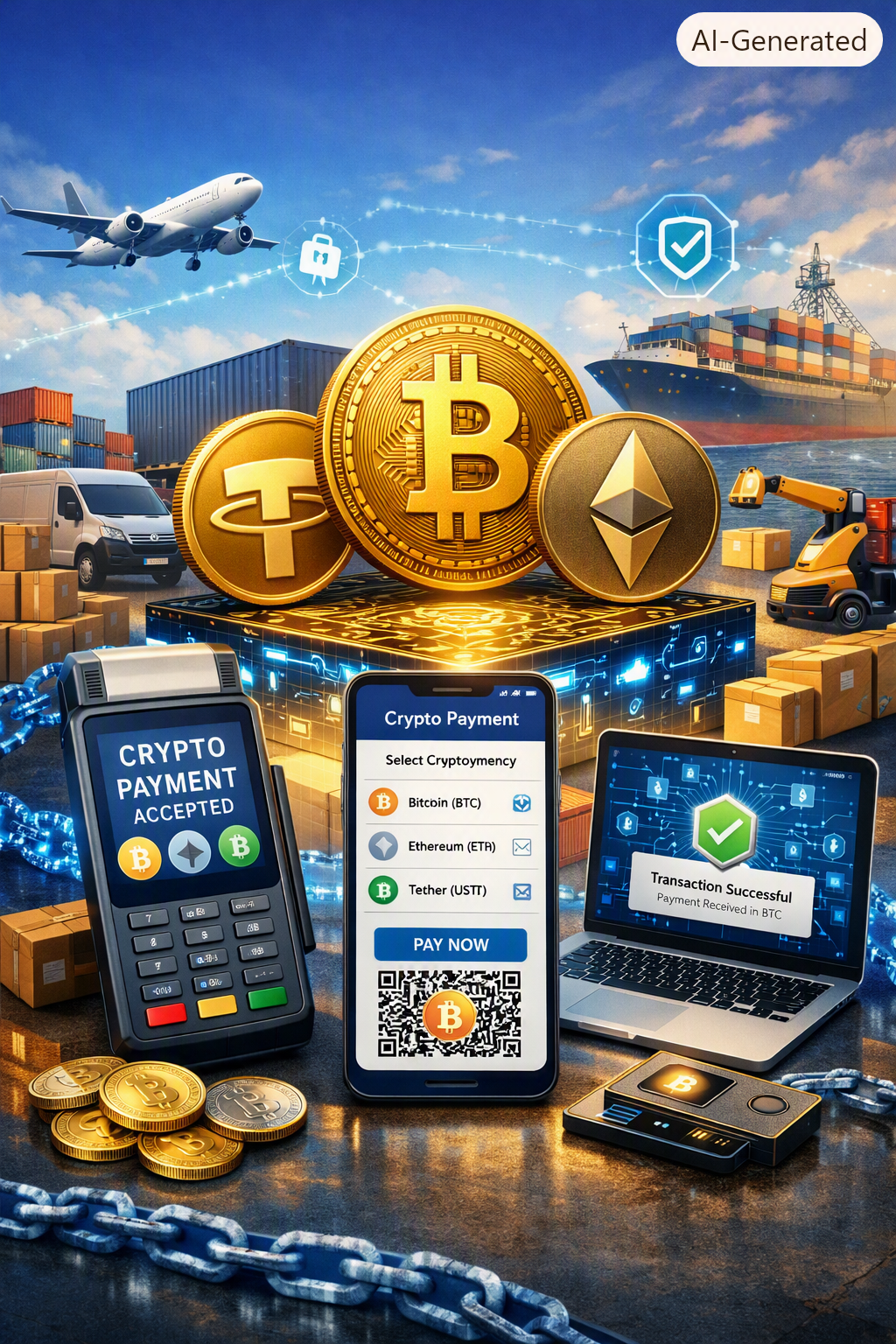
International Shipments with Crypto Payments
International Shipments with Crypto Payments: Instant Cost Calculation and Digital Logistics
International trade, cross-border e-commerce, and private shipments are evolving much faster than traditional financial and logistics processes. Users expect that arranging delivery to another country can be as simple as ordering a product from an online store: select the destination, specify the package parameters, instantly see the cost, pay conveniently, and receive a ready shipping invoice. Against this backdrop, the system of international shipments with crypto payments, instant rate calculation, and automated shipping label creation is of particular interest.
The modern digital payment logistics system combines courier services, payment tools, blockchain technologies, online cost calculation, and delivery status tracking in one interface. Customers can use USDT, BTC, and other digital assets, while logistics companies can receive payments faster, reduce banking costs, and enter the international market without complex currency operations.
Key areas of such an ecosystem include crypto shipping payment system, instant logistics pricing, blockchain courier payments, USDT BTC shipping labels, and global crypto delivery platform. These technologies do not replace classical logistics but make it more accessible, transparent, and convenient for businesses and private shippers.
What is an International Delivery System with Crypto Payments
An international delivery system with crypto payments is a digital platform that allows users to arrange the transportation of a package between countries, calculate the rate, pay for logistics services in cryptocurrency, and receive electronic documents for handing over the shipment to the courier. Unlike the traditional model, where the customer has to separately find a carrier, clarify the rate, pay via bank transfer, and manually fill out documents, a unified platform integrates all stages into one digital scenario.
The foundation of such a system is the integration of several components. These include a database of transport company rates, a cost calculation module, a payment crypto wallet, a shipping label generation system, courier service APIs, a tracking service, and transaction verification tools. As a result, the client sees not abstract information about delivery but a specific offer considering the route, weight, dimensions, type of shipment, insurance, customs conditions, and additional services.
The crypto shipping payment system is particularly relevant for companies that work with international clients, freelancers, marketplaces, digital entrepreneurs, and buyers from countries with limited access to international banking tools. Payment in USDT helps reduce the impact of currency fluctuations, while BTC can be used as an alternative method for international settlements. Meanwhile, the logistics service itself remains standard: the package is handed over to the carrier, goes through sorting centers, and is delivered to the recipient.
How the Shipment Arrangement Process Looks
Typically, the user goes through several sequential stages:
Specifies the country of origin and the destination country.
Enters the weight, dimensions, and category of the contents.
Selects the appropriate rate and delivery method.
Receives instant logistics pricing — an instant cost calculation.
Selects cryptocurrency for payment.
Confirms the transaction through the blockchain wallet.
Receives the shipping label, QR code, and tracking number.
Hands over the package to the courier or takes it to the drop-off point.
For the client, the simplicity of the interface is crucial. They do not need to understand the technical details of blockchain, manually select the network without prompts, or transfer amounts between multiple services on their own. A reliable platform displays the wallet address, selected network, exact amount, fee, and payment invoice validity period.
Why Crypto Payments are in Demand in Logistics
Cryptocurrency payments reduce the number of intermediaries between the sender and the logistics service provider. An international bank transfer can take several days, incur additional fees, and require payment purpose confirmation. In contrast, a blockchain transaction is recorded on the network and can be verified automatically.
The most convenient asset for payment for delivery is considered to be USDT, as its value is pegged to the US dollar. This simplifies expense forecasting. BTC can be used by users who prefer to pay for services from their own cryptocurrency balance. In the future, the system may support ETH, USDC, and other digital assets.
Instant Cost Calculation for International Delivery
One of the main advantages of a digital logistics platform is instant logistics pricing — the ability to calculate shipping costs instantly. Traditionally, a customer has to send a request to a manager, wait for a response, clarify the availability of the route, and only then make a decision. An automated system performs the calculation in just a few seconds, using data about the route, carrier rates, and cargo characteristics.
The cost of international shipping is formed from several components. The calculation may include the base rate, fuel surcharge, weight factor, dimensional weight, remote area surcharge, customs processing, insurance, packaging, and additional services. The more parameters the system takes into account, the more accurate the final price will be.
What data is needed for automatic calculation
To obtain an accurate rate, the user typically inputs:
the country and city of origin;
the country and city of destination;
the actual weight of the package;
the length, width, and height of the packaging;
a description of the contents;
the declared value;
the desired delivery time;
the need for insurance;
the method of handing the shipment to the courier.
In some cases, the system requests the postal code, the type of sender and recipient, the category of goods, and information about whether the shipment is commercial or personal. This information helps to determine customs risks and choose the appropriate mode of transport.
Considering dimensional weight
In international shipping, the rate is often calculated based not only on actual weight but also on dimensional weight. If a package is light but takes up a lot of space, the carrier uses a special formula:
Dimensional weight = length × width × height / carrier factor.
The factor may vary depending on the delivery service, destination, and type of transport. The platform should show the user which weight was used for the calculation: actual or dimensional. This increases transparency and helps avoid situations where the final price after the cargo is handed over turns out to be higher than initially quoted.
Price conversion to cryptocurrency
After determining the rate in fiat currency, the system converts the amount to USDT, BTC, or another supported asset. It is important to consider the current exchange rate, network fee, and possible reserve for cryptocurrency price fluctuations. For stablecoins, the calculation is usually more stable, while for BTC payments, the platform may set a short rate lock period.
A good digital payment logistics system should display in advance:
the shipping cost in the base currency;
the amount to be paid in cryptocurrency;
the size of the network fee;
the validity period of the invoice;
the selected blockchain network;
the minimum number of confirmations;
the refund policy.
This information makes payment understandable even for users who do not have extensive experience with cryptocurrency services.
Crypto shipping payment system: how crypto payment for shipping works
A crypto shipping payment system — is not just the ability to specify a cryptocurrency wallet address for transferring funds. A full-fledged solution should automatically recognize the payment, match it with the order, verify the amount, and initiate further logistics processes. After confirming the transaction, the system creates the shipment, reserves the rate, and generates the necessary documents.
When placing an order, the client selects the appropriate asset, such as USDT or BTC. The platform generates an invoice indicating the amount and address. The user transfers the funds from their wallet, after which the system monitors the blockchain in real-time. When the transaction receives the required number of confirmations, the order is marked as “Paid.”
Payment in USDT
USDT is often chosen for international logistics calculations due to its relative price stability. The company can set the price in dollars or another base currency, and the system converts it to the equivalent in USDT. This simplifies financial planning and reduces the impact of sharp fluctuations in the cryptocurrency market.
However, when paying with USDT, it is important to choose the correct network. The same asset can exist on different blockchains, such as Ethereum, Tron, BNB Chain, and others. The sender and recipient of the payment must use a compatible network. Therefore, the interface must clearly warn the user: transferring USDT through an unsupported network may lead to delays or loss of funds.
Payment in BTC
Payment in BTC is suitable for users who hold funds in the first cryptocurrency and want to use it directly for service payments. Since the Bitcoin exchange rate can fluctuate significantly, the system must lock in the order value for a specific period. If the payment is received after the locking period ends, additional payment or recalculation may be required.
For added convenience, a QR code compatible with a cryptocurrency wallet can be used. The user scans the code, verifies the amount, and confirms the transfer. After that, the service automatically updates the order status.
Automatic Payment Reconciliation
Automatic reconciliation is one of the key elements of blockchain courier payments. The platform links each order with a unique payment identifier or a separate address. This allows distinguishing payments from different clients and minimizing manual accounting work.
The system can record the following data:
transaction hash;
sender's address;
recipient's address;
amount;
selected network;
time of sending;
number of confirmations;
blockchain fee;
payment status.
This information is useful not only for the client but also for the support service, finance department, carrier, and auditors.
Blockchain Courier Payments and Transaction Transparency
Blockchain courier payments allow the use of blockchain to confirm payment, automate settlements, and increase trust among participants in the logistics chain. Each transaction receives a unique identifier and can be verified in the public explorer of the corresponding network. This reduces the risk of disputes over whether a payment was sent and when it was received.
Blockchain does not eliminate the need for contracts, invoices, and accounting, but it provides an additional technical level of control. This is especially important for logistics companies when working with international clients, partners, and agents.
Benefits of Blockchain for Courier Services
The main benefits include:
acceleration of international settlements;
reduction of dependence on banking intermediaries;
ability for automatic payment verification;
transparent transaction history;
reduction of manual operations;
convenient integration via API;
support for programmable payment scenarios.
For example, after confirming the transaction, the system can automatically send shipment details to the courier service. After scanning the package at the sorting center, the order status can be updated. Upon the occurrence of a specific event, payment to the partner can be triggered or part of the deposit can be returned to the client.
Smart Contracts in Logistics
A smart contract can be used for automatic payment distribution among multiple participants. For example, part of the amount goes to the courier service, part to the platform operator, and a separate share is reserved for insurance coverage. Upon the occurrence of a predefined event, funds can be transferred without manual intervention.
However, the use of smart contracts requires caution. The code must undergo auditing, and the rules for cancellation, refunds, and dispute resolution should be clear in advance. Not all logistics situations can be fully automated: customs delays, packaging damage, and force majeure require the involvement of specialists.
Limitations of Blockchain Payments
Despite the advantages, blockchain settlements have limitations. Transactions may be delayed due to network congestion, users may make mistakes when selecting a blockchain, and cryptocurrency operations are regulated differently in various countries. Therefore, a professional platform should implement address verification, payment warnings, limits, a refund system, and customer support.
USDT BTC Shipping Labels: Electronic Transport Documents
USDT BTC shipping labels are digital tags and transport documents generated after payment for shipping in cryptocurrency. A shipping label typically contains sender and recipient information, a barcode or QR code, tracking number, carrier information, route, and additional handling instructions.
After successful payment, the client receives the label in their personal account and via email. It can be downloaded in PDF format, printed, or used as a digital code if the specific carrier supports paperless transfer.
What Information is Included on the Shipping Label
Depending on the country and carrier, the document may include:
unique tracking number;
name or title of the sender;
recipient's details;
delivery address;
contact phone number or email;
weight and dimensions of the package;
barcode;
QR code;
service type;
special handling notes;
customs identifier;
insurance information.
At the same time, payment information does not always need to be displayed on the outside of the package. The payment made in USDT or BTC is stored in the system and linked to the order through an internal identifier. This helps maintain privacy and avoids overloading the shipping label with unnecessary data.
Automatic document generation
Automation reduces the number of errors when filling out shipping documents. If a customer enters an address in the online form, the system can verify the postal code, phone format, destination validity, and compliance of the destination country with the selected rate. If necessary, the data is converted into the format of a specific courier service.
In some cases, the system generates several documents at once:
shipping label;
commercial invoice;
customs declaration;
packing list;
insurance certificate;
payment receipt;
instructions for package transfer.
This is especially useful for online stores and companies that process a large number of shipments daily.
Bulk label generation for businesses
Corporate clients can upload orders via CSV file, API, or integration with an online store. The platform automatically calculates the cost for each package, creates invoices, and generates a set of labels after payment confirmation.
This model allows for the use of crypto payments in fulfillment processes, marketplaces, and international trading systems. The manager does not have to manually create each shipping document, verify transactions, and transfer data to a separate program.
Digital payment logistics system for businesses
The Digital payment logistics system is designed not only for individual senders. Its primary users can be online stores, manufacturers, exporters, agency networks, marketplaces, and companies that regularly ship goods abroad.
Businesses gain a unified tool for accepting payments, calculating rates, creating documents, transmitting data to carriers, and monitoring financial operations. This reduces operational costs and helps serve customers faster.
Integration with online stores
The platform can connect to websites and stores via API or ready-made modules. When placing an order, the customer immediately sees delivery options and costs in the selected currency. If the store supports cryptocurrency payments, the customer can pay for both the product and the logistics service simultaneously or pay for delivery separately.
Integration may include:
automatic address transfer;
rate calculation in the cart;
carrier selection;
payment in USDT or BTC;
creation of shipping label;
transmission of tracking number to the store;
status updates;
notifications to the customer.
As a result, delivery becomes part of a unified user journey.
API for carriers and partners
The API allows for the connection of multiple courier services and comparison of their offers. The system can request rates, create shipments, obtain tracking numbers, and transmit status data. At the same time, the business is not required to develop a separate integration with each carrier.
For large companies, access restrictions, API keys, request logs, limits, and user rights segregation are important. For example, an operator can create shipments, an accountant can view payments, and an administrator can manage rates and integrations.
Managing cryptocurrency transactions
The corporate system should support financial reporting. It is useful to display in the personal account:
order amount in base currency;
payment amount in cryptocurrency;
conversion rate;
network fee;
platform fee;
payment status;
date of receipt;
transaction hash;
refund data.
For businesses, it is also important to have CSV exports, integration with accounting software, and the ability to generate reports by periods, clients, routes, and carriers.
Global crypto delivery platform for international clients
The global crypto delivery platform is a scalable digital environment that connects clients, courier services, payment networks, vendors, and logistics operators from different countries. Its mission is to make international shipping accessible regardless of where the sender is located and what financial instrument they are using.
This platform can function as an aggregator: comparing offers from different carriers, displaying delivery times and costs, accepting crypto payments, and forwarding orders to the chosen service. Additionally, it can provide insurance, customs support, cargo consolidation, and warehousing services.
Localization for Different Countries
For an international audience, it is essential to consider the linguistic, currency, legal, and logistical specifics of particular regions. The interface can support multiple languages, and rates can be displayed in USD, EUR, and other currencies with the option to pay in crypto assets.
The system must also correctly handle:
different address formats;
international phone numbers;
postal codes;
import regulations;
restrictions on certain categories of items;
local holidays and delivery timelines;
customer identification requirements.
Customs Procedures
Crypto payment does not exempt the sender from customs obligations. A package may require a declaration, invoice, proof of value, and a description of its contents. The platform should inform the customer about the necessary documents for the selected destination.
The accurate description of the goods is of particular importance. Phrases like "gift" or "personal items" are not always sufficient. For commercial shipments, product codes, country of origin, quantity, and value may be required. The more complete the information, the lower the likelihood of delays at the border.
International Restrictions
Before payment, the system must check the availability of the route, the acceptability of the contents, and the feasibility of conducting a cryptocurrency transaction. Some countries have restrictions on digital assets, cross-border payments, or specific categories of goods. The platform must comply with applicable legislation and should not position crypto payment as a means to circumvent sanctions, tax, or customs requirements.
Security, Identification, and User Protection
Security is one of the main factors of trust in a platform that simultaneously handles international logistics and cryptocurrency payments. Users must be assured that their funds will reach their destination, personal data will not be disclosed, and shipments can be tracked at every stage.
Protection of Crypto Payments
To ensure payment security, the following measures are implemented:
HTTPS and data encryption;
two-factor authentication;
address confirmation before transfer;
automatic network checks;
transaction limits;
monitoring of suspicious transactions;
segregation of hot and cold wallets;
backups;
employee access control.
If the platform stores clients' cryptocurrency, security requirements become even stricter. A more secure model may be a non-custodial approach, where the user independently sends funds to the payment address, and the service does not have ongoing control over their assets.
KYC and AML Procedures
Depending on the jurisdiction and business model, customer identification may be required. KYC helps confirm the user's identity, while AML checks are aimed at detecting suspicious transactions and money laundering risks.
The verification may include:
first and last name;
country of residence;
identity document;
address confirmation;
analysis of the nature of the transaction;
sanctions list checks.
At the same time, the platform must adhere to the principle of data minimization and clearly explain why specific information is being requested.
Protection of Personal Data
The logistics system processes names, addresses, phone numbers, email addresses, and details about the contents of packages. Access to this data should only be granted to those employees and partners who need it to fulfill the order. Important aspects include privacy policies, data retention periods, deletion rules, and the procedure for handling user requests.
Shipment Tracking and Automatic Notifications
After creating a shipping label, the client needs to provide convenient tracking. The tracking number should work not only on the platform's website but also, if possible, in the system of the chosen carrier. This allows for obtaining package movement data from the primary source.
Statuses may include:
order created;
awaiting payment;
payment detected;
payment confirmed;
label generated;
shipment accepted;
package directed to the sorting center;
clearing customs;
handed over to the courier;
delivered;
issue occurred.
Connection Between Payment and Logistics Status
One of the advantages of blockchain courier payments is the ability to link financial and logistics status within a single system. As long as the transaction is not confirmed, the label may remain blocked. After receiving the required number of confirmations, the document becomes available for printing.
If the delivery is canceled, the system can register the return according to the service's rules. It is important to note that returns in cryptocurrency may differ from the original fiat amount due to exchange rate fluctuations. Therefore, return conditions should be formulated in advance.
Notifications for Sender and Recipient
Users can receive notifications via email, SMS, messenger, or through push notifications. The notification includes the order number, status, tracking link, possible actions, and support contact information.
For businesses, it is useful to set up automatic messages about delays, changes in customs status, the need to provide documents, and successful deliveries.
Advantages of International Shipping with Crypto Payments
Using a cryptocurrency logistics platform offers advantages to different user categories. Private clients gain a convenient payment method, while companies receive a tool for automation and access to new markets.
Advantages for Senders
Senders can:
quickly find out the shipping cost;
pay for the service in USDT or BTC;
avoid waiting for bank transfers;
receive a ready-made invoice;
track the order online;
compare multiple carriers;
use a single personal account.
This model is especially beneficial for people living in different countries, working with international clients, or lacking convenient access to traditional payment tools.
Advantages for Businesses
Companies gain:
reduction in manual work;
automatic document creation;
integration with online stores;
payment and rate control;
scaling of international sales;
transparent reporting;
the ability to accept clients from different regions.
Crypto payments can also attract an audience that prefers digital assets and expects sellers to support modern payment methods.
Advantages for Courier Services
Carriers receive structured data, automatic payment verification, and the ability to onboard new clients through a single channel. The platform can distribute orders among partners based on cost, delivery time, geography, and service quality.
Potential Risks and Mitigation Strategies
Cryptocurrency logistics is associated with certain risks. The main ones include transfer errors, volatility, regulatory restrictions, fraud, and technical failures.
Errors in Sending Cryptocurrency
A user may select an unsupported network, enter an incorrect address, or transfer an amount without considering the fee. To reduce risk, the interface should display clear warnings, use QR codes, verify address formats, and allow users to reconfirm payment parameters before sending.
Volatility of Cryptocurrencies
When paying with BTC, the order cost can change within minutes. A solution is to fix the exchange rate for a limited time, use stablecoins, or recalculate payments according to pre-established rules.
Fraud Schemes
Fraudsters may create fake websites, send false payment details, or use stolen information. Users should verify the platform's domain, avoid clicking on suspicious links, and confirm payments only within the official interface.
Regulatory Risks
The rules for handling cryptocurrencies and international payments vary by country. The platform operator must consult with specialized lawyers, comply with the requirements of specific jurisdictions, and not promise users absolute service availability in all regions.
How to Choose a Platform for Crypto Shipping
Before connecting to the service, it is essential to evaluate not only the support for USDT and BTC but also the entire range of logistics and financial features.
Main Selection Criteria
It is important to check:
the list of supported countries;
available courier services;
the accuracy of instant logistics pricing;
the speed of payment confirmations;
supported networks;
the availability of an API;
the ability to create labels in bulk;
the quality of tracking;
return policies;
fees;
the level of technical support;
KYC and AML requirements;
compliance with legislation.
Low fees do not always mean favorable conditions. It is necessary to consider network fees, conversion costs, charges for creating shipments, insurance, and possible return fees.
User Interface Convenience
The platform should be understandable to someone without technical knowledge. At the payment stage, it is especially important to eliminate ambiguity: the asset, network, amount, and validity period of the invoice should be clearly and prominently displayed.
For businesses, user roles, transaction history, filters, report exports, integrations, and the ability to quickly find an order by number, address, or transaction hash are important.
Future Prospects of Crypto Delivery Platforms
In the future, international crypto logistics platforms may become part of a comprehensive digital trade infrastructure. The development of APIs, artificial intelligence, smart contracts, and automated warehouses will make the shipping process even faster.
Systems will be able to predict delivery times, automatically select the optimal carrier, account for the likelihood of customs delays, and recommend packaging. Artificial intelligence can analyze rates, routes, and transaction history to offer the most advantageous option to the client.
A promising direction is the tokenization of logistics services. For example, a corporate client could purchase digital credits for shipping in advance, and the system would deduct them as shipments are created. Another option is the use of programmable deposits for insurance and compensation.
However, the development of the industry will depend on regulation. The clearer the rules for using digital assets become, the easier it will be for large companies to implement blockchain courier payments and digital payment logistics systems into real business processes.
International shipments with crypto payments and instant cost calculations combine logistics, digital payments, and blockchain into a single convenient system. The crypto shipping payment system allows for delivery payments in USDT and BTC, instant logistics pricing helps quickly determine the final rate, and USDT BTC shipping labels simplify the creation of transport documents.
For businesses, such a platform becomes a tool for automation, integration with online stores, and access to the global market. For individual users, it offers a convenient way to arrange international shipments without lengthy banking procedures. Blockchain courier payments enhance the transparency of transactions, while the global crypto delivery platform creates a unified space for senders, carriers, and recipients.
For such a system to be truly reliable, it must combine a user-friendly interface, accurate rate calculations, secure processing of crypto payments, quality tracking, customs support, and compliance with legislation. In this case, digital logistics can become an essential part of future international trade and delivery.