

 RU
 UA
 DE
 FR
 ES
 CN
 SA
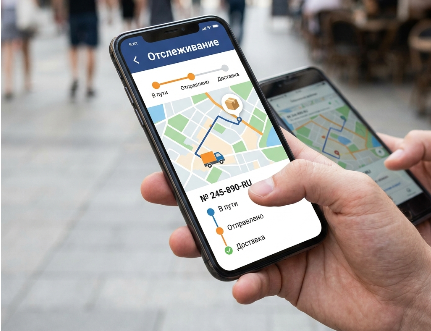
Mobile Apps for Shipment Tracking
Growth of Mobile Applications for Package Tracking: Technologies, Opportunities, and Prospects
Mobile applications for tracking shipments have become an essential part of modern logistics. Just a few years ago, customers had to search for the carrier's phone number, visit the courier service's website, or send a request to customer support to find out where their package was. Today, it's enough to open a tracking app, enter the tracking number — and the user receives up-to-date information about the delivery status almost in real-time.
The development of e-commerce, the growth of international trade, and the increase in the number of marketplaces have made shipment tracking not an additional service, but a basic one. Buyers want to know when their order was accepted, left the warehouse, handed over to the carrier, crossed the border, and arrived at the pickup point. Businesses, in turn, need to manage large volumes of shipments, reduce the number of support inquiries, and ensure transparency in all logistics operations.
A modern parcel tracking mobile app integrates data from various transport companies, sorting centers, warehouses, and courier services. Such solutions utilize automated data collection, push notifications, geolocation, integration with CRM and warehouse management systems. As a result, both the customer and the seller have a unified digital space for monitoring deliveries.
Why Mobile Package Tracking is Rapidly Developing
The rise in popularity of tracking applications is not only due to the convenience of smartphones. At the core of this process are significant changes in consumer behavior, trade structure, and transportation organization. Users have become accustomed to receiving information instantly: they track bank transactions, taxis, food orders, and health status through mobile services. Therefore, waiting for package status updates for several days is perceived as a lack of service.
Moreover, e-commerce has become international. An order can be placed on a website in one country, stored in a warehouse in another, transported through a third, and delivered by a local operator in a fourth. In such a route, traditional tracking methods prove to be insufficiently effective. International tracking requires the integration of data from multiple information systems that may use different status formats and identifiers.
Another reason for growth is the need to optimize costs. The more accurately a company knows the location of a shipment, the easier it is to plan warehouse loading, courier operations, and customer service. If the system alerts in advance about a delay, the operator can suggest an alternative route or notify the recipient. This reduces the number of repeat deliveries, contact center inquiries, and conflict situations.
Changing Customer Expectations
The modern customer wants to see not just a general status of "in transit." They need specific data: where the package is, when it was accepted by the carrier, what stage customs clearance is at, when delivery is expected, and who is responsible for the next segment of the route. The more expensive or important the shipment, the greater the need for detailed information.
A mobile service can display the movement history, predict the arrival date, and send notifications with every change. Users can choose a convenient communication channel: push notifications, email, SMS, or in-app messages. This personalization increases loyalty and makes the delivery process clear.
Development of Marketplaces and International Trade
Marketplaces process vast volumes of orders daily. Many products are shipped from different sellers and transported by several logistics operators. If information about such shipments is stored in disparate systems, it becomes difficult for the buyer to track the entire order.
A tracking app solves this problem by consolidating data into a single interface. Users can add multiple shipments, track orders from different stores, and receive notifications without needing to visit individual carrier websites. For marketplaces, this is also beneficial: unified tracking reduces the load on support and increases service transparency.
What is a Mobile Application for Package Tracking?
A parcel tracking mobile app is a mobile application designed to receive, process, and display information about the movement of packages. Its primary function is to search for a shipment by tracking number, but modern platforms offer much more functionality.
The application can automatically recognize the carrier, synchronize with logistics operators' databases, generate delivery forecasts, and maintain order history. In corporate solutions, features such as bulk shipment uploads, employee rights distribution, SLA monitoring, delay analytics, and integration with the company's internal systems are available.
The architecture of such a product typically includes a mobile client, a server platform, API integrations with carriers, a database, and a notification module. Information from different operators is normalized: statuses presented in various formats are converted into user-friendly categories — for example, “accepted,” “shipped,” “arrived in destination country,” “handed over to courier,” “delivered.”
Key Features of the Application
The basic capabilities of a tracking app include:
tracking a package by tracking number;
automatic carrier identification;
displaying the current status;
viewing movement history;
delivery date forecasting;
push notifications;
storing multiple shipments;
device synchronization;
support for different languages and currencies;
contacting customer support;
displaying pickup points and parcel lockers.
More complex systems additionally support route mapping, estimated time of arrival calculations, electronic delivery confirmations, delivery photos, digital signatures, and service quality assessments.
User Interface and Usability
The success of a mobile application largely depends on its interface. Users should be able to quickly add a shipment and understand its current status without having to study complicated instructions. Therefore, high-quality applications utilize visual progress bars, color coding, and clear wording.
It is important to consider that some users track their packages irregularly, while others constantly monitor multiple orders. For the former, quick search is essential, while the latter require sorting, filtering, grouping, and notification customization. A good design should work equally well on smartphones with different screen sizes and under unstable internet connections.
International Tracking and Features of Cross-Border Delivery
International tracking is significantly more complex than domestic tracking. A cross-border package goes through several logistics stages: acceptance by the seller, export sorting, customs inspection, international transportation, import clearance, transfer to a local operator, and delivery to the final recipient.
Each segment may use a separate information system. One carrier creates its own identifier, another adds a local number, and the customs service uses yet another set of data. If the platforms are not interconnected, the customer sees incomplete or delayed information.
Modern parcel tracking mobile apps address this issue by consolidating multiple sources. The system matches numbers, analyzes statuses, and creates a unified timeline. It must also account for language differences, time zones, calendar peculiarities, and the requirements of specific countries.
Customs Clearance
Customs is one of the most unpredictable stages of international delivery. The duration of the inspection depends on the contents of the package, the value of the goods, the accuracy of the documents, and the legislation of the destination country. In the application, it is important not just to show the status “in customs,” but to explain what is happening and whether any action is required from the recipient.
Advanced systems can notify the client of the need to provide passport details, pay duties, or confirm the description of the goods. This reduces downtime and helps avoid the return of the shipment.
Status Translation and Data Standardization
Different carriers may use hundreds of internal statuses. Such terminology is often unclear to users. The international tracking system converts them into standardized stages and accompanies them with explanations.
For example, a technical status may mean that the package has left an intermediate sorting center, but in the app, it is displayed as “shipment directed to destination country.” This standardization makes the digital service user-friendly regardless of the sender's and recipient's country.
Shipment Tracking Systems for Businesses and Logistics Operators
Shipment tracking systems are not only used by individual buyers. They are an essential tool for online stores, manufacturers, distributors, transportation companies, and large corporate clients. In business, tracking is used to monitor deliveries, plan inventory, manage returns, and analyze carrier performance.
A corporate system can integrate data on orders, warehouses, routes, and couriers. The manager can see which shipments are delayed, where problems frequently occur, and which operators meet their deadlines. This allows for decision-making based on actual metrics rather than assumptions.
Integration with CRM, ERP, and WMS
For businesses, integration with existing software products is particularly important. If delivery data is not linked to the order record, employees have to manually check statuses and transfer information between systems.
Integration with CRM allows for automatic notifications to clients about changes. Connection with ERP helps account for deliveries in financial and operational planning. WMS systems gain the ability to synchronize warehouse operations with the actual movement of shipments. API interfaces facilitate data exchange without the constant involvement of employees.
SLA Monitoring and Analytics
Companies use shipment tracking systems to monitor contractual metrics. These include the time taken to hand over the order to the carrier, delivery duration, the percentage of shipments without delays, the success rate of deliveries, and the number of returns.
The analytical module can identify problematic routes, overloaded sorting centers, and periods of seasonal load increases. Based on this data, businesses can adjust routes, change collaboration terms, and enhance customer service.
Real-Time Delivery Tracking: How Real-Time Tracking Works
Real-time delivery tracking involves the most timely updates on the location and status of deliveries. It is important to understand that "real time" can have different technical meanings. For urban couriers, data may update every few seconds, while for international parcels, new information may only appear after passing through the next checkpoint.
The system may utilize GPS, couriers' mobile devices, barcode scanning, RFID tags, telematics sensors, and geofences. When a courier receives an order, the system logs the event. As the courier approaches the address, the app can send a notification to the recipient. After delivery, an electronic confirmation is generated.
GPS and Geolocation
GPS tracking is particularly in demand in the last mile. The recipient can see the approximate location of the courier and the number of stops remaining until their address. For logistics companies, geolocation helps monitor route compliance, distribute new orders, and respond quickly to deviations.
However, constant transmission of coordinates requires battery power and mobile traffic. Therefore, systems use different update frequency modes depending on the stage of the route and the type of delivery.
Geofences and Event Monitoring
A geofence is a virtual area on a map. When a vehicle or courier enters or exits it, the system automatically logs the event. This is convenient for monitoring arrivals at warehouses, departures from sorting centers, and approaching the client's address.
Geofences help automate notifications and reduce the number of manual operations. They are also used for analyzing wait times, identifying traffic jams, and assessing the actual duration of routes.
Limitations of Real-Time Tracking
Complete continuous tracking is not possible at every stage of the chain. Signals may be absent in tunnels, remote areas, airplanes, and closed warehouse spaces. Additionally, not all carriers transmit coordinates openly.
Therefore, the application should clearly explain delays in updates. If the system displays outdated information without explanations, users may mistakenly conclude that the parcel is lost. Transparent comments increase trust in the service.
App Logistics: Digitizing Delivery Processes
App logistics is not just a standalone program for finding tracking numbers. In a broader sense, it refers to a digital ecosystem that manages all stages of order movement. It can include route planning, task distribution among couriers, vehicle monitoring, warehouse management, return processing, and client communication.
Mobile applications are especially useful for employees working outside the office. Couriers receive routes, address lists, order details, and delivery instructions via their smartphones. Dispatchers monitor task completion, while clients receive notifications about arrivals.
Courier App
The courier application typically includes navigation, an optimized route, recipient contact details, the ability to mark delivery attempts, and upload supporting materials. Depending on the specifics of the job, features such as photos, electronic signatures, barcode scanning, or one-time codes may be used.
These functions help reduce the number of errors. The courier sees an up-to-date list of tasks, while the company receives confirmation of the operation almost immediately.
Dispatcher Application
The dispatch part of the system is designed for order distribution, monitoring employee workload, and managing exceptions. If one courier is unable to complete the route, the dispatcher can redistribute some shipments.
The control panel displays delays, cancellations, delivery retries, and other non-standard events. This allows for quick intervention in the process and prevents a decline in customer experience.
Recipient Application
The recipient uses the mobile service to select a time slot, change the address, reschedule delivery, or choose a pickup point. This flexibility reduces the number of unsuccessful delivery attempts and makes the delivery process more convenient.
Digital Courier Services and Their Impact on the Market
Digital courier services are changing the traditional model of interaction between the sender, carrier, and recipient. Previously, the courier service was perceived as an operator that simply moved packages. Today, it is becoming a technological platform capable of predicting events, automating communications, and offering personalized delivery options.
Digital services utilize mobile applications, cloud technologies, machine learning, and API integrations. As a result, customers can manage their deliveries independently, while companies can handle more shipments without a proportional increase in staff.
Omnichannel Communication
Users can receive information through the app, SMS, email, chatbots, and messengers. An omnichannel approach is important because people have different habits. Some prefer push notifications, others regularly check their email, and some want to interact with a bot.
The main condition is consistency of information. If different channels show different statuses, it leads to distrust. All messages should be generated from a single data source.
Automation of Customer Support
The majority of customer inquiries are related to standard situations: where is the package, why is it delayed, when will it be delivered, and what to do in case of an address change. Chatbots and automated responses can handle such requests without operator involvement.
Complex cases are forwarded to a specialist along with the order history and already collected data. This reduces the processing time of inquiries and improves the quality of support.
Artificial Intelligence and Delivery Time Prediction
Modern tracking systems are gradually shifting from recording past events to predicting future ones. Algorithms analyze route history, weather conditions, road congestion, seasonality, sorting center operations, and carrier statistics.
Based on this data, the application can calculate the likely delivery date and warn of potential delays. For businesses, forecasting helps plan warehouse resources and proactively communicate with customers.
Predictive Analytics
Predictive analytics identifies patterns that are difficult to notice with manual monitoring. For example, the system can determine that shipments of a certain type are regularly delayed on a specific route or that the number of unsuccessful deliveries increases on certain days.
Such insights allow for schedule adjustments, route corrections, and the selection of more reliable partners.
Handling Non-Standard Situations
Artificial intelligence can classify exceptions: damaged packaging, recipient absence, address errors, returns to the warehouse, or customs delays. Automatic classification speeds up response times and helps choose the appropriate scenario.
However, algorithms must operate under the supervision of specialists. Incorrect interpretation of status can lead to erroneous notifications and degrade the user experience.
Security and Data Protection in Tracking Applications
The mobile application for packages processes personal and commercially sensitive information. This may include the recipient's name, address, phone number, order history, and route information. Therefore, security is an essential part of development, not an additional feature.
The application must use a secure connection, reliable authentication, and access control. Corporate users should only see shipments that fall within their authority. It is also important to maintain an activity log and monitor attempts at suspicious access.
Protection of Personal Information
It is essential to collect only the data that is truly necessary for the service to function. Users should understand why the application needs access to geolocation, contacts, or notifications. Permissions should be requested reasonably and in stages.
Data is stored using encryption, backups, and regular infrastructure testing. Security updates must be installed promptly.
Fraud Protection
The popularity of tracking attracts fraudsters. Users may receive fake messages requesting payment for delivery or asking for banking information. Reliable digital courier services should clearly define official communication channels and warn about suspicious links.
It is advisable to use internal notifications within the app, payment confirmations, and protection against status spoofing. The less a user relies on random SMS messages, the lower the likelihood of a fraudulent attack.
How to Choose a Package Tracking App
When selecting an app, it is important to consider not only the appearance and number of features. It is crucial to check if the service supports the necessary carriers, how often the information is updated, and how clear the statuses are.
For the average user, the main criteria are stability, ease of search, accuracy of notifications, and availability of international tracking. For businesses, API, bulk processing of shipments, analytics, integrations, and the ability to brand the interface are more important.
What to Pay Attention To
Before installation or implementation, it is worth checking:
the list of supported carriers;
the availability of international destinations;
the frequency of data updates;
support for multiple tracking numbers;
integration capabilities;
notification settings;
conditions for storing personal data;
availability of customer support;
user reviews;
the cost of advanced features.
It is also important to assess the quality of forecasts. Some apps display only the statuses received from the carrier, while others additionally calculate the expected delivery date. These capabilities should be distinguished, as a forecast is not a guarantee.
Future Prospects for Package Tracking Mobile Applications
In the coming years, mobile tracking applications will become more automated and personalized. Users will not have to manually enter tracking numbers: the app will be able to retrieve data from emails, marketplaces, or connected accounts.
Route visualization, delay forecasting, and delivery management through a single interface will develop. Systems will increasingly take customer preferences into account: convenient delivery times, eco-friendly delivery methods, pickup points, and acceptable waiting periods.
Smart Notifications
Instead of sending a large number of similar messages, apps will send only truly useful notifications. For example, the system may not notify about every movement within the sorting center but will definitely alert about the courier's arrival, changes in deadlines, or the need to take action.
Intelligent notifications will reduce information overload and make the service more comfortable.
Eco-Friendliness and Route Optimization
Digitalization helps reduce environmental impact. Route optimization decreases vehicle mileage, while precise timing of deliveries reduces the number of repeat trips. Users can choose consolidated delivery or a pickup point if it helps reduce fuel consumption.
Unified International Standards
The development of international trade requires the unification of data formats and statuses. The more carriers connect to common standards, the more accurate and understandable international tracking becomes.
In the future, users will be able to track packages from different countries in one application with virtually no gaps between stages of the route.
The growth of mobile package tracking applications is a natural result of the development of e-commerce, international logistics, and digital services. A tracking app helps users monitor shipments, while businesses can automate operations, increase transparency, and improve service quality.
A modern mobile package tracking application integrates data from various carriers, supports international tracking, sends notifications, and provides delivery forecasts. Shipment tracking systems allow companies to manage deliveries, monitor SLAs, analyze delays, and integrate logistics with CRM, ERP, and warehouse platforms.
Real-time delivery tracking technologies, geolocation, artificial intelligence, and digital courier services make delivery more predictable. In the future, such applications will be more deeply integrated with marketplaces, automate decision-making, and offer personalized order pickup scenarios.
For users, this means more control and less uncertainty. For businesses — reduced costs, increased efficiency, and strengthened customer trust. That is why mobile tracking is becoming one of the key elements of modern logistics infrastructure.