

 RU
 UA
 DE
 FR
 ES
 CN
 SA
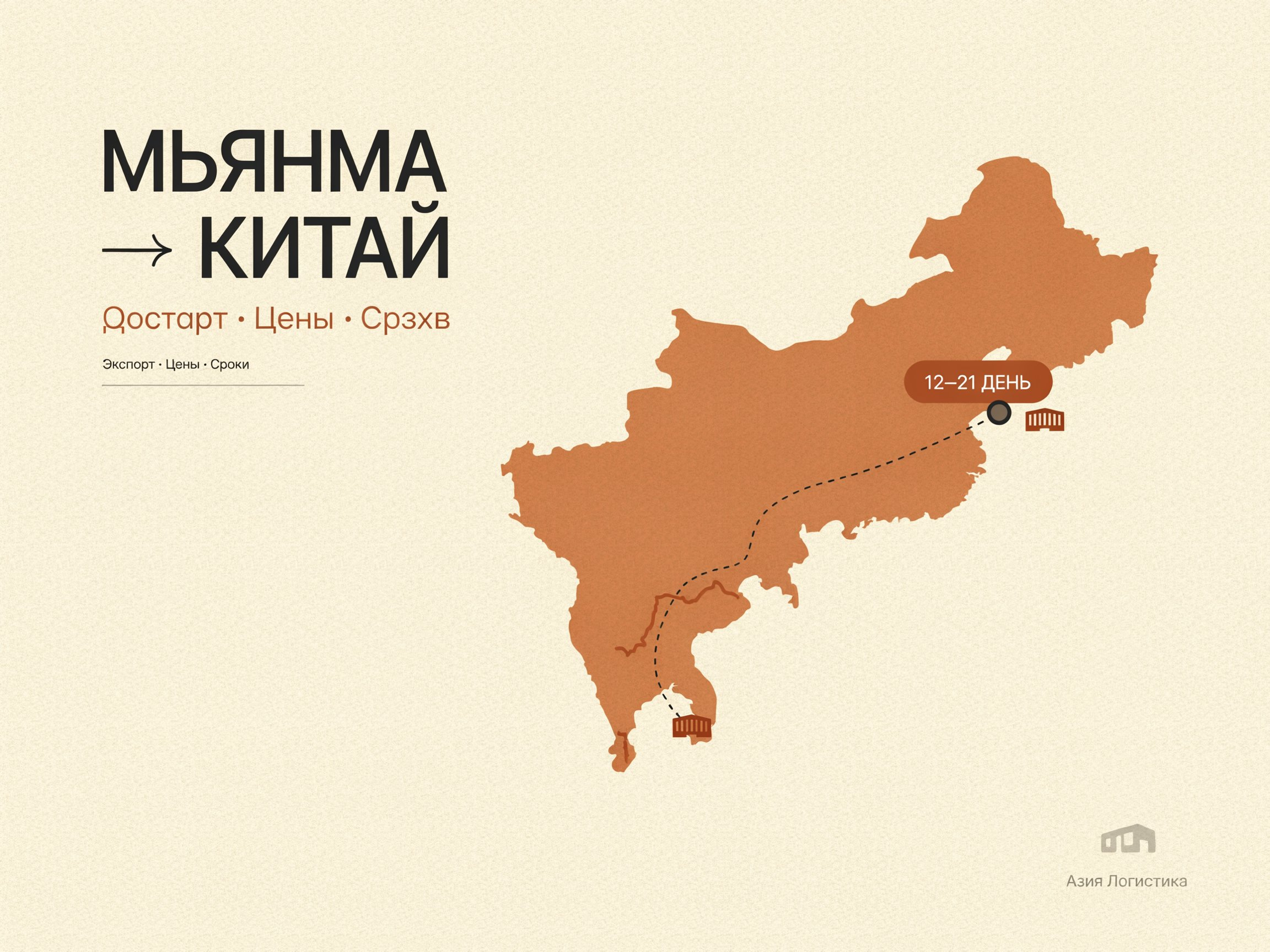
Cargo Delivery from Myanmar to China
Freight Delivery from Myanmar to China: Companies, Prices, Timelines, and Export Documentation
Myanmar and China maintain active trade and economic ties, with cross-border transportation between the two countries increasing annually. Agricultural products, textiles, timber, industrial raw materials, electronics, equipment, and consumer goods are transported through land border crossings, seaports, and international airports. Due to the shared land border, freight delivery from Myanmar to China can be faster than to other Asian countries; however, the final timelines depend on the route, road conditions, congestion at checkpoints, and customs clearance specifics.
For businesses, it is crucial to determine the appropriate mode of transportation in advance, calculate logistics costs, prepare export documents, and check the requirements for specific categories of goods. Errors in shipping documents, incorrect HS codes, or lack of permits can lead to delays, additional expenses, and the return of goods to the sender.
This article provides a detailed overview of the main delivery options along the Myanmar — China route, popular logistics directions, estimated prices, transportation timelines, export documentation procedures, and criteria for selecting a transportation company.
Features of Freight Transportation Between Myanmar and China
Organizing transportation between Myanmar and China has several unique features. Despite the shared border, not every section is suitable for regular international traffic. In practice, carriers use specific road corridors, seaports, and combined schemes with transloading in third countries or at specialized logistics centers.
The main land flow passes through the northeastern regions of Myanmar towards the Chinese province of Yunnan. One of the most well-known routes is through the Muse — Ruili border crossing. It connects the town of Muse in Myanmar with the Chinese city of Ruili and is used for transporting goods to Kunming, Chengdu, Chongqing, Guangzhou, and other regions of China.
The choice of route is influenced by:
type of cargo;
volume and weight of the shipment;
presence of hazardous or perishable goods;
urgency of delivery;
budget of the carrier or importer;
need for "door-to-door" delivery;
availability of consolidation warehouses;
temperature control requirements;
readiness of export documents.
For small shipments, consolidated transportation is often used. In this case, the cargo is combined with shipments from other clients, which reduces transportation costs. However, consolidation requires additional time for receiving, sorting, documentation, and transloading of goods.
Large commercial shipments are usually transported by a separate truck, container, or sea transport. This option allows for better control over timelines and transportation conditions, but its cost is higher.
Main Methods of Freight Delivery from Myanmar to China
Road Transportation Across the Land Border
Road transportation is one of the most sought-after methods for delivering goods from Myanmar to China. Its main advantage is the ability to organize direct movement of the shipment from the sender's warehouse to the recipient's warehouse without a lengthy sea segment.
Road transport is suitable for:
medium-sized commercial shipments;
textile products;
food products, provided sanitary requirements are met;
household goods;
spare parts;
equipment;
packaging materials;
agricultural products.
During transportation, the cargo is delivered to the border terminal in Myanmar, undergoes export control, then crosses the border and is processed on the Chinese side. Depending on the agreements, the cargo may be transloaded from one truck to another. This is due to differences in transport admission rules, technical requirements, and the organization of border terminal operations.
The timeline for road transportation from Myanmar to China typically ranges from several days to two weeks. If the cargo is headed to border cities in Yunnan, delivery can be completed faster. Additional time will be required for internal transportation when heading to central or eastern regions of China.
Sea Delivery
Sea transportation is used for heavy, bulky, and inexpensive goods per unit weight. This method is particularly advantageous for shipping containerized shipments, industrial equipment, raw materials, furniture, construction materials, and large commercial products.
Depending on the route, cargo can be shipped from ports in Myanmar, such as the Yangon area, to Chinese ports. Upon arrival, the container undergoes unloading, customs procedures, and is delivered to the recipient by road or rail transport.
The advantages of sea freight include:
relatively low cost for large volumes;
the ability to use standard containers;
convenience for regular shipments;
high vessel capacity;
the possibility of combining sea delivery with road transport.
The main disadvantage is the longer delivery time. Sea transport includes not only transit time but also container submission, loading, port clearance, waiting for the vessel, transshipment, import clearance, and delivery to the final address.
Air Freight
Air delivery is used for urgent, expensive, light, and compact shipments. Documents, product samples, electronics, medical devices, components, expensive spare parts, and goods sensitive to long storage are transported by air.
The main advantage of air freight is the short delivery times. In some cases, cargo from Myanmar to China can be delivered within a few business days. However, the cost is calculated not only based on actual weight but also on volumetric weight. Therefore, large but light boxes can be expensive to transport.
Before shipping, it is necessary to check:
permissible dimensions and weight;
the presence of batteries;
the composition of chemical substances;
liquid restrictions;
packaging requirements;
the possibility of transporting hazardous materials;
the need for special certificates.
Rail and Multimodal Transport
Rail transport is often used as part of a combined scheme. For example, cargo is delivered by truck to a logistics terminal and then sent by train deeper into China. This option can be convenient for large shipments traveling long distances.
Multimodal delivery combines two or more modes of transport: road, sea, rail, or air. The client signs a contract with one logistics operator, and the company coordinates the entire route.
Advantages of the multimodal scheme include:
the ability to find the optimal combination of cost and speed;
delivery to remote regions;
single route control;
cargo consolidation;
reduced dependence on a single mode of transport.
The downside is the more complex organization. With each transshipment, the risk of damage to packaging, discrepancies in documents, or additional costs increases.
Delivery Time from Myanmar to China
Estimated Delivery Times
The delivery time for the route Myanmar - China depends on the specific city of departure and destination. Seasonal factors, transport format, type of cargo, and customs clearance speed also play a role.
Estimated delivery times are as follows:
| Mode of Transport | Estimated Time |
|---|---:|
| Road delivery to border areas of China | 3–7 days |
| Road transport to Kunming and neighboring cities | 5–10 days |
| Road transport to central regions of China | 8–16 days |
| Sea delivery to a Chinese port | 10–25 days |
| Sea delivery with warehouse delivery | 18–35 days |
| Air transport | 2–6 days |
| Consolidated cargo | 10–25 days |
| Multimodal transport | 12–30 days |
The indicated values are approximate. The actual time is calculated after receiving data about the cargo and route.
Factors Affecting Delivery Duration
The most significant factor is customs clearance. If the documents are prepared correctly, the goods have a clear description, correct classification code, and all necessary permits, the clearance process is faster. In case of discrepancies, customs may request additional information, conduct inspections, or assign expertise.
Seasonality also affects delivery times. During periods of increased trade turnover, the load on border crossings, terminals, and warehouses increases. Additional delays may occur during national holidays, adverse weather conditions, and transportation restrictions.
On land routes, it is necessary to consider road conditions, the operation of border points, the possibility of vehicle replacement, and driver requirements. In some areas of Myanmar, local instability and movement restrictions may affect delivery times.
Cost of Shipping Cargo from Myanmar to China
How Shipping Costs Are Calculated
The delivery price is not a fixed amount. The carrier calculates it based on several parameters:
the weight and volume of the cargo;
the number of packages;
the type of packaging;
the route;
the method of transportation;
the distance from the warehouse to the terminal;
the need for cargo pickup;
customs clearance;
insurance;
warehouse storage;
transloading;
delivery to the final address;
the presence of special conditions.
For air shipments, the calculation is based on the greater value — actual or volumetric weight. In maritime logistics, the cost is often determined by the type of container: 20-foot, 40-foot, refrigerated, or specialized.
Road transport can be calculated per truck, pallet, kilogram, cubic meter, or the entire batch. For consolidated cargo, a rate based on weight or volume is typically used.
Estimated Prices
The exact rate can only be obtained after providing the product specifications. Below are approximate ranges that are used solely for preliminary assessment:
| Type of Transport | Estimated Cost |
|---|---:|
| Consolidated Road Cargo | from $150–350 per m³ |
| Full Truck Load | from $2,500–6,500 |
| Sea Container | from $1,200–4,500 without full set of fees |
| Air Freight | from $5–14 per kg |
| Customs Clearance | from $100–500 and up |
| Delivery to Warehouse in China | calculated separately |
In practice, the final amount may vary in either direction. For example, seasonal demand spikes, non-standard sizes, hazardous cargo, or remote addresses can significantly increase the rate.
It is essential to clarify which services are included in the offer. A low base rate sometimes does not cover border fees, terminal handling, insurance, broker services, storage, and domestic delivery within China.
Major Freight Companies for the Myanmar – China Route
International Logistics Operators
Large international transport and logistics companies typically offer comprehensive services: cargo pickup, consolidation, export documentation, transportation, import declaration, and delivery to the recipient. Their advantage lies in a well-developed network of agents, standardized procedures, and the ability to track shipments.
Such operators are suitable for companies that value:
transparent documentation;
insurance;
regular shipments;
a single contract;
door-to-door delivery;
control at multiple stages of the route;
working with corporate clients.
However, the rates of large international companies may be higher than those of local carriers.
Regional Forwarders
Regional companies have a good understanding of the specifics of land crossings between Myanmar and China, local terminals, and the procedures for working with trade representatives. They can offer more flexible pricing and adapt routes more quickly to non-standard situations.
A regional forwarder is particularly useful for shipments:
from small towns;
through land border crossings;
of consolidated batches;
of goods requiring additional consolidation;
with non-standard documentation.
When choosing such a company, it is necessary to verify its legal status, the presence of a physical office, insurance contract, experience in the specific route, and customer reviews.
How to Choose a Reliable Transport Company
Before signing a contract, you should request a detailed commercial proposal. It should specify the route, type of transport, estimated timelines, list of included services, pricing structure, and any potential additional charges.
A reliable carrier typically:
Requests a complete description of the cargo.
Clarifies the country of origin and final address.
Checks the possibility of exporting and importing the goods.
Provides a contract or forwarding request.
Explains what documents will be required.
Does not promise unrealistically short timelines without caveats.
Informs about risks and limitations.
Provides information about insurance.
Organizes cargo tracking.
Defines the responsibilities of the parties.
Special attention should be paid to companies that only provide the total cost without a breakdown. Before the shipment begins, it is important to understand whether border fees, terminal services, customs brokerage, and delivery within China are included in the rate.
How to Arrange Export from Myanmar to China
Exporter Preparation
The export procedure begins with verifying the seller and the product. The exporting company must have the right to conduct foreign economic activity and comply with the legislation of Myanmar. Additional licenses, quotas, or approvals may be required for certain categories of products.
Before preparing the documents, it is necessary to determine:
the exact name of the product;
the commodity code;
the country of origin;
the value of the product;
the quantity and weight;
the type of packaging;
the delivery terms according to Incoterms;
the point of departure;
the point of destination;
information about the importer in China.
Errors at this stage can lead to complications when submitting the export declaration and subsequent import clearance.
Main Documents
Typically, the following documents are required for export from Myanmar to China:
foreign trade contract;
commercial invoice;
packing list;
transportation bill;
export declaration;
documents of origin;
permission or license, if required by law;
quality certificates;
sanitary and phytosanitary documents;
import permits for China;
insurance policy for cargo insurance.
For food products, plants, animals, wood, pharmaceuticals, and chemical products, the list of documents may be significantly longer. Chinese regulatory authorities have specific requirements for labeling, composition, packaging, and registration of certain categories of goods.
Customs Declaration
The export declaration contains information about the product, sender, recipient, value, quantity, packaging, classification code, and route. The document is submitted to the customs system in the prescribed manner, often through an authorized broker or logistics agent.
After the declaration is submitted, customs may:
release the cargo without inspection;
request additional documents;
verify the declared value;
conduct a physical inspection;
assign weight or quantity control;
require corrections to the information.
On the Chinese side, the importer must comply with local legislation. Depending on the type of goods, import duties, value-added tax, and other payments may be charged.
Packaging and Labeling Requirements
Cargo Packaging
Quality packaging reduces the risk of damage to the product during loading, transportation, transshipment, and storage. For road and sea transport, cardboard boxes, wooden crates, pallets, bags, metal containers, and specialized containers are used.
Packaging must meet:
the nature of the product;
weight and dimensions;
duration of the route;
likelihood of moisture;
temperature conditions;
method of loading;
requirements of the carrier and customs.
Wooden packaging for international transport may require special treatment and labeling according to phytosanitary regulations. If the labeling is missing or incorrectly formatted, the cargo may be delayed at the border.
Labeling
It is recommended to indicate on the packaging:
the name of the product;
the number of packages;
gross and net weight;
dimensions;
country of origin;
sender and recipient information;
order or batch number;
handling symbols;
temperature regime information;
fragility warning.
Labeling must match the information in the invoice and packing list. Any discrepancies may lead to additional questions from customs or the warehouse.
Delivery Terms and Responsibilities of the Parties
When formalizing a deal, it is important to choose the appropriate Incoterms delivery basis. It determines who pays for transportation, insurance, export and import procedures, as well as when the risk transfers from the seller to the buyer.
International shipping can utilize terms such as EXW, FCA, CPT, CIP, DAP, and others. For example, under EXW, the buyer assumes a significant portion of the responsibilities right at the seller's warehouse. With DAP, the seller arranges delivery to an agreed location, but import clearance usually remains the buyer's responsibility.
An incorrectly chosen basis can lead to disputes over who should pay for:
loading;
export clearance;
delivery to the border;
transportation within China;
insurance;
unloading;
customs duties;
storage and demurrage.
All terms should be documented in the contract, invoice, and shipping request. It is also recommended to separately outline responsibilities for delays, damage, shortages, and route changes.
Cargo Insurance Myanmar — China
Insurance is not always mandatory, but for commercial shipments, it is considered a prudent measure of protection. During transport, cargo can be damaged during loading, transloading, accidents, flooding, fire, or improper storage.
When choosing a policy, it is important to check:
the insured amount;
the list of insured risks;
the deductible;
exclusions from coverage;
the claims process;
the list of required evidence;
the notification deadlines for the insurer.
It is important to understand that the carrier's liability is usually limited by the terms of the contract and international transport regulations. If the goods have a high value, the standard liability of the carrier may be insufficient.
To file an insurance claim, photographs of the damages, a commercial act, transport documents, an invoice, a packing list, and a terminal or carrier's report may be required.
Tracking and Delivery Control
After handing over the cargo, the carrier should provide a tracking number, waybill, or another shipment identifier. Depending on the scheme, the client may receive notifications about arrival at the warehouse, border crossing, transloading, customs clearance, and delivery to the recipient.
For regular shipments, it is advisable to use reporting that records:
pickup date;
actual weight;
number of packages;
vehicle or container number;
departure date;
border crossing;
customs status;
arrival date;
confirmation of goods transfer.
This control helps identify delays and respond quickly to route changes. If the carrier does not provide any information after receiving the cargo, it is a concerning sign.
Potential Risks and Mitigation Strategies
Transporting goods from Myanmar to China can involve logistical, customs, and commercial risks. These include:
border delays;
incomplete documentation;
incorrect product code;
discrepancy in value;
damage to packaging;
loss of part of the shipment;
rate changes;
closure or restrictions at the crossing;
additional inspections;
payment delays;
import denial.
To reduce risks, it is essential to verify the counterparty in advance, enter into a written contract, prepare documents, insure the cargo, and agree on a backup route. It is also advisable to build in a time buffer, especially for deliveries by a specific date.
One should not rely solely on the lowest rate. An overly cheap transport option may indicate a lack of insurance, an unofficial clearance scheme, additional fees, or delivery without guaranteed timelines.
Practical Recommendations for Exporters and Importers
Before shipping goods from Myanmar to China, it is recommended to go through several steps:
Prepare a detailed description of the goods.
Clarify the classification code.
Check export and import requirements.
Prepare an invoice and packing list.
Select an appropriate mode of transport.
Request quotes from at least a few companies.
Compare not only the price but also the range of services.
Agree on the Incoterms delivery basis.
Arrange for insurance.
Check packaging and labeling.
Document timelines and responsibilities in the contract.
Obtain documents after the delivery is completed.
If the goods are being shipped for the first time, it is advisable to use the services of a customs broker or freight forwarder with experience specifically in the China-Myanmar route. The specialist will be able to check the set of documents, identify restrictions in advance, and suggest the most suitable logistics scheme.
Shipping cargo from Myanmar to China can be done by road, sea, air, rail, or multimodal transport. Road transport across the land border is suitable for fast commercial shipments, sea transport is advantageous for large and heavy consignments, air delivery is used for urgent and expensive goods, while combined schemes allow for the delivery of cargo to remote regions of China.
On average, cargo from Myanmar to China takes from a few days for air transport or delivery to the border region to several weeks for sea and multimodal logistics. The cost depends on weight, volume, route, type of cargo, season, and the set of additional services.
To arrange export without delays, it is necessary to prepare the contract, invoice, packing list, transport documents, export declaration, and required certificates in advance. Special attention should be paid to the product code, labeling, and requirements from the Chinese side.
A reliable transport company should provide a transparent calculation, a clear route, information on timelines, a list of documents, insurance conditions, and cargo tracking procedures. Comprehensive preparation helps reduce risks, avoid unforeseen expenses, and ensure stable delivery between Myanmar and China.