

 RU
 UA
 DE
 FR
 ES
 CN
 SA
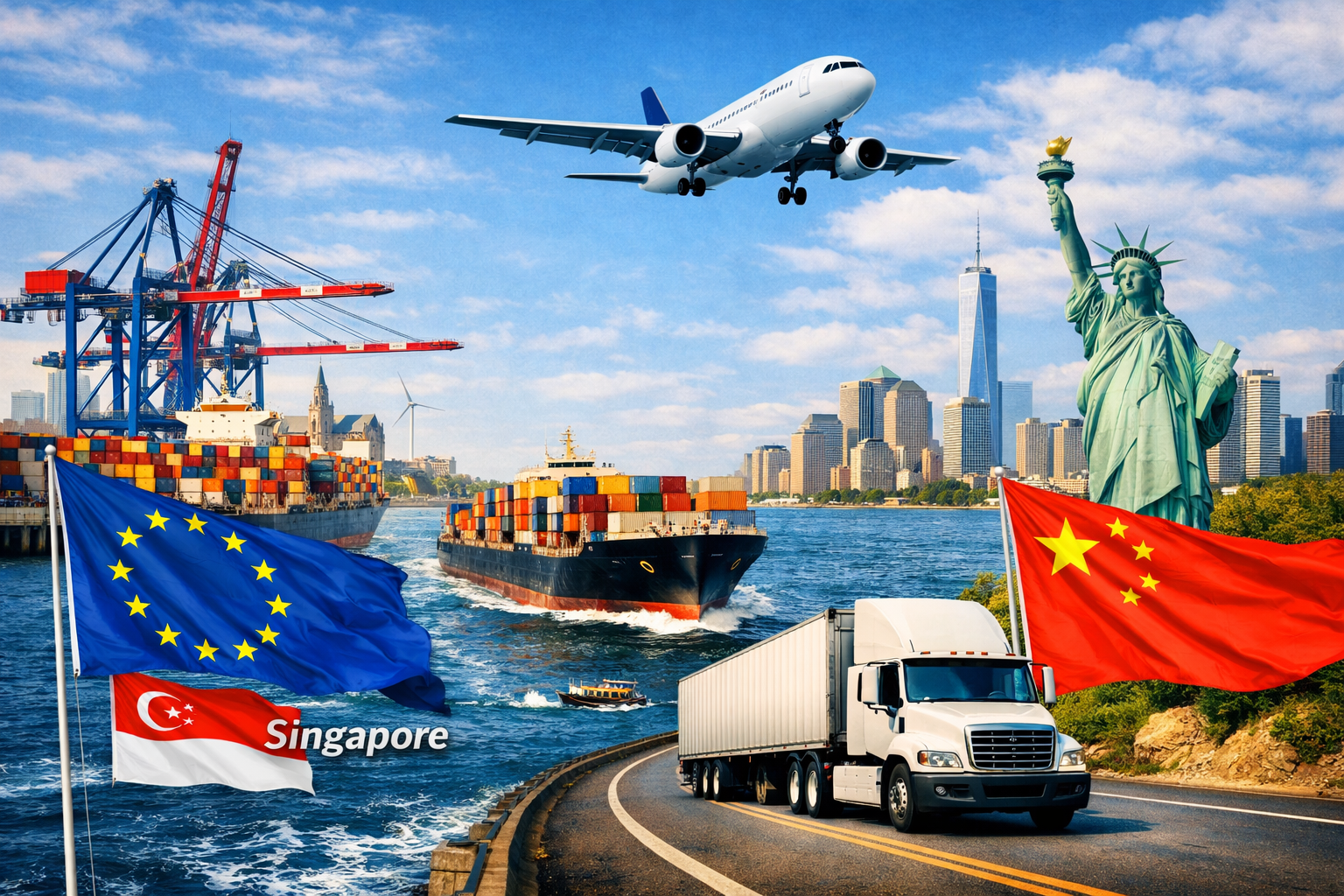
Optimizing International Shipping Times Between Europe and the USA
Optimizing International Shipping Times Between Europe and the USA: Accelerating Delivery and Enhancing Logistics Efficiency
International shipping between Europe and the USA represents a complex system involving manufacturers, freight forwarders, carriers, warehouse operators, customs brokers, insurance companies, and end recipients. The delivery duration is influenced not only by the distance between the continents but also by numerous additional factors: the chosen mode of transport, route specifics, port congestion, documentation regulations, weather conditions, seasonal demand fluctuations, and the quality of interaction among all participants in the supply chain.
Optimizing international shipping times allows companies to reduce costs, bring products to market faster, maintain necessary inventory levels, and improve customer service quality. Achieving results requires more than just selecting the fastest transport. It is essential to establish a unified logistics strategy that integrates planning, cargo routing, digital monitoring, risk management, and timely customs clearance.
The Importance of Optimizing International Shipping Times Between Europe and the USA
The speed of international delivery directly impacts business competitiveness. If cargo is delayed, a company may face product shortages, production halts, breaches of contractual obligations, fines, and loss of customer trust. Industries dealing with seasonal products, electronics, automotive components, pharmaceuticals, perishable goods, and items with short life cycles are particularly sensitive to delivery times.
However, accelerating shipping should not come at the expense of uncontrolled budget increases. The main task of logistics is to find a balance between speed, cost, safety, and delivery predictability. The optimal route is not always the shortest path. Sometimes a longer route can help avoid congested ports, complicated transshipments, or unstable sections of the transport network.
How Delivery Times Affect Business
The duration of international shipping determines the amount of working capital tied up in inventory. The longer goods are in transit, the more products a company must store in warehouses to prevent shortages. Accelerating delivery allows for reduced safety stock, lower warehousing costs, and quicker responses to demand changes.
Reducing transportation time also helps improve planning accuracy. When a business has reliable information about the cargo's location and estimated arrival date, it can organize unloading in advance, prepare the warehouse, coordinate delivery to the customer, and minimize transport downtime.
For international trade, predictability is especially important. Even a relatively long route can be more advantageous than a fast but unstable option if its timelines are easily forecasted. Therefore, logistics efficiency is assessed not only by average delivery duration but also by the number of deviations from the planned date.
Main Causes of Delays
The most common reasons for increased delivery times between Europe and the USA include:
insufficient preparation of commercial and transport documents;
errors in invoices, packing lists, and product classification;
customs delays;
seasonal congestion at seaports;
shortage of containers or transport capacity;
lack of coordination among supply chain participants;
incorrect route selection;
complex multimodal transport schemes;
adverse weather conditions;
technical malfunctions of ships, aircraft, or ground transport;
limited visibility of cargo movement;
untimely data transfer between information systems.
Addressing these factors requires not one-time measures but systematic management of the entire supply chain.
Choosing the Optimal Mode of Transport
Selecting the right mode of transport is one of the key tools for accelerating international delivery. Between Europe and the USA, maritime, air, road, rail, and multimodal schemes are used. Each option has its own advantages, limitations, and areas of application.
Maritime Transport
Maritime transport remains the primary method for moving large shipments between Europe and the USA. It is suitable for container shipments, industrial equipment, vehicles, raw materials, furniture, consumer goods, and other items where cost-effectiveness is more critical than maximum speed.
The key advantage of sea logistics is its high cargo capacity and relatively low cost of transporting a single unit of goods. However, the duration of delivery depends on the chosen ports of departure and destination, vessel schedules, the number of transshipments, weather conditions, and terminal congestion.
To optimize sea transportation, it is essential to choose direct services or routes with minimal transshipments. Container capacities should be booked in advance, peak periods should be taken into account, and the actual reliability of the carrier should be verified. Sometimes using an alternative port can reduce the overall delivery time, even if the distance to it is greater.
Aerial Transportation
Air freight is used for urgent, expensive, compact, or time-sensitive cargo. Airplanes significantly shorten the transatlantic segment of the route; however, the cost of this solution is considerably higher than that of sea transport.
The efficiency of air transportation depends not only on flight time. Important factors include the delivery of cargo to the airport, terminal processing, customs clearance, sorting, and transportation to the final recipient. If the ground stages are poorly organized, the advantages of air transport may be partially lost.
To expedite air delivery, pre-agreed acceptance windows, electronic document processing, direct flights, shipment consolidation, and delivery through airports with developed cargo infrastructure are utilized.
Multimodal Transportation
Multimodal transportation combines several modes of transport within a single logistics scheme. For example, cargo may be delivered by truck to a European port, then by sea to the USA, and after arrival—by rail or truck to the final warehouse.
This approach allows for cost optimization and the use of the advantages of different transport systems. However, as the number of stages increases, so does the risk of delays, damage, and errors in cargo transfer. Therefore, a multimodal scheme requires precise scheduling, a single coordinator, and quality information exchange.
Optimization of Cargo Routing
Cargo routing is the process of selecting the most efficient sequence of transport operations considering timeframes, costs, risks, and product characteristics. In international transportation between Europe and the USA, it is necessary to consider not only the starting and ending points but also all intermediate links.
Route Selection Criteria
When developing a route, the following should be analyzed:
the distance between the points of departure and destination;
processing time at ports, airports, and terminals;
the number of transshipments;
the possibility of using a direct service;
the availability of alternative ports;
customs specifics;
restrictions on cargo type and weight;
the likelihood of seasonal delays;
the reliability of the carrier;
the availability of temporary storage facilities;
the cost of the last mile;
the ability to track cargo in real-time.
The route should be evaluated as a single chain. A fast sea segment will not yield results if the cargo waits several days for a truck at the destination port. Similarly, air transport will not be effective if there are lengthy document approvals at the point of departure.
Direct and Alternative Routes
Direct routes usually reduce the number of transshipments and lower the risk of cargo damage. However, they may have limited schedules or higher prices. Alternative routes through another port or transport hub sometimes provide more stable delivery.
To make a decision, it is useful to compare several scenarios:
a standard economical route;
an expedited route;
a combined multimodal scheme;
a backup route in case of congestion;
an urgent air option for critical shipments.
Having pre-prepared alternatives allows for quick responses to market changes and avoids the need to develop a new route after a problem arises.
Customs Clearance as a Factor in Delivery Speed
Customs procedures often become one of the main reasons for delays in international shipments. Even a well-organized transport route can lose several days due to document errors, incorrect product descriptions, or missing necessary permits.
Document Preparation
To expedite customs clearance, it is essential to check the document set in advance. Depending on the nature of the shipment, the following may be required:
commercial invoice;
packing list;
transportation invoice;
certificates of origin;
compliance documents;
licenses and permits;
information about the value of goods;
commodity codes;
insurance documents;
documents for packaging and labeling.
All data in the documents must match. Discrepancies in weight, number of packages, value, or product description can lead to additional requests and inspections.
Pre-declaration
Preliminary data submission to customs authorities allows for checks to begin before the cargo arrives. This approach reduces the time goods spend in port or airport and helps identify discrepancies in advance.
Companies are advised to create standard document templates, use electronic document management, and assign responsible employees for information control. It is also important to determine the product classification code in advance and check the import requirements for the USA or European countries.
Working with a customs broker
An experienced customs broker helps reduce the likelihood of errors and speeds up the clearance process. They oversee declarations, interact with government agencies, verify applicable rates, and ensure compliance with regulatory requirements.
However, one cannot completely shift responsibility to the broker. The cargo owner must provide accurate information about the product, its purpose, composition, value, and origin. The better the initial data, the faster the clearance process.
Supply Chain Management
Optimizing international transportation is impossible without comprehensive supply chain management. Transportation is just one stage. The overall timeline is influenced by production, assembly, packaging, consolidation, warehousing, export procedures, import, delivery to the distribution center, and the last mile.
Synchronization of participants
All participants in the logistics process must work according to a unified plan. The manufacturer must prepare the order on time, the warehouse must ensure shipment, the carrier must provide transportation, the forwarder must coordinate the route, and the recipient must prepare for acceptance.
Delays at any stage can affect the entire shipment. Therefore, it is recommended to establish checkpoints and designate responsible individuals. For each stage, it is necessary to determine the planned timeframe, acceptable deviation, and actions to take in case of schedule disruptions.
Consolidation of cargo
Consolidation allows combining small shipments into one transport batch. This reduces transportation costs and can increase container loading efficiency. However, consolidation requires precise planning, as waiting for other cargo can extend the shipping time.
For urgent deliveries, it is better to use partial consolidation or separate transport. Savings from batch consolidation should be weighed against potential losses from delays.
Inventory Management
Reducing delivery times is closely related to proper inventory management. If deliveries are stable and predictable, a company can reduce its stock reserves. However, if routes are frequently delayed, a larger safety stock must be maintained.
To enhance efficiency, demand forecasting, turnover analysis, needs planning, and inventory distribution across multiple warehouses are employed. Regional distribution centers in Europe and the USA help bring goods closer to the end customer and reduce last-mile time.
Digitalization and Cargo Movement Control
Modern global logistics actively uses digital technologies for managing timelines. Information systems allow tracking cargo, controlling documents, predicting delays, and quickly restructuring routes.
Real-time tracking
Monitoring systems provide data on the location of containers, vessels, vehicles, or air shipments. Depending on the equipment, information about temperature, humidity, impacts, tampering, and other parameters can be obtained.
Online tracking helps promptly detect deviations from the route. If a vessel is delayed, the logistics manager can proactively change the delivery from the port, reschedule the warehouse window, or notify the client.
Integration of information systems
Effective management requires integrating data from the manufacturer, forwarder, carrier, warehouse, broker, and recipient. Integration reduces manual data entry and minimizes the risk of errors.
In logistics, the following can be used:
transport management systems;
warehouse systems;
order management platforms;
electronic data interchange;
enterprise resource planning systems;
digital booking platforms;
analytical dashboards;
forecasting tools for delivery times.
A unified information environment allows you to see the entire route from the supplier to the customer, rather than just separate fragments of the transportation process.
Delay Forecasting
Analytical tools can take into account data on weather, port congestion, vessel schedules, road conditions, and the historical performance of carriers. Based on this information, a forecast for the actual arrival date is generated.
Forecasting is especially important for shipments with strict delivery deadlines. The company gains the ability to proactively choose an alternative route, change transportation modes, or redistribute inventory.
Reducing Processing Time at Ports and Terminals
Port processing can take a significant portion of the total duration of international transportation. Even if the transatlantic crossing is on schedule, the cargo may be delayed due to unloading queues, equipment shortages, late document receipt, or issues with container pickup.
Port Selection
When selecting a port, it is essential to evaluate not only its geographical location but also its actual performance. Important factors include container processing speed, availability of rail and road routes, warehouse facilities, customs infrastructure, and frequency of delays.
Sometimes, it is more advantageous to use a less congested port that is located further from the final recipient. The additional ground leg can be offset by faster processing and fewer delays.
Export Planning
Once the cargo arrives, it is necessary to organize its export in advance. This involves booking truck or rail capacity, coordinating time windows, and checking document readiness.
Monitoring the free storage period of the container is particularly important. If the cargo is not picked up on time, additional costs and operational complications may arise. A notification system helps ensure critical dates are not missed.
Using Warehouses Near the Port
An intermediate warehouse allows for temporary storage of cargo and more flexible organization of further distribution. This is especially useful for large shipments, variable volumes, and the need to distribute goods across multiple regions.
However, warehouse processing must be planned in advance. Additional handling can increase time and costs, so a warehouse should only be used when there is a clear operational task.
Transport Efficiency and Reducing Operational Losses
Transport efficiency is determined not only by speed. It includes load completeness, utilization levels of transport capacities, number of empty runs, planning accuracy, handling costs, and delivery reliability.
Load Optimization
Proper packaging allows for increased cargo quantity in the container, reduces the risk of damage, and decreases the number of shipments. Weight, volume, centering, and compatibility limitations of different cargo categories must be considered.
Using standard packaging sizes simplifies consolidation. For regular shipments, it is beneficial to analyze actual loading and adjust the design of the containers.
Reducing Downtime
Downtime occurs while waiting for documents, transport, loading, unloading, customs decisions, or warehouse availability. To minimize them, schedules should be coordinated in advance, and automatic notifications should be utilized.
It is also important to analyze the reasons for each deviation. If delays regularly occur in one area, the process should be reviewed, the service provider changed, or a backup option created.
Carrier Performance Evaluation
When selecting a carrier, one should not rely solely on rates. It is necessary to evaluate:
compliance with declared timelines;
percentage of delays;
quality of tracking;
speed of request processing;
availability of backup capacity;
handling of claims;
number of damages;
schedule stability;
quality of documentation support.
A comprehensive evaluation helps to choose not just a cheap, but a truly effective logistics partner.
Risk Management in International Logistics
Even a well-planned shipment can encounter unforeseen circumstances. Therefore, risk management should be part of the overall strategy for optimizing timelines.
Main Logistics Risks
The most significant risks include:
port closures or congestion;
strikes;
political restrictions;
changes in customs regulations;
extreme weather events;
container shortages;
damage or loss of goods;
information system failures;
carrier bankruptcy;
last mile delays.
Each risk should have an assessment of probability, potential impact, and a pre-prepared response plan.
Contingency Scenarios
A contingency plan may include:
an alternative port;
another carrier;
a backup mode of transport;
an additional warehouse;
the option to split the shipment;
switching part of the cargo to air freight;
increasing insurance reserves;
changing the production schedule.
Splitting shipments often helps reduce the risk of complete delivery stoppage. Critical goods can be sent via expedited methods, while less urgent items can take a more economical route.
Cargo Insurance
Insurance does not directly shorten delivery times, but it mitigates the financial consequences of unforeseen events. When transporting expensive, fragile, or sensitive goods, insurance coverage helps protect the business from losses.
The terms of the policy should match the actual route, type of transport, packaging, and potential risks. It is important to determine in advance the procedure for document processing in case of damage or loss of cargo.
Practical Strategy for Accelerating Delivery Between Europe and the USA
Companies looking to optimize international shipping can use a step-by-step approach.
Step 1. Analyze the Current Supply Chain
First, it is necessary to examine the actual route and identify where delays occur. This includes analyzing production time, packaging, transport waiting times, customs clearance, port handling, and delivery to the customer.
Step 2. Identify Priority Shipments
Not all goods require the same speed. Shipments should be categorized by urgency, value, sensitivity to transport conditions, and the consequences of delays.
Step 3. Compare Transport Schemes
For each product category, compare sea, air, and multimodal options. Evaluate total "door-to-door" times, not just the time spent in transit.
Step 4. Prepare Documentation
Standard forms, checklists, and digital approval procedures are created. Documents are prepared before transport begins, and key information is provided to the broker in advance.
Step 5. Set Up Monitoring
A tracking system is implemented, checkpoints are assigned, and automatic notifications for delays are established.
Step 6. Develop Backup Routes
For critical routes, alternative ports, carriers, and modes of transport are identified in advance.
Step 7. Continuous Results Analysis
After each delivery, the planned and actual timelines, reasons for deviations, costs, and service quality are evaluated. Based on the analysis, routes and agreements with partners are adjusted.
SEO Optimization and Key Queries in Logistics Content
The topic of international shipping between Europe and the USA has a broad semantic coverage. To promote informational and commercial materials, key phrases that align with user intentions are used:
international shipping between Europe and the USA;
delivery time optimization;
accelerating international delivery;
logistics between Europe and the USA;
cargo routing;
shipping goods from Europe to the USA;
shipping goods from the USA to Europe;
supply chain optimization;
reducing transport time;
transport efficiency;
global logistics;
multimodal shipping;
sea freight Europe – USA;
air freight between Europe and the USA;
customs clearance for international cargo;
tracking international shipments;
managing delivery timelines.
Keywords should be distributed naturally, avoiding overloading the text with repetitions. It is important to cover the topic substantively, use thematic synonyms, and answer real audience questions. For SEO, the structure of headings, logical internal linking, clear meta descriptions, lists, tables, and user-friendly navigation are also important.
Optimizing international shipping times between Europe and the USA requires a comprehensive approach. Simply choosing a faster mode of transport is not enough. It is essential to analyze the entire supply chain: from product preparation and document processing to port handling, customs control, domestic delivery, and the transfer of cargo to the final recipient.
The most effective tools include the correct selection of transport schemes, reducing the number of transshipments, pre-customs clearance, digital tracking, using alternative routes, synchronizing participants, and continuously analyzing actual results. Inventory management, contingency planning, carrier evaluation, and bottleneck control play a significant role.
Companies that systematically manage delivery times not only achieve faster logistics but also enhance business resilience. Reducing transit time helps lower warehousing costs, improve customer service, accelerate capital turnover, and compete more effectively in the international market. Well-structured global logistics becomes a strategic advantage, enabling predictable supply management even in an unstable transport environment.