

 RU
 UA
 DE
 FR
 ES
 CN
 SA
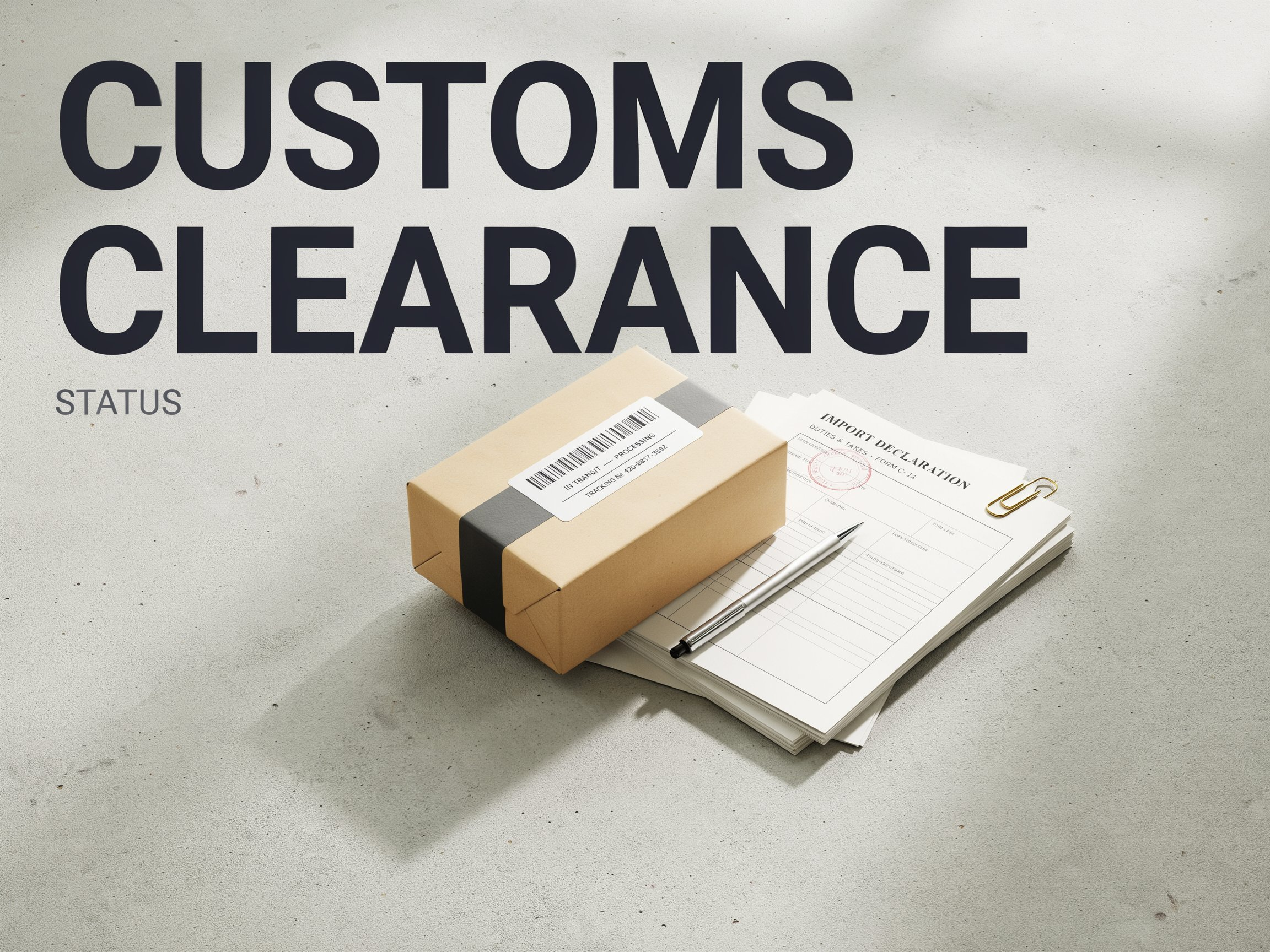
Customs Clearance Status for International Packages
What Does the Status "Customs Clearance" Mean for an International Parcel
International shipping involves several mandatory stages: sending the parcel, transportation between countries, arrival in the destination country, border inspection, and transfer of the shipment to the local delivery service. One of the most important stages is displayed in the tracking system as the status "customs clearance." In English, it may be referred to as customs clearance status, customs processing, customs inspection, clearance delay, or similar phrases.
For the recipient, this status often causes concern. It seems that the parcel has stopped, gotten lost, or that serious problems have arisen. However, in most cases, customs clearance is a standard procedure that international shipments undergo. Customs authorities check the documents, product description, its value, category, country of origin, and compliance with legal requirements.
The duration of the procedure depends on several factors: the destination country, type of delivery, the performance of the specific carrier, the contents of the parcel, the accuracy of the documents, and the need to pay customs duties. Sometimes the inspection takes a few hours, while in complex cases, it may last several days or even weeks.
Below, we will take a closer look at what the customs clearance status means, the stages an international parcel goes through, why delivery delays occur, and what the recipient can do.
What is the "Customs Clearance" Status and Why Does It Appear
The status "customs clearance" means that the international parcel has arrived in the destination country or transit point and has been handed over for inspection to the customs service. At this stage, government authorities determine whether the import of the goods is permitted, whether the documents are correctly completed, and whether duties, taxes, or other fees need to be paid.
Customs clearance is a mandatory part of international logistics. Even if the sender used express delivery, the parcel may not always be handed over to the courier immediately after arriving at the airport or sorting center. The carrier is required to present cargo data to customs authorities, who then decide on the release of the shipment.
In the international parcel tracking system, the same process may be referred to differently. For example:
Customs clearance;
Customs processing;
Clearance in progress;
Import customs;
Held by customs;
Customs inspection;
Awaiting customs documents;
Import duties pending;
Shipment under customs control.
The wording depends on the company handling the transportation. At DHL, UPS, FedEx, national postal services, and marketplaces, the names of the statuses may vary, although they refer to the same stage.
It is important to understand the difference between normal processing and problematic delays. If the status has appeared recently and does not change for one or two days, this is usually a normal situation. Customs authorities handle a large number of shipments, so updates may not appear immediately. Additionally, information in the tracking system is sometimes uploaded with a delay.
If the status remains unchanged for an extended period, the carrier may request additional information. Most often, this concerns the value of the goods, payment documents, description of the contents, recipient's passport details, or confirmation of the purchase destination.
What Actions Are Taken at Customs
During the customs processing, specialists or an automated system check:
information about the sender and recipient;
description of the contents of the parcel;
quantity and value of the goods;
commodity code;
country of manufacture;
presence of import restrictions;
compliance of documents with the actual contents;
need for duties and taxes to be assessed.
In some cases, the parcel may be directed for physical inspection. This does not necessarily indicate a violation. Inspections may be conducted randomly, based on the category of goods, value, or due to discrepancies in the declaration data.
How Customs Clearance of an International Parcel Works
The customs process consists of several sequential stages. The exact number depends on the country, carrier, and type of shipment; however, the overall scheme usually remains the same.
First, the carrier transmits electronic data about the package to customs. This includes addresses, weight, value, product description, quantity of items, and document information. For commercial shipments, additional documents such as an invoice, packing list, contract, certificate of origin, and permits may be required.
Next, the customs system analyzes the information. If the shipment is categorized as low risk and its value does not exceed the established duty-free limit, it may be released automatically. After that, the package is sent to a sorting center or courier service.
If the data is insufficient, a manual check begins. Customs may request confirmation of the product's price from the recipient. Such confirmation is typically accepted in the form of an electronic receipt, bank statement, order screenshot, invoice from the online store, or a link to the product page.
The next stage involves calculating payments. If the shipment's value exceeds the duty-free threshold or the product is subject to special fees, the system determines the amount of customs duty, value-added tax, and other mandatory payments. In some countries, broker fees or administrative charges from the carrier may also be added to the total.
After all requirements are met, a decision is made regarding the release. The tracking status may appear as:
Customs clearance completed;
Import clearance successful;
Released by customs;
Customs cleared;
Shipment released.
Then the package is handed over for domestic delivery. Sometimes there may be a delay of several hours between the completion of clearance and the appearance of a new status, as the shipment needs to be physically moved from the customs terminal.
Why customs may take longer than usual to check a package
The speed of clearance is affected by seasonal peaks, holidays, sales, a high volume of international orders, and staff shortages. Delays may also occur due to complex product classification. For example, electronics, cosmetics, pharmaceuticals, food products, batteries, children's items, and products made from natural materials may require additional scrutiny.
Issues can also arise from inaccurate descriptions. Phrases like “gift,” “sample,” or “accessories” may not provide enough information. The customs inspector needs to understand what exactly is inside, what material the product is made of, and what its actual price is.
What the customs clearance status means for DHL, UPS, and FedEx
Major international carriers use their own tracking systems, so the same stage may be displayed differently. In practice, the statuses from DHL, UPS, and FedEx have similar meanings but may indicate different actions within the process.
For DHL, you may encounter phrases related to the arrival of the shipment in the destination country, the start of import clearance, the need to provide documents, or waiting for payment. For example, the status may indicate that the package is at customs, awaiting a decision from the regulatory authority, or temporarily held until information is received from the recipient.
For UPS, messages like “Your package is pending release from a non-UPS broker,” “Import scan,” “Clearance in progress,” or “Additional information is needed” are often displayed. This may mean that UPS has submitted information to customs, but the release is not yet complete. Sometimes the carrier may indicate the need to provide a tax number, invoice, or product description.
For FedEx, statuses like “Clearance delay,” “International shipment release,” “Clearance in progress,” and similar notifications are used. The term clearance delay directly indicates a delay in customs release, but it does not always signify a serious problem. The cause may simply be a routine wait for inspection, a holiday, or a request for additional documents.
Why tracking data may update with a delay
The carrier's tracking system does not always receive information from customs in real-time. Some operations are performed within the departmental information system, and data is transmitted to the carrier in batches. Therefore, the package may already be at the next stage, even though the previous status is still displayed in the public tracker.
Additionally, the carrier may show only aggregated data. For example, several internal operations may be grouped under a single label of “customs clearance.” This can make it difficult for the recipient to understand whether an inspection, payment calculation, physical examination, or release is expected.
If the status of DHL, UPS, or FedEx hasn't changed for several days, it is recommended to open the detailed shipment page and check the section with additional notifications. Sometimes there is a request there that does not appear in the brief version of the tracker.
How long does customs processing take and when to start worrying
There is no universal timeframe for customs clearance. Simple shipments can pass inspection in a few hours. In other cases, the process takes from two to five business days. If documents are required, a physical inspection, consultation with another agency, or payment of duties is needed, the timeframe increases.
Typically, you can expect the following intervals:
up to 24 hours — standard automatic processing;
from 1 to 3 business days — regular inspection or high workload;
from 3 to 7 business days — possible request for documents or payment calculations;
more than a week — it's advisable to contact the carrier;
several weeks — unresolved issues, restrictions, or the need for a customs broker may be likely.
It is important to consider calendar weekends and public holidays separately. If the package arrives before the weekend, movement may resume only after several business days.
Reasons to contact customer support include the following situations:
status hasn't changed for more than five to seven business days;
the tracker indicates that documents are needed;
there is a note about unpaid duties;
the carrier reports an inability to contact the recipient;
there is a discrepancy in value or contents;
the package has been sent for additional inspection;
the status "held by customs" appears without further explanation;
the delivery time has significantly exceeded.
It is important not to wait too long if the carrier explicitly requests information. In some countries, shipments may be returned to the sender if documents are not provided within the specified timeframe.
What documents may be needed for package release
The list of documents depends on the country, type of goods, and their value. For a typical consumer order, it is usually sufficient to confirm the recipient's identity and the purchase price. However, in certain situations, the list of requirements may be broader.
The most commonly requested documents include:
passport details or identification data;
tax identification number;
invoice from the online store;
electronic receipt;
proof of payment;
bank statement;
order screenshot;
link to the product page;
description of the contents;
power of attorney for the customs representative;
certificate of conformity;
license or import permit;
documents of origin of the goods.
If the package is sent by an individual, they may ask to clarify whether the shipment is a gift, personal item, sample, or commercial batch. It is important to respond accurately and not undervalue the cost. Inaccurate information can lead to delays, recalculation of payments, fines, or confiscation of goods.
Documents should be submitted through the official channel of the carrier. Do not send passport details to a random email address or provide them to unknown intermediaries. Check the domain of the website, tracking number, and contact details provided in the official tracker of DHL, UPS, FedEx, or the postal service.
How to properly describe the contents of the shipment
The description should be specific. Instead of the word "goods," it is better to write "cotton sports t-shirt," "wireless headphones," "ceramic mug," or "mobile phone case." For multiple items, it is advisable to specify the name of each, quantity, material, and value.
If the product consists of several components, this should also be indicated. For example, a cosmetics set, an electronics kit, or a device with a battery may fall under different rules. The more precise the description, the lower the likelihood of additional questions.
Customs duties, taxes, and other payments
One of the most common reasons for delays is the need to pay import fees. Customs duties are tariffs that may be charged when exceeding the duty-free limit or when importing certain categories of goods. In addition to duties, the country's legislation may provide for VAT, excise tax, environmental fees, document processing fees, and customs broker services.
The amount of payment depends on several parameters:
declared and confirmed value of the goods;
cost of delivery and insurance;
product category;
country of origin;
quantity of goods;
import regime;
personal or commercial nature of the shipment;
applicable limits and rates.
The exact formula is set by the destination country. In some countries, the payment is calculated only on the amount exceeding the duty-free threshold. In others, the tax base includes the value of the goods, delivery, and insurance.
If the package is sent by courier, the carrier may contact the recipient for payment through a personal account or a secure link. Sometimes the sender pays in advance if a rate with included taxes and duties is chosen. In international trade, this may be referred to as DDP – delivery with duties paid by the seller. In the DAP option, part of the obligations falls on the recipient.
Do not pay fees via links from suspicious messages. Scammers often use well-known names like DHL, UPS, or FedEx and demand a small amount for "unlocking the package." Verify information only on the official website by entering the tracking number manually.
Why delivery delays occur due to customs
Delivery delay during international shipping does not always mean the loss of the shipment. Most often, the delay is related to the package being between stages of inspection, payment calculation, and transfer to the local operator.
The main reasons may include:
incomplete or inaccurate description of the goods;
absence of an invoice or receipt;
incorrectly stated value;
errors in the address or recipient's details;
exceeding the duty-free limit;
need to pay taxes;
physical inspection;
seasonal load;
weekends and holidays;
restriction on the import of certain goods;
suspicion of a commercial shipment;
need for approval from another government agency;
damage to packaging;
discrepancy between weight and declared data;
lack of communication with the recipient.
Shipments containing goods that require special conditions are particularly often delayed. These may include medicines, food products, seeds, plants, liquids, batteries, leather, fur, and wood products. Customs may check not only the legality of import but also sanitary, veterinary, phytosanitary, and technical requirements.
In case of a delay, do not immediately file a missing package report. First, determine if there is an official request for documents or payment regarding the shipment. If the recipient does not respond, the package may be returned to the sender, destroyed, or stored according to local regulations.
What to do if the package is stuck in customs
The first step is to check the tracking number on the official website of the carrier. Do not rely solely on third-party services: they sometimes show outdated or incomplete information. Review the event history and ensure there is no request for documents, payment, or address confirmation.
Next, contact the carrier. Provide the tracking number, recipient's full name, date of birth, or other details if requested by customer support. Ask:
where the package is physically located;
whether customs clearance has started;
whether additional documents are needed;
whether duties have been assessed;
who is responsible for paying them;
whether there is a deadline for providing information;
whether the carrier can act as a broker;
what will happen if there is no response.
If documents are needed, prepare them in a readable format. File names should be clear, and the information must match the data in the order. Do not alter receipts or undervalue the goods.
If a customs broker is required, the carrier usually provides the relevant instructions. For expensive, commercial, or complex shipments, it may be necessary to contact the customs authority independently. In this case, it is advisable to learn the procedure and list of required documents in advance.
After providing the information, check the tracking number daily. Updates may not appear immediately. If there is no response within a few business days, contact customer support again and keep records of inquiry numbers, emails, and receipts.
What to do if the package does not clear customs
Sometimes customs decides not to release a shipment. This may be due to prohibited content, quantity restrictions, lack of a license, inaccurate declaration, or inability to confirm the value.
Possible outcomes include:
the recipient is allowed to provide additional information;
the package is released after paying duties;
the goods are sent for inspection;
the shipment is returned to the seller;
the contents are seized completely or partially;
the package is destroyed according to established procedures;
the recipient is offered to refuse the import.
If you believe the decision is incorrect, you can request an official explanation and the procedure for appeal. Do not attempt to pressure the inspector, hide information, or use counterfeit documents. Such actions can only worsen the situation.
When purchasing from an online store, it is also necessary to contact the seller. If the item cannot be delivered due to the legal specifics of the destination country, the seller sometimes agrees to arrange a return. However, the costs for return shipping, duties, and fees depend on the store's policies and the chosen shipping method.
Features of International Package Tracking
International parcel tracking services gather information from multiple sources: carrier systems, customs authorities, airports, sorting centers, and national postal services. Therefore, statuses may appear at different speeds and not always in a strictly sequential order.
For example, the tracker may display statuses simultaneously or in an unusual order:
the shipment has left the sender's country;
arrived in the destination country;
accepted by customs;
awaiting processing;
handed over to the local operator;
located in a sorting center;
on its way to the courier.
Sometimes the local operator creates a new tracking number. In this case, the original number continues to show the international stage, while the internal number allows you to see further delivery within the destination country.
Third-party aggregators are convenient for preliminary checks, but their data is not always official. For issues related to documents, payments, and delays, use the specific carrier's website. If the shipment has been handed over to the national postal service, also check its official resource.
How to Reduce the Risk of Customs Clearance Issues
Most delays can be prevented before shipping. When ordering a product, it is essential to check the import rules of the destination country, duty-free limits, and restrictions for specific categories of goods.
It is recommended to:
provide an accurate description of the goods;
use the actual value;
verify the recipient's name and address;
keep the invoice and payment confirmation;
clarify any restrictions in advance;
not to combine multiple identical items into one package;
consider the shipping cost when calculating payments;
choose a carrier that provides customs support;
respond promptly to delivery service inquiries;
not to transmit documents through unofficial channels.
The seller should also correctly prepare commercial documents and electronic declarations. Errors on the sender's side often lead to the recipient needing to provide additional confirmations.
Before purchasing expensive equipment, medical products, cosmetics, food items, or products with batteries, it is advisable to familiarize yourself with the requirements of the specific country. Information on the store's website does not always take into account the import rules of the recipient's country.
Frequently Asked Questions about the "Customs Clearance" Status
Does this status mean the package is lost?
No. The customs clearance status means that the shipment is undergoing customs inspection or awaiting its completion. It does not indicate that the package is lost. If the information does not update for too long, you should contact the carrier to clarify the reason.
Do I need to go to customs myself?
In most cases, no. DHL, UPS, FedEx, and other large companies interact with customs authorities on their own. The recipient only needs to provide documents or pay the assessed fees. Personal visits are mainly required for complex, expensive, or commercial shipments.
Why has the package already arrived in the country but has not yet been delivered?
Arrival in the country does not mean the end of the import process. The package may be awaiting inspection, payment calculations, value confirmation, or transfer to a local carrier. Courier delivery usually does not begin until customs releases the shipment.
Can the status remain unchanged for several days?
Yes. This can happen during high volume periods, weekends, physical inspections, or while waiting for documents. If the time exceeds the usual period, check the carrier's messages and contact support.
Who pays the customs fees?
This depends on the delivery terms. Under some rates, the recipient bears the costs, while under others, the seller includes them in the price in advance. If the order does not specify otherwise, be prepared for possible payment of import fees.
What does clearance delay mean?
The phrase clearance delay translates to "customs clearance delay." It may be caused by waiting for documents, tax calculations, content inspections, or technical delays. For an accurate answer, check additional comments in the tracking or contact the carrier.
The status "customs clearance," customs clearance status, or customs processing is a normal part of international shipping. It indicates that the package is undergoing import control, and the carrier and customs authorities are checking the documents, contents, value, and the possibility of importing the goods.
In most cases, clearance is completed automatically or after providing simple information. However, delays may increase if there are errors in the declaration, the value is unverified, the duty-free limit is exceeded, or customs duties and taxes need to be paid.
The recipient should regularly check the official tracker of DHL, UPS, FedEx, or the national postal service, carefully read notifications, and promptly provide requested documents. Do not ignore messages about payments and information requests, but also do not pay fees through unverified links.
If the status does not change for longer than the usual period, contact the carrier's support and clarify the specific reason. Properly completed documents, accurate product descriptions, and timely responses significantly increase the likelihood of quick release of the package and successful completion of international shipping.