

 RU
 UA
 DE
 FR
 ES
 CN
 SA
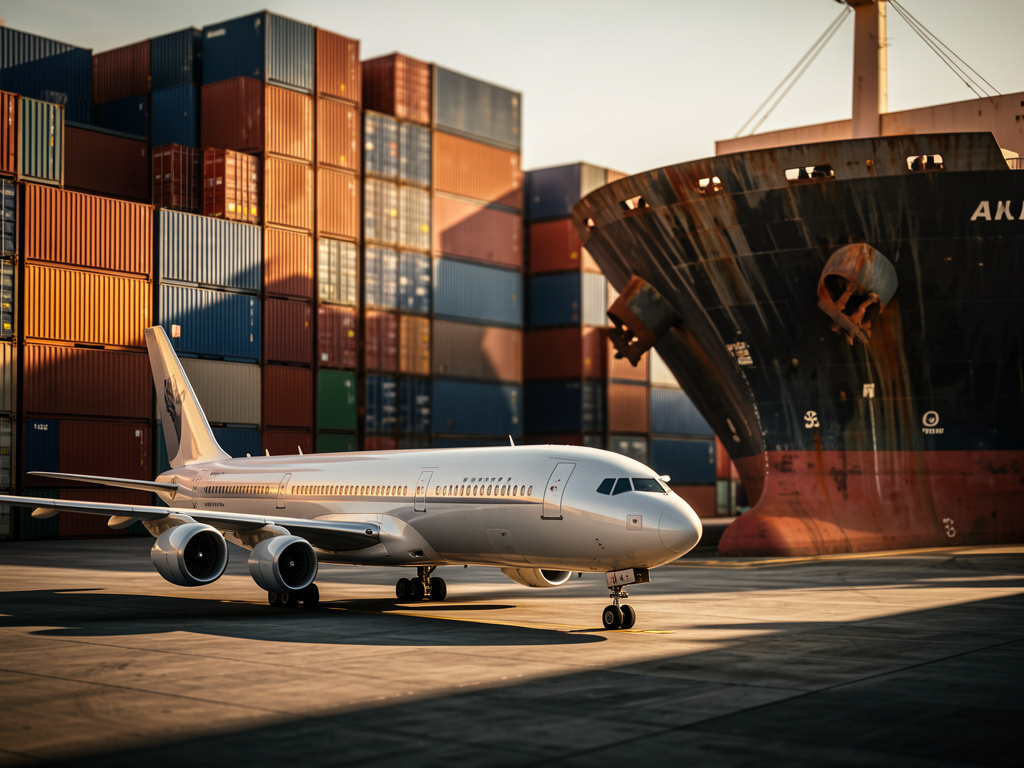
Air and Sea Shipping
Aviation and Sea Delivery: Comparison of Timelines, Costs, and Transportation Features
The choice of international delivery method directly affects the timelines for receiving cargo, the size of logistics expenses, the level of risks, and the convenience of managing shipments. The most popular options remain air and sea transport. The first method is characterized by high speed and is suitable for urgent shipments, while the second allows for transporting large batches at a lower cost.
It is impossible to definitively say which is better—air or sea. The optimal solution depends on the characteristics of the cargo, the distance, the budget, the requirements for timelines, the frequency of shipments, and the specifics of the route. For some companies, express logistics is critically important, so they choose air transport. For others, reducing costs becomes a priority, making sea container shipping more advantageous.
International cargo delivery has long ceased to be solely a matter of choosing between an airplane and a ship. Today, transporting goods from one country to another represents a complex logistics chain involving airlines, shipping lines, freight forwarders, courier services, terminals, warehouses, customs representatives, and last-mile transportation companies. The correct choice of route affects not only the cost of transportation but also the speed of delivery, the safety of the goods, the volume of necessary documentation, and the final cost of the product.
Air delivery is traditionally used when time is of the essence. Airplanes transport electronics, product samples, medical and pharmaceutical goods, expensive components, documents, urgent spare parts, clothing, small batches of products, and cargo that needs to be delivered quickly to the customer. Sea transport, on the other hand, is primarily designed for large volumes. A container ship can carry a massive amount of goods simultaneously, making the cost of transporting a single unit of product significantly lower for large batches.
The time difference between the two transportation methods can be substantial. International air delivery can take anywhere from a few days to one or two weeks, considering cargo pickup, processing, customs clearance, and delivery to the final address. For example, the published service parameters of UPS provide for some air transport options with timelines of about 1–3 business days, and for consolidated cargo—approximately 3–5 business days depending on the destination.
Sea transport is noticeably slower. According to Maersk, international sea delivery generally takes about 20–45 days, with the actual timeframe depending on the route, ports, documentation processing, transshipments, and the current situation on the trade route. During peak season, timelines can increase.
Costs are also formed based on completely different principles. For air cargo, actual and volumetric weight are significant, while sea transport is often calculated based on the container, its type, route, port charges, and additional fees. Therefore, comparing the cost of the two delivery methods solely by price per kilogram is not always accurate.
In practice, the choice begins with several questions: how much does the cargo weigh, what is its volume, how expensive is it, is urgent delivery required, are there any transportation restrictions, how important is the exact arrival date, and can a full container be formed? For a small batch, the cost of air transport may be justified, while for several tons of goods, sea transport often becomes the more economically suitable solution.
Air Delivery: Features, Advantages, and Limitations
Air delivery involves transporting cargo by air between departure and destination airports. Depending on the transportation scheme, the cargo can be delivered by regular passenger flights, specialized cargo planes, or as part of an express shipment by a courier service.
The main advantage of air transport is minimal timelines. While a sea container takes several weeks to reach the destination port, an airplane can deliver cargo to another continent in just a few days. This is why air logistics is in demand for urgent shipments, replenishing warehouse stocks, transporting product samples, and goods with a limited shelf life.
Another important benefit is high predictability. Air transport is less affected by the conditions of sea ports, traffic on major shipping routes, and the duration of port operations. However, air delivery can also face delays due to weather conditions, high airport congestion, customs control, and restrictions on transporting certain categories of goods.
What Cargo is Profitable to Transport by Air
Air freight is particularly advantageous for goods that have a high value relative to their weight and volume. These include:
electronics and components;
medical equipment;
pharmaceutical products;
jewelry;
documents and samples;
expensive spare parts;
seasonal goods;
products with a limited shelf life;
urgent commercial shipments.
Air delivery is also suitable for shipments where production downtime costs more than high freight rates. For example, if the absence of a single part halts the production line, air transport may be economically justified even at a significant shipping cost.
However, air transport has limitations regarding weight, dimensions, and type of cargo. Hazardous materials, batteries, aerosols, liquids, and certain chemicals require special arrangements. Large and very heavy shipments are often impossible or unprofitable to send by air.
Sea Freight and Container Shipping
Sea freight is considered one of the most cost-effective methods of international transportation. The majority of global trade is conducted by sea, as container ships can carry thousands of tons of goods over long distances.
The foundation of maritime logistics is container shipping. Cargo is placed in a standard container, which can be transferred between ships, trains, and trucks without unloading its contents. This format is called multimodal transport. It allows for delivery organized on a "door-to-door" basis and reduces the number of handling operations with the goods.
Sea freight is particularly advantageous for transporting large shipments, heavy, bulky, and not overly urgent cargo. The cost of sea freight is usually calculated based on the type of container, route, port of departure, port of destination, seasonality, and additional fees.
Main Types of Container Shipping
The most commonly used standard containers are:
20-foot containers — optimal for heavy cargo;
40-foot containers — suitable for bulky shipments;
40-foot High Cube — have increased height;
refrigerated containers — used for temperature-sensitive goods;
Open Top containers — used for tall or oversized cargo;
Flat Rack — designed for oversized equipment and machinery.
If the cargo does not fill an entire container, LCL (Less than Container Load) shipping is used. In this case, goods from different shippers are placed in one container. The client pays only for the actual volume or weight occupied, making this option convenient for small shipments.
When the container is fully loaded, the FCL (Full Container Load) format is applied. It ensures fewer transshipments, increases cargo safety, and often proves to be more cost-effective for larger volumes.
Which is Faster: Air or Sea?
When comparing speed alone, air delivery significantly outpaces sea freight. The average time for international air cargo transport ranges from 2 to 10 days, not including the time for document preparation and customs clearance. Express delivery can take from one to several business days.
Sea transport typically takes from 20 to 60 days. On certain long-distance routes, the time can extend to 70–90 days. The duration depends on distance, number of transshipments, port congestion, weather conditions, vessel schedules, and the situation on specific routes.
Comparison of Shipping Times
Estimated shipping times may look as follows:
| Direction | Air Delivery | Sea Delivery |
|---|---:|---:|
| Nearby International Destinations | 1–4 days | 10–25 days |
| Asia — Europe | 3–8 days | 30–50 days |
| Asia — Russia | 3–10 days | 35–60 days |
| Asia — North America | 3–7 days | 25–45 days |
| Major Intercontinental Routes | 5–12 days | 40–70 days |
The indicated values are approximate. The total delivery time includes not only the time the cargo is on the plane or ship but also the pickup from the warehouse, consolidation, export document processing, loading, customs clearance, delivery to the final recipient, and possible storage at the terminal.
Therefore, when choosing transportation, it is important to consider not only the travel time but also the entire logistics chain. Sometimes air delivery to a remote airport followed by a complicated road transport does not provide a significant advantage compared to a sea route to a convenient port.
Which is more cost-effective: air or sea?
In terms of cost, sea transportation is almost always cheaper than air delivery, especially when it comes to heavy and bulky cargo. The reason lies in the large carrying capacity of ships and the lower cost of transporting a single unit of goods.
Air freight is primarily calculated based on the chargeable weight, which can be either actual or volumetric, depending on which figure is greater. Therefore, a light but bulky cargo can sometimes end up costing more than expected.
Sea freight is often determined by the type of container, the route, and the shipping conditions. In consolidated shipping, the calculation may be based on cubic meters, weight, or linear meters.
What makes up the cost of air transportation
The price of air delivery may include:
base air freight rate;
fuel surcharge;
airport fees;
terminal handling;
document processing;
customs clearance;
pickup from the warehouse;
delivery from the airport;
insurance;
charges for special shipping conditions.
Additional surcharges may apply for hazardous cargo, oversized items, temperature control, storage, and expedited processing.
What makes up the cost of sea freight
The cost of sea container transportation includes:
base sea freight;
port fees;
export document processing;
container loading;
delivery to the port;
terminal handling;
documentation fees;
customs clearance;
delivery from the port;
container unloading;
return of empty equipment;
insurance;
possible fees for delays and storage.
A low sea freight rate does not always mean a low total cost. It is important to clarify in advance which services are included in the rate and which are charged separately.
When air delivery is economically justified
Despite the high cost, air transport can be more advantageous in the overall economics of delivery. For example, a company may be able to sell products faster, avoid stock shortages, or prevent production stoppages.
When evaluating, it is necessary to consider not only the transport tariff but also the total costs:
cost of inventory storage;
losses from delays;
penalties to customers;
risk of disrupting the production schedule;
expenses for warehouse rentals;
cost of frozen capital;
losses from seasonal demand drops.
If the product has high margins and speed to market is critical, air freight can yield greater profits, even despite the expensive shipping costs.
For example, seasonal products are often shipped by air if the sea route would result in the goods arriving after the sales period has ended. Similarly, urgent delivery of components may be cheaper than halting a production line.
When sea transportation is the best solution
Sea transport is preferable for regular shipments and large batches when timelines allow for advance planning of inventory replenishment. It is suitable for furniture, construction materials, industrial equipment, textiles, household appliances, raw materials, and other goods that do not require urgent delivery.
The main advantages of sea logistics include:
low transportation costs;
high container capacity;
ability to ship heavy cargo;
convenience of multimodal schemes;
a large number of international routes;
possibility of regular shipment planning.
The main disadvantage is the long delivery time. Additionally, sea logistics depend on ship schedules, port congestion, transit restrictions, and container equipment. Therefore, it is essential to allow for a time buffer when planning.
Express logistics: when maximum speed is crucial
Express logistics is focused on the fastest possible movement of documents, parcels, and small commercial cargo. It typically utilizes air flights, dedicated sorting centers, courier delivery, and expedited customs clearance.
Express services are convenient when you need to:
urgently send documents;
deliver product samples;
replace a faulty part;
fulfill a customer's urgent order;
ensure the delivery of medical materials;
transport a small valuable item;
deliver cargo by a specific date.
However, express delivery is more expensive than standard air freight. The rate includes not only air transport but also courier handling, sorting, pickup, door-to-door delivery, and priority processing of logistics operations.
For large shipments, express logistics is usually not used. In such cases, standard air delivery, sea freight, or a combined scheme is chosen.
Comparison of Risks and Cargo Safety
The safety of goods is influenced not only by the mode of transport but also by the quality of packaging, labeling, securing, insurance, and handling at terminals. Air transport typically involves fewer transshipments and shorter transit times. This reduces the likelihood of prolonged exposure to moisture, temperature fluctuations, and mechanical stress.
However, air cargo passes through airport terminals and may be subject to strict inspections. Special packaging is required for fragile or sensitive items.
Sea transport takes longer, so moisture protection, containerization, and proper placement within the container are particularly important. Cargo must be securely fastened to prevent movement during rolling and maneuvers of the vessel. Refrigerated containers are used for temperature-sensitive goods.
Insurance is advisable when transporting expensive, fragile, technically complex, and commercially important items. The insurance policy can cover damage, loss, accidents, fire, and other risks depending on the terms of the contract.
Customs Clearance for Air and Sea Cargo
Customs procedures are a mandatory part of international delivery regardless of the chosen mode of transport. It is necessary to prepare a foreign trade contract, invoice, packing list, transport documents, certificates, and permits if required for specific products.
For air delivery, accuracy of data regarding weight, number of packages, contents, and value of goods is crucial. Discrepancies in documents can lead to delays at the airport terminal.
In sea transport, special attention is paid to container documents, bills of lading, information about seals, and product descriptions. Errors can incur additional costs for container storage, demurrage, or document corrections.
To reduce risks, companies often delegate customs clearance to a customs broker or logistics operator. The specialist checks the documents, product classification, HS code, applicable restrictions, and payment calculations.
Combined Delivery: Air, Sea, Rail, and Road Transport
It is not always necessary to choose only air or sea transport. Modern logistics actively uses multimodal schemes, where multiple modes of transport are combined into a single chain.
For example, cargo can be delivered:
by truck from the supplier to the terminal;
by sea to a major port;
by rail to a distribution center;
by truck to the recipient's warehouse.
Another option is to send the bulk of the shipment by sea, while a small volume of urgent goods is sent by air. This scheme allows for a reduction in average delivery costs while avoiding shortages of the most in-demand items.
Combined transport is particularly effective for businesses with unstable demand. The main volume of products is shipped via an economical sea route, while urgent batches are delivered by expedited means.
How to Choose the Optimal Mode of Transport
To correctly choose between air and sea delivery, several factors need to be assessed:
weight and volume of the cargo;
cost of the goods;
urgency of delivery;
shelf life;
seasonal demand;
permissible logistics budget;
temperature control requirements;
dimensions and packaging features;
possibility of consolidation;
route and availability of ports or airports.
Air transport is usually chosen for urgent, expensive, light, and compact cargo. Sea transport is suitable for bulky, heavy, and scheduled deliveries. For intermediate requirements, rail or multimodal transport can be considered.
The practical rule is simple: if the delay costs more than the difference between air and sea rates, it's worth choosing air freight. If the product does not require urgent delivery and its volume is large, sea container freight will likely be more cost-effective.
Major Sea Carriers and Choosing a Container Route
Among the most notable players in the global container market are MSC, Maersk, CMA CGM, COSCO, Hapag-Lloyd, ONE, and Evergreen. These companies operate large fleets of container ships and serve international trade routes between Asia, Europe, North America, the Middle East, Africa, and other regions.
MSC is one of the largest container carriers in the world. The company services a wide range of destinations and offers transportation for both standard containers and specialized cargo. For businesses, not only the size of the fleet and the geography of routes are important, but also the availability of suitable schedules between specific ports.
Maersk combines sea transportation with a comprehensive range of ground and logistics services. This allows clients to organize not only the movement of containers between ports but also subsequent delivery to warehouses. The company notes that the total duration of sea transportation depends on many factors, including document processing, customs, loading, and unloading.
CMA CGM is another major international container carrier. The company operates on key trade routes and offers various options for transporting containerized cargo. COSCO also has an extensive network of maritime services, particularly important for trade between Asia, Europe, and North America.
Hapag-Lloyd holds a significant position in the container shipping market, while ONE and Evergreen complement the group of major international operators. When choosing between them, shippers typically consider not only the base freight but also the frequency of departures, port of call, availability of direct service, waiting times, container storage conditions, and delivery options after the port.
An important parameter is free time — the period during which a container can remain at the terminal or with the client without incurring certain additional charges. If documents are delayed or the recipient cannot pick up the container in time, additional costs can significantly increase the final price.
The choice of port is equally important. For example, for European imports from Asia, ports like Hamburg, Rotterdam, Antwerp, and other major port hubs can be considered. Sometimes a longer sea route proves economically justified due to better vessel frequency or more convenient ground delivery.
A container route can be direct or involve transshipment. Direct service potentially reduces the number of operations, while a route through a transit port may sometimes offer a more favorable rate or more convenient schedule. However, each additional operation increases the number of stages where delays can occur.
For businesses that regularly import products, the stability of the logistics scheme is more significant than the one-time cost of the container. If shipments occur weekly, even a difference of a few hundred dollars per container over a year adds up to a substantial amount. Therefore, companies often enter into contracts with carriers or freight forwarders to obtain customized commercial terms.
In an unstable market, it is especially important to request the current rate right before shipping. Sea freight can change faster than a commercial contract for the supply of goods can be prepared. In September 2026, the market situation on some routes demonstrated such dynamics, where fuel costs and external events led to sharp changes in rates.
Air or Sea: Cost, Timing, and Practical Choice
The choice between air and sea freight should be viewed as a comparison of the entire logistics chain, not just the cost of transportation. Air freight wins primarily in time, while sea freight excels in the ability to transport large volumes. However, the specific outcome depends on the product, route, weight, dimensions, and buyer requirements.
Consider a shipment of electronics weighing several hundred kilograms. If the product is needed at the warehouse within a few days, sea freight may be too slow. Even a significantly higher price for air freight may be justified by the fact that the company can start selling the product faster and does not tie up working capital for several weeks.
A completely different situation arises when transporting several dozen cubic meters of furniture. Sending such a volume via express air freight is almost pointless from an economic standpoint. Container sea freight allows for the distribution of transportation costs over a large number of product units, significantly reducing the transportation component of the cost price.
For medium-sized cargo, there is an intermediate option — LCL or consolidated air freight. In this case, the customer pays only for their share of the transport space. This approach allows for not having to wait for a full container to be formed while also not paying for the entire container.
If we consider delivery times, express air delivery can take a few days, regular air freight takes about a few days to two weeks, while sea delivery takes around 20–45 days or sometimes longer. It is important to note that these are different logistics processes, so the comparison should take into account not only the transport time but also customs, terminal handling, and door-to-door delivery.
The cost difference is also significant. For small shipments, international express rates can range from dozens to hundreds of dollars. For container shipments, we are talking about thousands of dollars per transport space. However, a container can hold a significantly larger volume of goods, so the price per unit of product can turn out to be much lower.
International logistics can be conditionally represented as several levels. A small package weighing a few kilograms is most often sent via express courier. Heavier commercial cargo may fall into the category of air freight. Large batches, pallets, and regular deliveries require a comparison of air freight with LCL or FCL. This approach helps avoid situations where expensive express services are used for cargo that could be transported much cheaper.
The value of the goods themselves is also crucial. For products worth tens of thousands of euros, a month-long delay can be much more expensive than the additional charge for air transport. For cheap mass-produced goods, the opposite is true: transportation costs should be minimal, making sea containers a more rational option.
Financial considerations must also be taken into account. While the goods are in transit, the company cannot fully utilize the funds invested in them. Faster delivery reduces the capital freeze period. Therefore, the comparison should consider not only the carrier's rate but also the economic value of time.
This is why there is no universal answer to the question of the best mode of delivery. Each shipment has its own combination of factors: price, time, volume, risk, urgency, temperature requirements, nature of the goods, and destination.
How the Final Price is Formed and Why the Rate Changes
At first glance, the cost of freight transportation seems simple: weight multiplied by the rate per kilogram or a specific price paid for a container. In reality, the final bill is formed from a large number of components.
In air freight, the basis can be the rate for actual or volumetric weight. If the cargo takes up a lot of space but is light, the carrier calculates its volumetric characteristic. Therefore, changing the packaging size can sometimes reduce costs even without decreasing the weight of the goods.
In express delivery, additional charges may arise for remote areas, extra handling, non-standard sizes, customs clearance, storage, special cargo categories, and fuel surcharges. FedEx, for example, publishes separate lists of additional services and fees and indicates that the final cost depends on the characteristics of the specific shipment.
In sea logistics, the structure is even more complex. In addition to ocean freight, there may be terminal handling charges, documentation fees, port charges, container handling fees, land delivery, storage, and various surcharges. Therefore, an offer with a low ocean freight rate may not necessarily be the cheapest after adding all other components.
Fuel has a significant impact. Sea and air carriers regularly adjust fuel surcharges in accordance with changing costs. In September 2026, the rise in fuel prices was one of the factors leading to a sharp increase in rates on certain sea routes.
Seasonality is also important. Before major holidays, sales, and periods of increased demand, companies begin to move large volumes of goods in advance. Available space on ships and planes decreases, so rates may increase.
In the maritime market, an additional factor is the imbalance of containers. After delivering the goods, the container needs to be returned to circulation. If there is an excess of empty containers in a certain region, the carrier needs to move them to where there is demand. These operations also affect the economics of the route.
Geopolitical events can change logistics even more dramatically. Changes in routes, restrictions on vessel passage, closure of certain air corridors, increased insurance costs, or changes in port infrastructure lead to increased time and cost of transportation.
For air freight, the available cargo capacity is crucial. In August 2026, DHL Global Forwarding noted that global cargo capacity remained roughly stable year-on-year, while significant changes occurred on specific routes. On the China to Europe route, the cargo capacity of freight aircraft, according to the company, decreased by approximately 30% since June 2026.
Therefore, a good logistics calculation should include several scenarios. For example, express delivery can be used for the urgent part of the order, air freight for the main batch with a short lead time, and sea freight for large stock. This combined model allows for risk distribution and reduces dependence on a single mode of transport.
For regular shipments, it is useful to compare not only the rates of different carriers but also the total cost of logistics ownership. This includes transportation, customs fees, storage, insurance, capital costs, potential delays, and delivery from the terminal to the final warehouse.
This approach transforms freight transportation from a simple purchase of a transport service into comprehensive supply chain management.
International Logistics in Modern Trade
Air and sea delivery serve different functions but together form the foundation of the global freight transportation system. Aircraft provide speed and the ability to quickly move relatively small batches over vast distances. Cargo ships enable the transportation of enormous volumes of products and support international trade in bulk goods.
The largest companies—DHL, FedEx, UPS, MSC, Maersk, CMA CGM, COSCO, Hapag-Lloyd, ONE, and others—offer various options for organizing shipments. Some specialize in express delivery, others are ocean container lines, while others combine transportation, warehousing, customs clearance, and ground logistics.
Prices, however, cannot be considered constant. For air shipments, the cost is primarily determined by the route, weight, volume, service, and additional services. For sea freight, important factors include the container, trade route, port, vessel schedule, seasonality, fuel, and the state of the global market.
In 2026, it is particularly evident how quickly the cost of international logistics can change. The air freight market continues to experience fluctuations in demand and available capacity, while sea rates on certain routes significantly increased in September due to external factors and fuel costs.
For a small urgent shipment, a cost of several dozen or hundreds of dollars can ensure receipt of the goods within a few days. For a container, the cost can be measured in thousands of dollars, with delivery times spanning several weeks. Moreover, a higher price for air transport does not necessarily imply a greater economic burden: if the goods are expensive and urgent, speed can have intrinsic commercial value.
When choosing transportation, it is important to look at the entire chain from the sender's warehouse to the recipient's warehouse. The cost of transportation between airports or ports is just one part of the expenses. Additional costs may include ground delivery, terminal handling, customs, storage, insurance, and other services.
For this reason, professional logistics is almost always based on comparing several options. One route may be cheaper but longer. Another may be faster but more expensive. A third may have a more convenient port or airport, resulting in a lower total cost after ground delivery.
The main difference between air and sea remains unchanged: an airplane buys time, while a sea container allows for savings on scale. The higher the value of speed and the lower the weight-to-value ratio of the goods, the more attractive air transport becomes. The larger the shipment volume and the lower the acceptable transportation component in the product price, the more important sea logistics is.
Modern international delivery, therefore, is not merely a question of choosing between two modes of transport but a task of finding the optimal combination of speed, price, reliability, and volume. This combination ultimately determines how much the product will cost the buyer and how quickly it can travel from the manufacturer to the warehouse, store, or end customer.
Final Comparison of Air and Sea Delivery
Air delivery excels in speed, predictability, and convenience for urgent shipments. It is suitable for expensive, compact, perishable, and critically important goods. The main drawback is the high cost and limitations on weight, volume, and specific categories of cargo.
Sea freight leads in cost when transporting large shipments. Container shipping allows for the transport of heavy and bulky goods, the use of multimodal routes, and reduces production costs. The downside includes long delivery times, dependence on vessel schedules, and potential storage or demurrage fees.
Thus, the answer to the question "which is faster: air or sea?" is obvious — air. When it comes to "which is more cost-effective?" sea freight often comes out on top. However, the final choice must be made considering the entire logistics chain, cargo characteristics, business requirements, and the cost of potential delays.
For effective organization of international shipping, it is recommended to calculate several route options in advance, compare rates including all additional fees, check customs clearance times, and allow for a time buffer. This approach will help select the optimal delivery format, reduce costs, and ensure supply stability.