

 RU
 UA
 DE
 FR
 ES
 CN
 SA
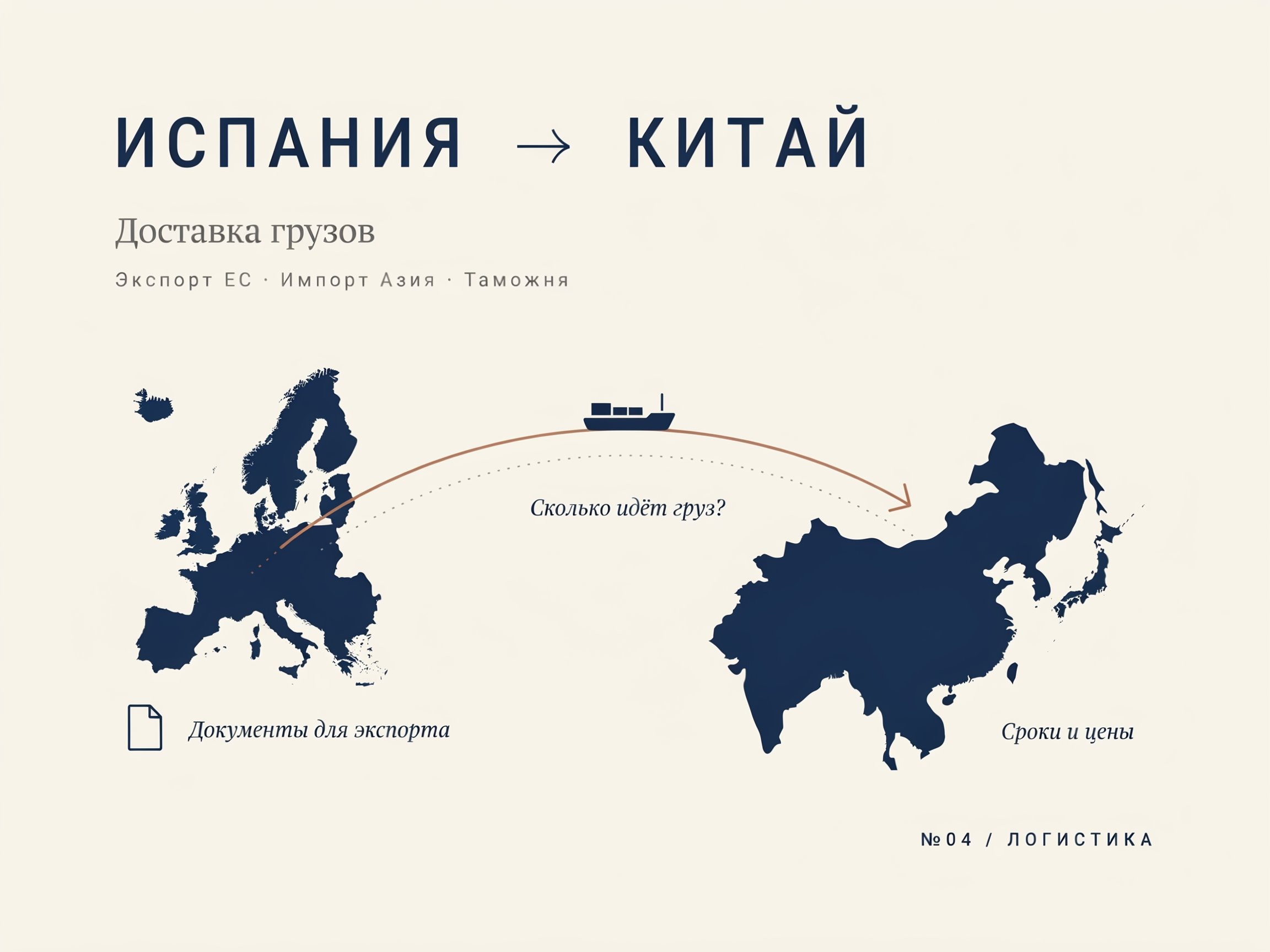
Cargo Delivery from Spain to China
Freight Delivery from Spain to China: Export from the EU, Import to Asia, Documents, Timelines, and Costs
International freight delivery from Spain to China is a complex logistics process that involves preparing export documentation, selecting the appropriate mode of transport, passing customs control in the European Union, and handling import procedures in the People's Republic of China. Spain has a well-developed transport infrastructure, major seaports, and a convenient location for shipments to Asian countries. China, in turn, is one of the largest global markets, regularly receiving Spanish food products, equipment, pharmaceuticals, cars, spare parts, textiles, cosmetics, wines, and industrial goods.
The final cost and duration of transportation are influenced by the characteristics of the cargo, the chosen route, seasonality, type of transport, the need for consolidation, temperature control requirements, and customs clearance specifics. Before starting transportation, it is important to determine the HS code, check export and import restrictions, prepare commercial documents, and agree on the delivery terms according to Incoterms.
Features of Freight Transportation from Spain to China
The transportation of goods between Spain and China falls under international multimodal logistics operations. Depending on the type of product, the cargo can be transported by sea, air, rail, or a combined route. In practice, maritime container transport is the most sought-after option, as it allows for the transportation of large batches at a reasonable price.
Spain has several key transport hubs. For maritime shipments, the ports of Valencia, Barcelona, Algeciras, and Bilbao are most commonly used. From these points, cargo is sent to Chinese ports in Shanghai, Ningbo, Shenzhen, Guangzhou, Qingdao, Tianjin, and Hong Kong. The specific port is chosen based on the location of the supplier, the final recipient, the availability of shipping lines, and delivery conditions.
International delivery from Spain to China can be carried out for both commercial shipments and smaller consignments. Large businesses typically use full container loads (FCL). If the volume of goods is insufficient to fill a container, consolidated shipping (LCL) is used. In this case, products from several shippers are placed in one container, which reduces costs but increases processing times at consolidation warehouses.
When planning transportation, it is essential to consider not only the distance between countries. Important factors include port transshipments, transit terminals, customs procedures, labeling rules, certification, and specifics of Chinese legislation. Some categories of goods require prior registration of the importer, obtaining permits, or confirmation of compliance with local standards.
What Goods Are Most Frequently Transported from Spain to China
Regular exports from Spain to China include:
food products and agricultural goods;
olive oil, wines, and alcoholic beverages;
meat and fish products;
pharmaceutical products and medical equipment;
cosmetics and perfumes;
cars, components, and spare parts;
industrial equipment;
electronics and technological devices;
ceramics, glass, and construction materials;
textiles, footwear, and leather goods;
chemical products;
luxury items and designer goods.
Each type of product has its own rules for export and import clearance. For example, food products may require veterinary, phytosanitary, or sanitary certificates. Medical products are subject to special regulations, and chemicals can only be transported with a safety data sheet and compliance with packaging requirements.
Main Methods of Freight Delivery from Spain to China
The choice of transport depends on urgency, budget, volume, and characteristics of the goods. There is no universal option that suits all shipments. Therefore, logistics companies typically analyze the cargo, route, and recipient's requirements before offering one or more transportation options.
Sea Delivery Spain–China
Maritime container transport is the primary method for transporting large batches between Europe and Asia. This option is suitable for goods that do not require urgent delivery. The cargo is placed in a standard 20 or 40-foot container and then shipped from a Spanish port to China.
The advantage of sea shipping is the relatively low cost per unit of goods. A significant volume of products can be loaded into a container, and specialized solutions are used when necessary: refrigerated containers, containers for hazardous materials, platforms for oversized equipment, and tanks for liquids.
Disadvantages include long delivery times, dependence on vessel schedules, potential delays at ports, and the impact of weather conditions. It is also important to consider the time required for transporting the cargo from the supplier's warehouse to the port, export clearance, loading, sea transit, unloading in China, customs clearance, and delivery to the final address.
Air Delivery from Spain to China
Air freight is used for urgent, high-value, small-sized, or time-sensitive cargo. Samples of products, medical goods, electronics, documents, spare parts, and high-value items are often sent by air.
The main advantage of air delivery is speed. However, the cost of transportation is significantly higher than that of sea or rail shipping. The price is influenced by actual and dimensional weight, departure airport, destination airport, cargo category, the need for special packaging, and additional airline fees.
Major airports in Spain, including Madrid and Barcelona, have regular cargo connections with Asian destinations. In China, delivery can be made through the airports of Beijing, Shanghai, Guangzhou, Shenzhen, or Hong Kong.
Rail Delivery between Spain and China
Rail routes provide a compromise between sea and air transport. Trains are usually faster than sea transport but cheaper than air freight. This option can be used for containerized cargo, industrial products, equipment, auto components, and other goods where a balance of cost and speed is important.
Rail delivery requires organizing transit logistics, as the route passes through several countries and may involve gauge changes, container transloading, and transit document processing. The actual availability of a specific route depends on the geopolitical situation, operator schedules, the capacity of rail terminals, and existing international restrictions.
Multimodal Delivery
Multimodal transport involves using several modes of transport within a single logistics solution. For example, the cargo is picked up by truck from a warehouse in Spain, then delivered to the port, shipped by sea to China, and after customs clearance, transported by road to the final recipient.
This format is convenient for "door-to-door" delivery. The client interacts with a single logistics operator who coordinates carriers, documents, terminals, insurance, and customs procedures. The multimodal scheme is especially in demand if the sender's or recipient's warehouse is far from the main port or rail terminal.
How Long Does Cargo Take from Spain to China
The delivery time depends on the chosen mode of transport, route, type of cargo, and clearance conditions. There is no single timeframe suitable for all shipments, as the same transport can take different numbers of days depending on the season, port congestion, and document readiness.
Average Transport Times
Estimated times are as follows:
air delivery – approximately 3 to 10 days;
express delivery – about 2–7 days;
rail transport – approximately 18 to 35 days;
sea delivery – approximately 30 to 55 days;
multimodal transport – about 25–60 days.
The specified times are preliminary. They are usually counted either from the moment the cargo is accepted by the carrier or from the vessel's departure date, not from the order placement date. The complete logistics cycle includes picking up the goods, packaging, consolidation, delivery to the port or airport, customs clearance, main transit, unloading, import procedures, and delivery within China.
What Can Increase Delivery Time
The duration of transport is affected by:
incomplete set of documents;
errors in the invoice or packing list;
incorrect HS code;
lack of licenses and certificates;
delay in customs payment;
high port congestion;
seasonal peaks before national holidays;
adverse weather conditions;
cargo inspection;
need for additional labeling;
restrictions on transporting certain categories of goods;
delay at the consolidation warehouse;
discrepancy between actual weight and data in documents.
Before shipping, it is recommended to agree in advance on the expected transit time and clarify whether it includes delivery from the warehouse to the terminal, customs clearance, and transportation to the final address.
What documents are needed for export from Spain
To export goods from Spain outside the European Union, a set of commercial, transport, and customs documents must be prepared. The composition of this set depends on the type of product, the terms of the transaction, and the method of delivery.
Main documents for export transportation
Typically, the following are used:
Commercial invoice — contains information about the seller, buyer, product, quantity, price, currency of the transaction, and delivery terms.
Packing list — describes the number of packages, gross and net weight, dimensions of the packaging, and contents of each cargo unit.
Transport document — bill of lading for sea transport, air waybill for air delivery, or railway waybill for transport by train.
Export declaration — is issued for the release of goods from the territory of the European Union.
Contract or purchase order — confirms the commercial relationship between the parties.
Certificate of origin — may be required to confirm the country of manufacture of the product.
Insurance policy — is issued when insuring the cargo.
Permits — licenses, certificates, sanitary, veterinary, phytosanitary, and other confirmations.
Documents must match in terms of product information, quantity, weight, value, packaging, and participants in the transaction. Any discrepancies can trigger inquiries from customs, delays in release, or the need for corrections.
EORI and customs registration
A company exporting goods from the EU usually must have an EORI number. It is used for customs interactions within the European Union. If the supplier does not handle export procedures independently, they can delegate the customs clearance to a customs representative or logistics operator.
It is also necessary to check whether the goods are subject to export control. Certain categories of products may have restrictions, especially if they relate to dual-use technologies, industrial equipment, chemicals, military products, or strategic materials.
Documents for importing goods into China
Import clearance in the PRC requires the preparation of documents by the Chinese recipient or their customs representative. The list depends on the category of goods, the code of the Chinese commodity nomenclature, the country of origin, and the current requirements of government authorities.
Basic set of import documents
Most often, the Chinese side requires:
commercial invoice;
packing list;
foreign trade contract;
transport document;
certificate of origin;
import declaration;
compliance documents;
licenses and permits;
sanitary, veterinary, or phytosanitary certificates;
insurance documents;
information on the composition and characteristics of the goods;
documents on the value and terms of delivery.
For food products, documents regarding the manufacturer, composition, shelf life, safety, and compliance with Chinese standards may be required. Labels must contain information in Chinese if required by the rules for the specific category of products.
Some goods can only be imported through a registered importer. Therefore, before shipping, it is important to ensure that the recipient has the right to import the goods into China and has the necessary registrations.
Checking requirements before shipping
Before loading, it is recommended to:
determine the product code in the Chinese classification;
check the import duty and VAT rate;
clarify the need for a license;
find out labeling requirements;
check restrictions for the specific country of origin;
coordinate the list of documents with the Chinese broker;
check packaging and the possibility of inspection;
clarify whether a certificate of conformity or product registration is needed.
Preliminary checks help avoid situations where the cargo has already arrived in China but cannot be released due to the lack of a permit document.
Customs clearance for export from the EU
Exporting from Spain to China begins with the preparation of a declaration and the submission of product information to the customs authorities of the European Union. The declaration can be submitted by the exporter independently or by a customs representative under a power of attorney.
The declaration includes the sender, recipient, destination country, product code, value, weight, number of packages, transport, delivery terms, and other information. After document verification, customs may release the cargo without inspection or direct it for additional control.
Special attention is paid to the correct determination of the HS code. This affects the document requirements, statistical reporting, the need for licenses, and the possibility of applying special restrictions. Incorrect classification can lead to fines, shipment delays, and revisions of information after release.
Additional procedures may be required for certain goods. For example, when exporting food products, sanitary documents may be checked, and when sending equipment, technical descriptions, serial numbers, and information about the product's purpose may be required.
Customs Clearance for Imports in China
After the cargo arrives, the Chinese importer or broker submits a declaration to the local customs authorities. The process checks the value, origin, classification, quantity, product description, and compliance with the submitted documents.
Based on the clearance results, the following may be charged:
import duty;
value-added tax;
excise tax;
port and terminal fees;
brokerage services;
storage fees;
charges for inspection or additional processing.
The amount of payments depends on the type of goods, country of origin, customs value, and applicable trade agreements. Spanish products may have specific tariff conditions, but their application depends on the specific product category and supporting documents.
If the documents are incorrectly prepared, customs may request additional information, assign an inspection, or adjust the customs value. Therefore, a pre-agreed package of documents is one of the main factors for quick delivery.
Shipping Costs from Spain to China
The cost of transportation is calculated individually. Even with the same route, the price can vary significantly depending on weight, volume, type of goods, and the chosen scheme.
Components of the Price
The final cost may include:
pickup of the cargo from the supplier in Spain;
delivery to the port, airport, or railway terminal;
packaging and palletizing;
loading operations;
export customs clearance;
freight;
port and terminal fees;
consolidation;
transshipment;
insurance;
import clearance;
payment of duties and taxes;
delivery within China;
storage and additional services.
For sea transport, the rate is often calculated per container or cubic meter. For consolidated cargo, the price depends on volume, weight, and number of packages. In air transport, the greater value between actual and volumetric weight is used.
Estimated Price Categories
Conditionally, the options can be divided as follows:
sea delivery — most cost-effective for large and non-urgent shipments;
rail delivery — medium level of cost and time;
air transport — the fastest but most expensive option;
express delivery — suitable for small shipments and documents;
multimodal transport — price depends on the number of segments in the route.
The exact rate can only be obtained after providing cargo details. Typically, the city of departure in Spain, the recipient's address in China, product description, HS code, number of packages, dimensions, weight, volume, value, and delivery terms are required for calculation.
Main Companies and Participants in Freight Transportation
The organization of delivery can be handled by international freight forwarders, shipping lines, airlines, railway operators, courier services, and customs brokers. Large logistics companies often offer comprehensive services: they pick up the cargo from the supplier, handle export clearance, book space on a ship or plane, monitor transit, assist with import, and arrange delivery to the recipient's warehouse.
Among the international operators working on European-Asian routes, you can find DHL Global Forwarding, Kuehne+Nagel, DSV, DB Schenker, Expeditors, CEVA Logistics, Maersk Logistics, and others. In addition to global brands, there are regional freight forwarders in Spain and China that specialize in specific ports, product categories, or consolidated shipments.
How to Choose a Transport Company
When selecting a carrier, it is worth checking:
experience on the Spain–China route;
the presence of an in-house customs clearance department;
the possibility of "door-to-door" delivery;
insurance conditions;
a list of additional fees;
the transparency of the commercial offer;
the availability of cargo tracking;
customer reviews;
responsibility for damage and delays;
the ability to handle hazardous, temperature-sensitive, or oversized goods.
It is important to request not only the base rate but also a complete breakdown of costs. Sometimes a low advertised price does not include terminal fees, export declarations, delivery within China, or import clearance.
Incoterms Delivery Conditions for Exports to China
Incoterms define who is responsible for transportation, insurance, export and import procedures, as well as when risks transfer.
For shipments from Spain to China, the following can be used:
EXW — the buyer picks up the goods from the seller's premises and organizes the main logistics;
FCA — the seller hands over the cargo to the carrier at an agreed location;
FOB — primarily used for sea transport, the seller is responsible for delivery to the ship's side;
CFR — the seller pays for sea freight to the Chinese port, but insurance is not included;
CIF — the seller pays for freight and minimum insurance;
DAP — the seller delivers the cargo to an agreed location, but import payments are usually paid by the buyer;
DDP — the seller assumes the maximum responsibilities, including import clearance and taxes, if legally possible.
An incorrectly chosen basis can lead to disputes over who pays additional costs and who bears the risks in case of damage or delays. Therefore, it is advisable to agree on delivery terms with the forwarder and customs specialist before signing the contract.
Cargo Insurance from Spain to China
International transportation is associated with risks of damage, loss, moisture, theft, accidents, improper loading, and delays. Even with reliable packaging, it is impossible to completely eliminate the possibility of incidents.
Insurance allows for compensation of the goods' value within the policy's terms. When arranging insurance, it is important to check:
whether the entire route is insured;
whether transportation to the warehouse and after arrival at the port is included;
which risks are covered;
whether there are any exclusions;
how the insured amount is calculated;
what the claims submission process is;
what documents will be required for payment.
For expensive, fragile, temperature-sensitive, and specialized goods, insurance is especially advisable. The insurance policy should match the actual value of the cargo, and the description of the goods in it should correspond to the commercial documents.
Packaging and Labeling of Goods
Quality packaging helps prevent damage during numerous transshipments. Sea transport involves exposure to vibration, humidity, temperature fluctuations, and pressure changes. For long routes, sturdy boxes, pallets, protective film, moisture absorbers, cushioning materials, and fasteners are used.
Packaging usually indicates:
the name of the goods;
the number of packages;
gross and net weight;
dimensions;
country of origin;
handling marks;
recipient information;
order or batch number;
hazard symbols, if necessary.
For food products, chemicals, pharmaceuticals, and goods with special storage conditions, additional requirements may apply. When transporting hazardous materials, special declarations, certified packaging, labeling, and compliance with international transport regulations are mandatory.
Common Mistakes in Organizing Deliveries
The most common problems arise from insufficient preparation. These include:
shipping without checking China's import requirements;
incorrect product description;
incorrect HS code;
underreporting the value on the invoice;
discrepancy between actual weight and data;
lack of certificates;
inadequate packaging;
incorrect choice of Incoterms;
ignoring restrictions on specific products;
absence of insurance;
choosing a carrier solely based on the lowest price.
To reduce risks, it is essential to prepare documents before booking the shipment, agree on the product description with the broker, check the requirements of the Chinese importer, and obtain a detailed cost estimate.
How to organize delivery from Spain to China step by step
The process can be divided into several stages:
Determine the characteristics of the cargo: type of product, quantity, weight, volume, value, and storage conditions.
Check the possibility of exporting from Spain and importing to China.
Identify HS codes.
Prepare the contract, invoice, and packing list.
Gather the necessary permits and certificates.
Select transportation and route.
Agree on Incoterms conditions.
Book space with the carrier.
Organize packaging and delivery of the goods to the terminal.
Complete the export declaration in the EU.
Carry out the main international transit.
Submit the import declaration in China.
Pay duties, taxes, and fees.
Receive the cargo after clearance.
Deliver the goods to the recipient's warehouse.
If a comprehensive service is used, part of these operations is handled by the freight forwarder. However, the sender and recipient must still provide accurate information and timely agree on documents.
Shipping goods from Spain to China requires careful planning, as it involves exporting from the European Union, international transportation, import clearance in China, and delivery to the final recipient. For large shipments, sea freight is usually the most economical solution. If speed is essential, air freight is chosen. Rail and multimodal routes allow for a balance between cost and time.
On average, cargo from Spain to China takes from a few days for air delivery to several weeks for sea transport. The final timeframe depends on the readiness of documents, port congestion, the chosen route, and the specifics of the goods. The cost is formed from freight, terminal expenses, customs clearance, insurance, taxes, and delivery in both countries.
For successful transportation, it is necessary to check the product code, certification requirements, labeling rules, import restrictions, and the authority of the Chinese recipient in advance. A reliable transport company will help select the route, calculate the price, prepare the documents, and organize the delivery of cargo from Spain to China on a "door-to-door" basis.