

 RU
 UA
 DE
 FR
 ES
 CN
 SA
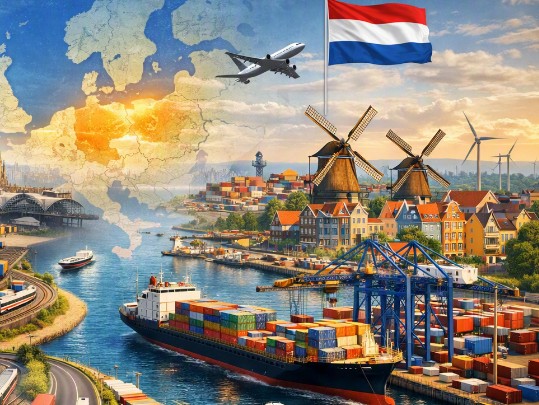
Cargo Delivery from China to the Netherlands
Freight Delivery from China to the Netherlands: Port of Rotterdam, Sea Freight, EU Customs, Prices and Timelines
The Netherlands holds a special place in European logistics. With its developed port infrastructure, convenient geographical location, and direct transport links to EU countries, the Port of Rotterdam is considered one of the main entry points for Chinese goods into the European market. It handles containers with electronics, industrial equipment, textiles, furniture, auto parts, construction materials, marketplace goods, and other products.
Delivery of cargo from China to the Netherlands can be carried out via sea, rail, road, and air transport. However, for most commercial shipments, sea freight remains the optimal solution: it allows for the transportation of large volumes at relatively low costs. Importing to the Netherlands requires careful preparation of documents, correct classification of the HS code, calculation of duties and VAT, as well as compliance with the customs requirements of the European Union.
This article thoroughly examines the main delivery methods from China to the Netherlands, shipping timelines, container costs from China to the Netherlands, specifics of operations through the Port of Rotterdam, EU customs clearance rules, choosing a logistics company, and typical mistakes made by importers.
Why the Netherlands is an Important Logistics Hub in Europe
The Netherlands is often chosen not only for supplying goods to the domestic market but also as a transit center for further delivery to Germany, Belgium, France, Luxembourg, Denmark, Austria, and other EU countries. The main reason is its developed transport system and access to one of the largest ports in the world.
The Port of Rotterdam accommodates container ships from virtually all leading international lines. After unloading, the container can be delivered to the recipient's warehouse by road, rail, barge, or as part of a multimodal transport. This allows for route selection based on budget, urgency, and cargo specifics.
For companies that regularly import products from China, the Netherlands can serve as a convenient consolidation point. For example, a container arrives in Rotterdam, undergoes customs clearance, after which part of the cargo is sent to Germany, part to Belgium, and the remainder is stored in the Netherlands. This format is particularly in demand among online stores, distributors, and owners of European warehouses.
Main Advantages of Delivery Through Rotterdam
The key advantages of the port include:
a large number of regular sea routes from China;
a developed network of container terminals;
the ability to deliver to other EU countries;
availability of temporary storage facilities and logistics hubs;
the presence of customs brokers and transport operators;
access to rail, road, and river routes;
the possibility of organizing "door-to-door" delivery.
Additionally, Rotterdam boasts a modern digital infrastructure. Participants in the transport process can track containers, submit documents in advance, coordinate unloading, and monitor customs procedures. This reduces the likelihood of delays and simplifies the management of international shipments.
Who Benefits from Importing Through the Netherlands
Delivery from China to the Netherlands is suitable for:
importers registered in the Netherlands;
companies with a warehouse or distribution center in the EU;
owners of online stores;
suppliers of goods to European marketplaces;
manufacturing enterprises;
wholesale companies;
distributors of Chinese products;
businesses that organize deliveries to multiple countries in Europe.
It is important to remember that importing to the Netherlands does not automatically grant the right to freely sell goods in all EU countries. Products must comply with European safety, labeling, certification, and technical regulation requirements.
Methods of Delivering Cargo from China to the Netherlands
The choice of transport depends on the volume of the shipment, weight, product category, budget, and desired delivery speed. For small urgent shipments, air transport is often used, for standard commercial deliveries—sea freight, while rail and multimodal solutions may be used for intermediate options.
Sea Delivery from China to the Netherlands
Sea freight is the most common method of delivering containers from China to the Netherlands. Its main advantage is the ability to transport a significant volume of cargo at a moderate shipping cost.
Shipments are usually made from Chinese ports such as:
Shanghai;
Ningbo;
Shenzhen;
Guangzhou;
Qingdao;
Xiamen;
Hong Kong;
Tianjin;
Dalian.
The most common arrival point is the Port of Rotterdam. Depending on the route, the vessel may go directly or stop at intermediate ports. The duration of transportation is influenced by weather conditions, terminal congestion, shipping line schedules, seasonality, and the situation on international maritime routes.
Full Container Load (FCL)
FCL is the transportation of a full container that is provided to a single shipper. The container can be loaded at the factory or at a consolidation warehouse. After being sealed, it is sent to the port, loaded onto the vessel, and delivered to Rotterdam.
The most popular options include:
20-foot container - 20GP;
40-foot standard container - 40GP;
40-foot high-capacity container - 40HC;
refrigerated containers;
specialized containers for oversized cargo.
FCL is suitable for large shipments where the volume of goods justifies renting the entire container. This option typically provides a shorter processing chain and reduces the number of transshipments.
Less than Container Load (LCL)
LCL is a transportation method where multiple shippers use one container. Goods are delivered to a consolidation warehouse in China, combined, processed, and sent to Europe as a single shipment.
Consolidated shipping is convenient if the volume of goods is insufficient for a full container. However, the final cost per cubic meter may be higher than with FCL, as it includes consolidation, sorting, loading, processing, and delivery services.
LCL may include additional steps:
receiving goods from different suppliers;
checking packaging and labeling;
measuring volume and weight;
combining shipments;
preparing export documents;
loading the container;
unloading and sorting in Europe;
delivering to the recipient's warehouse.
Rail Delivery from China to the Netherlands
Rail transport is traditionally seen as a compromise between sea and air transport. It is faster than sea delivery but usually cheaper than air freight. In practice, the availability of routes depends on the current geopolitical situation, transit restrictions, border procedures, and operator schedules.
Rail delivery can be used for:
electronics;
equipment;
auto parts;
goods with tight delivery deadlines;
medium and high-value products;
shipments for which sea transport is too slow.
During rail transport, cargo may pass through several countries and terminals. Therefore, it is necessary to clarify the route, the composition of services, the carrier's liability, and customs clearance procedures in advance.
Air Delivery China–Netherlands
Air transport is the fastest way to deliver goods from China to the Netherlands, but it is also one of the most expensive. This option is used for small, high-value, or urgent shipments.
Air freight is suitable for:
product samples;
spare parts;
medical goods;
electronics;
documents;
urgent commercial shipments;
high-value goods per weight unit.
The cost is calculated based on actual or volumetric weight, depending on which is greater. In addition to the airline's tariff, fees may be charged for airport handling, fuel surcharges, document processing, delivery to the warehouse, and customs escort.
Multimodal Delivery
Multimodal transport combines several modes of transport. For example, cargo can be delivered by sea from China to Rotterdam and then sent by road to Germany or Belgium. Another option is to deliver the container to a European terminal, followed by transshipment to rail or barge.
The multimodal scheme allows for optimizing costs and timelines, especially if the final recipient is far from Rotterdam. It is preferable for one logistics operator to be responsible for the entire transport. This makes it easier to control documents, insurance, timelines, and claims handling.
How Much Does a Container Cost from China to the Netherlands
The cost of shipping a container from China to the Netherlands is not fixed. It is determined by several factors and can vary significantly depending on the season, port of departure, type of container, contract terms, and current market conditions.
Approximately, the price for sea freight can be calculated as follows:
| Type of transport | Possible price range |
|---|---:|
| LCL (Less than Container Load) | approximately 80–220 euros per m³ |
| 20GP container | approximately 1,600–3,800 euros |
| 40GP container | approximately 2,400–5,500 euros |
| 40HC container | approximately 2,600–5,900 euros |
| Door-to-door delivery | from 3,000 euros and up |
| Express air delivery | from 5–9 euros per kg and up |
The values provided are approximate. They do not replace an individual calculation, as the final rate depends on the specific route and the services included.
What makes up the cost of sea transportation
The cost may include:
export clearance in China;
transport from the factory to the port;
loading the container;
port fees;
sea freight;
bill of lading processing;
terminal fees in Rotterdam;
agent services;
customs clearance;
storage;
inspection;
delivery within the Netherlands;
unloading;
return of the empty container;
insurance.
Not all logistics companies' offers include a complete list of expenses. Sometimes, a low price only refers to sea freight and does not account for port or local fees. Therefore, before signing a contract, it is essential to request a calculation on an "all-inclusive" basis or obtain a detailed breakdown of the rate.
Factors affecting the container price
The cost of shipping from China to the Netherlands is influenced by:
port of departure in China;
port of arrival;
type and size of the container;
weight and volume of the cargo;
nature of the product;
need for temperature control;
seasonality;
urgency;
Incoterms conditions;
broker services;
need for certification;
route after Rotterdam;
availability of storage and transloading;
currency fluctuations;
conditions on shipping lines.
During peak demand periods, rates can increase significantly. This often occurs before the Chinese New Year, at the end of summer, and before the European pre-holiday season.
Delivery times for cargo from China to the Netherlands
The shipping time depends not only on the distance between ports. It is important to consider production time, delivery from the factory to the port, export clearance, waiting for the vessel, sea transit, unloading, customs, and delivery to the final address.
Approximate delivery times are as follows:
| Delivery method | Approximate time |
|---|---:|
| Sea FCL (Full Container Load) | 30–50 days |
| Sea LCL | 35–60 days |
| Rail transport | 18–35 days |
| Air freight | 3–10 days |
| Express delivery | 2–7 days |
| Door-to-door delivery | 35–65 days |
These are guidelines, not guaranteed times. Sea transport may be prolonged due to port congestion, adverse weather, vessel delays, schedule changes, or additional inspections.
Stages of sea delivery
A typical supply chain includes:
order confirmation with the supplier;
checking the readiness of the goods;
delivery to the consolidation warehouse;
control of quantity and packaging;
export clearance;
submission of the container to the port;
loading onto the vessel;
sea transportation;
arrival in Rotterdam;
unloading the container;
submission of the declaration to customs;
payment of duties and taxes;
release of the goods;
delivery to the warehouse;
return of the container to the carrier.
If the cargo is shipped as a consolidated load, consolidation in China and deconsolidation in the Netherlands are added.
Customs clearance for imports in the Netherlands
Imports from China to the Netherlands are regulated by the customs legislation of the European Union. To legally import goods, it is necessary to determine their code, customs value, country of origin, and applicable control measures.
The importing company must have the ability to act as the declarant or delegate this function to a customs representative. For operations within the EU, registration for an EORI number—a unique economic operator number—is typically required.
What Needs to Be Prepared
The standard document package may include:
commercial invoice;
packing list;
contract with the supplier;
bill of lading or waybill;
certificate of origin;
export declaration;
technical description of the goods;
compliance documents;
licenses and permits;
insurance policy;
payment documents;
information about the recipient and importer;
power of attorney for the customs broker.
For certain goods, additional documents may be required. For example, special rules apply to food products, cosmetics, medical devices, chemicals, electrical equipment, children's products, and animal-derived products.
HS Code and Customs Duty
The product code determines:
the amount of import duty;
the need for a license;
the presence of restrictions;
labeling requirements;
the necessity for sanitary or technical control;
possible anti-dumping measures;
the applicable VAT rate.
An incorrect code can lead to additional payments, delays in clearance, fines, and further inspections. Therefore, it is better to determine the code before shipping the cargo, relying not only on the commercial name but also on the material, purpose, composition, design, and technical characteristics of the product.
Customs Value
The customs value usually includes the price of the goods and expenses related to delivery to the border or place of import into the EU. Depending on the terms of delivery, the following may be included in the calculation:
cost of the product;
packaging;
commission;
transportation to the port;
ocean freight;
insurance;
loading and unloading operations.
If the customs value is incorrectly stated, customs may have questions regarding the documents and transaction price. An excessively low value increases the risk of inspection, while an inflated value leads to overpayment of duties and VAT.
VAT and Import Payments in the Netherlands
When importing goods into the Netherlands, the following are typically paid:
import customs duty;
import VAT;
excise tax, if the goods fall into the excise category;
port and customs fees;
broker and carrier services.
The duty amount depends on the product code and country of origin. The standard VAT rate in the Netherlands is 21%, although reduced rates or special rules may apply to certain categories.
Companies registered as VAT payers may, in some cases, use the mechanism of transferring the accrual of import VAT with the appropriate permission. This scheme helps reduce the burden on working capital but requires accurate tax accounting.
It is important for the importer to determine in advance:
who is the official buyer;
who is listed as the recipient in the documents;
who pays the duties;
whose EORI the declaration is issued under;
where the goods are released;
who is responsible for tax reporting;
whether it is possible to apply for a deferral or transfer of VAT.
Incoterms for Shipments from China to the Netherlands
Incoterms define the responsibilities between the seller and the buyer. When ordering goods from China, EXW, FOB, CIF, DAP, and DDP are particularly common.
EXW
Under EXW, the buyer effectively picks up the goods from the supplier's premises and organizes further transportation independently. This option can be advantageous for experienced importers but requires oversight of export procedures in China.
FOB
Under FOB, the seller delivers the goods to the port and completes export formalities. The main ocean freight and subsequent expenses are paid by the buyer. This is a common option for container shipments.
CIF
Under CIF, the seller pays for transportation and insurance to the destination port. However, the buyer typically handles import clearance, VAT payment, and delivery after arrival.
DAP
Under DAP, the seller organizes delivery to the agreed location, but import payments are generally made by the buyer. This option is convenient if the importer wants to understand the route in advance but manage customs independently.
DDP
Under DDP, the seller assumes a broad range of responsibilities, including delivery and import clearance. In practice, it is essential to carefully check who the actual importer is, in whose name the declaration is made, and whether the seller is fulfilling tax obligations in the EU legally.
Main Companies Involved in Transportation
Transportation from China to the Netherlands can be organized by various categories of companies:
international shipping lines;
freight forwarders;
customs brokers;
warehouse operators;
courier services;
rail operators;
multimodal logistics companies;
local carriers in the Netherlands.
Large shipping lines typically offer container transportation between ports. The freight forwarder additionally organizes cargo pickup from the supplier, consolidation, documentation, delivery, and escorting. The customs broker is responsible for the declaration and interaction with customs authorities.
When choosing a contractor, it is important to evaluate not only the freight price. Factors include experience with a specific category of goods, partnerships in China and the Netherlands, quality of documentation, insurance coverage, tracking capabilities, and clear terms of liability.
How to Compare Offers from Logistics Companies
When requesting a quote, it is necessary to provide:
the city and address of the supplier;
port of departure;
description of the goods;
HS code, if already known;
number of packages;
total weight;
volume;
type of packaging;
readiness of the cargo;
desired timeframe;
delivery address;
Incoterms conditions;
need for insurance;
presence of hazardous or special characteristics.
Commercial offers should be compared based on the same set of services. One carrier may only specify freight, while another includes full delivery with customs clearance and delivery to the warehouse. Such rates cannot be directly compared.
Cargo Insurance from China to the Netherlands
Sea transportation is associated with risks of packaging damage, moisture, improper loading, loss of part of the goods, accidents, delays, and force majeure. The carrier's liability is often limited by international rules and the terms of the contract, which may be insufficient for full compensation of the cargo value.
Insurance helps protect the importer's interests. In the policy, it is essential to check:
the insured amount;
list of covered risks;
exclusions;
deductible amount;
claims submission procedure;
packaging requirements;
notification deadlines for damage;
documents confirming the damage.
When receiving a container, it is important to inspect the seal, packaging, and goods before signing the acceptance documents. Damage should ideally be documented with photographs and a report from the carrier.
Packaging and Labeling Requirements
The Chinese supplier must prepare the cargo considering the long sea transport and subsequent handling at the port. The packaging must withstand vibration, temperature fluctuations, humidity, stacking, and multiple handling.
The transport packaging should indicate:
product name;
number of packages;
gross and net weight;
box dimensions;
country of origin;
order number;
recipient details;
handling marks;
hazard information, if necessary.
For wooden packaging in international trade, special phytosanitary requirements and ISPM 15 labeling may be required. If the cargo is classified as hazardous, appropriate packaging must be used, and a dangerous goods declaration must be provided.
Common Mistakes When Importing from China to the Netherlands
Importers often underestimate the number of stages and expenses involved. The most common mistakes include:
choosing a carrier solely based on the lowest price;
failure to verify the supplier;
incorrect HS code;
incomplete product description;
lack of certificates;
underreporting customs value;
confusion regarding Incoterms;
absence of EORI;
unprepared packaging;
ignoring labeling requirements;
lack of insurance;
uncoordinated storage times at the port;
lack of a contingency budget;
using DDP without understanding the tax scheme.
Another issue may arise from discrepancies in the invoice, packing list, contract, and shipping documents. Even minor discrepancies in quantity, weight, or product description can lead to delays in processing.
How to Organize Door-to-Door Delivery
Door-to-door delivery means that the logistics operator takes on most of the operations—from picking up the goods at the factory in China to delivering them to a warehouse in the Netherlands.
Typically, the process looks like this:
accepting the order;
calculating the route;
checking the goods;
agreeing on the terms;
picking up the cargo;
consolidation;
export clearance;
ocean transportation;
unloading in Rotterdam;
customs clearance;
payment of fees;
delivery to the warehouse;
handing over documents to the recipient.
Before ordering such a service, it is important to clarify whether customs duties, VAT, delivery to a specific address, unloading, lifting, storage, and container return are included in the rate. The term "door-to-door delivery" does not always mean that all expenses are covered.
How to Reduce Shipping Costs from China to the Netherlands
You can save on logistics without violating customs regulations. This requires planning the shipment in advance and choosing the right transportation.
Practical ways to reduce costs:
combine small batches into one container;
book space on the vessel in advance;
choose the optimal port of departure;
use standard packaging;
control the volume of goods;
avoid urgent delivery unless necessary;
compare multiple routes;
agree on a unified "door-to-door" rate;
prepare documents in advance;
minimize storage at the port;
choose suitable Incoterms;
plan shipments outside of peak season.
However, excessive cost-cutting can lead to additional risks. A cheap rate without insurance, quality control, and customs support can sometimes end up being more expensive due to fines, delays, and damages.
Step-by-Step Algorithm for Importing from China to the Netherlands
To organize the shipment, it is recommended to follow this plan:
Check the Goods
It is necessary to determine whether the import of the products is allowed in the EU, and whether licenses, certificates, declarations, and special labeling are required.
Determine the HS Code
The code affects the duty, VAT, and control requirements. If in doubt, it is advisable to consult a customs specialist.
Check the Supplier
It is essential to agree on the product specifications, packaging, documents, production timelines, and payment terms.
Calculate Logistics
Compare FCL, LCL, air, rail, and multimodal transportation.
Select Incoterms
The delivery terms should clearly allocate costs, risks, and responsibilities between the parties.
Prepare Documents
The invoice, packing list, contract, and shipping documents must contain agreed-upon information.
Organize Export in China
The cargo is handed over to the carrier, undergoes export clearance, and is sent to the port.
Clear Customs in the Netherlands
The broker submits the declaration, after which the necessary payments are calculated and made.
Deliver Cargo to the Warehouse
After the container is released, it is directed to the recipient by road, rail, or river transport.
Shipping goods from China to the Netherlands is a multi-stage process where not only ocean freight and container price matter. The final result depends on the correct choice of route, quality of packaging, accuracy of documents, correct HS code, presence of EORI, compliance with EU requirements, and professional customs support.
Rotterdam port remains one of the most convenient points for importing Chinese goods into Europe. Through it, you can organize the transportation of full or consolidated containers, and then deliver the cargo to the Netherlands or other EU countries. For large shipments, ocean transport is most often chosen, for urgent deliveries—air freight, and for complex routes—a multimodal scheme.
The estimated cost of a container from China to the Netherlands depends on the type of container, the port of departure, the season, and the range of services. Therefore, an accurate calculation should be obtained based on the specific parameters of the cargo. When choosing a logistics company, it is advisable to compare not only the price but also the complete tariff structure, delivery times, liability, insurance, experience with EU imports, and customs clearance conditions.