

 RU
 UA
 DE
 FR
 ES
 CN
 SA
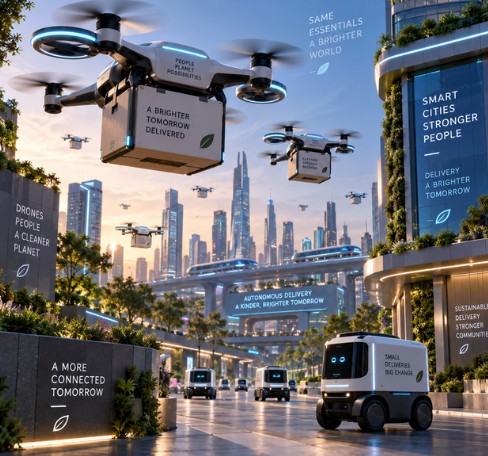
Drones and the Future of Autonomous Delivery
Drones and Autonomous Delivery of the Future: How Last-Mile Logistics Will Change
The growth of e-commerce, the increase in urban orders, and the rising demands for service speed are pushing the logistics industry to seek new solutions. One of the most promising directions is drones and autonomous delivery of the future. Unmanned aerial vehicles, ground robots, intelligent sorting complexes, and artificial intelligence-based software platforms are gradually forming a new model for moving goods.
Modern logistics is no longer limited to the traditional scheme of «warehouse — courier — customer». It includes automated order fulfillment centers, robotic pickup points, demand forecasting systems, digital maps, cloud-based transport management platforms, and last-mile autonomous devices. This approach allows for reduced delivery times, lower operational costs, and more flexible service.
Technologies such as drone delivery logistics, autonomous delivery systems, future courier drones, AI-powered delivery robots, and last-mile delivery automation are merging into a single ecosystem. As a result, a new vision of what a Smart Delivery Future will look like emerges. Delivery becomes not just a transportation service but an intelligent system capable of independently analyzing orders, selecting routes, considering weather conditions, and interacting with other participants in the logistics chain.
What is Autonomous Delivery and Why is it Becoming Popular?
Autonomous delivery is the movement of goods with minimal or no direct human involvement. Transport management, route planning, cargo condition monitoring, and receipt confirmation are performed by digital systems. Depending on the format, aerial drones, ground robots, autonomous vehicles, robotic carts, and hybrid platforms are used.
The main reason for the growing interest in such solutions is related to changes in consumer behavior. People have become accustomed to ordering goods online and expect short delivery times. For many customers, receiving an order on the same day, within a few hours, or even minutes has become the standard. At the same time, the burden on courier services is increasing, especially in large cities with high population density and complex traffic situations.
Traditional delivery faces a number of challenges. Couriers waste time in traffic jams, spend resources searching for parking, and are forced to serve a large number of addresses on different routes. The rising costs of fuel, wages, and fleet maintenance also affect the final price of the service. Autonomous technologies can partially address these issues.
Key Elements of an Autonomous Logistics System
Full-fledged autonomous delivery includes several interconnected levels:
a digital order management platform;
artificial intelligence algorithms;
automated warehouses;
unmanned vehicles;
navigation and control systems;
sensors, cameras, and communication devices;
electronic recipient identification;
a remote monitoring mechanism;
charging and maintenance infrastructure.
A drone or robot does not operate in isolation. It receives tasks from a central system that evaluates order characteristics, transport availability, route congestion, weather conditions, and urban environment constraints. After that, an optimal delivery scenario is formed.
The Role of Artificial Intelligence
Artificial intelligence helps forecast demand, group orders, select the appropriate type of transport, and adjust routes in real-time. If an obstacle appears in the path of the drone, the weather changes, or a road section is closed, the system can suggest an alternative route.
AI also analyzes delivery history. Based on this data, it can determine peak order times, identify areas that require additional storage points, and decide where to place charging stations. As a result, delivery innovations become not isolated experiments but part of a comprehensive business development strategy.
Drones for Delivery: How They Work and Areas of Application
Drones for delivery are unmanned aerial vehicles equipped with navigation modules, cameras, sensors, and a special cargo compartment. They can move along a predetermined route or choose a direction independently, taking into account digital maps and current conditions.
The most common are multicopters capable of taking off and landing vertically. They do not require a long runway and can operate in confined spaces. Some models use an airplane design, which allows them to cover greater distances with lower energy consumption. Hybrid devices combine the advantages of both types.
Technological Architecture of Drone Delivery Logistics
The drone delivery logistics system consists of several components. First, the order is received by a digital platform. The program checks the weight, dimensions, and category of the item, then determines if drone delivery is suitable. If the cargo meets the requirements, the system selects the nearest warehouse or distribution point.
Next, an aerial route is calculated. The following factors are taken into account:
height restrictions;
buildings and infrastructure;
power lines;
airport zones;
weather conditions;
battery charge level;
permitted flight corridors;
distance to the pickup point.
During flight, the drone transmits telemetry data to the control center. Even with a high degree of autonomy, many systems anticipate remote monitoring. A specialist can intervene in the operation in case of an unusual situation, loss of communication, or security threat.
What Items Can Drones Deliver
Currently, drones are particularly promising for transporting small and urgent shipments. These include medications, laboratory samples, documents, food, everyday goods, and small packages. In certain scenarios, drones can deliver spare parts, tools, and components to remote manufacturing sites.
An important advantage is the ability to deliver to locations where conventional transport operates slowly or cannot access. These can be rural areas, islands, mountainous regions, disaster zones, and hard-to-reach settlements. In emergency medicine, drones can quickly deliver blood, vaccines, and essential medications.
Limitations of Aerial Delivery
Despite their potential, drone delivery has limitations. The payload of most civilian models remains relatively small. Flight time depends on battery capacity, cargo weight, wind speed, and ambient temperature. Additional challenges are related to noise, safety, security against hacking, and airspace regulation.
Therefore, drones will not replace all types of transport. Their primary role is to address specific logistics tasks where speed, flexibility, and independence from traffic congestion are crucial.
Autonomous Ground Robots and the Future of Courier Delivery
In addition to aerial vehicles, ground robots are also actively developing. These are small electric platforms capable of moving along sidewalks, pedestrian zones, campus areas, business parks, and residential complexes. They are equipped with cameras, lidar, ultrasonic sensors, and navigation systems.
AI delivery robots analyze their surroundings, recognize people, vehicles, curbs, and other obstacles. If necessary, the robot stops, changes its trajectory, or selects a different route segment. Control can be fully autonomous or combined, where an operator connects to the system in complex situations.
Advantages of Last-Mile Robots
Ground robots are particularly effective over short distances. They can transport groceries, prepared meals, medications, and small online orders from a local warehouse to a home or pickup point. Their use allows for:
reducing the burden on couriers;
decreasing the number of car trips;
cutting route maintenance costs;
providing delivery throughout the day;
utilizing electric propulsion;
increasing predictability of arrival times.
Unlike drones, robots are not subject to height restrictions and do not create air traffic. However, they require quality pedestrian infrastructure and clear rules for interaction with people.
How the Robot Interacts with the Recipient
Upon arrival at the destination, the robot can send a notification to the client via a mobile app. A personal code, QR code, biometric verification, or confirmation in the app is used to open the container. After the item is retrieved, the lid closes, and the system records the completion of the delivery.
This scheme enhances security and reduces the likelihood of errors. It is also necessary to consider cases when the recipient is absent, cannot open the container, or encounters a technical malfunction. Therefore, the digital platform should provide operator support and alternative order delivery scenarios.
Last mile automation: automating the last mile
The term last mile automation refers to the automation of the final stage of logistics — delivering goods from a local distribution point to the customer. The last mile often becomes the most expensive and complex part of the entire chain. It can account for a significant portion of transportation costs, especially with a large number of scattered addresses.
Last mile automation involves not only the use of robots and drones. It includes intelligent order distribution, micro-warehouses, automated parcel lockers, dynamic routing, digital identity verification, and time slot management.
Micro-warehouses and urban fulfillment centers
For the effective operation of autonomous transport, it is necessary to place goods closer to the consumer. This is why micro-warehouses are emerging in cities — small automated points located near residential areas, office districts, and transport hubs.
The micro-warehouse receives goods from a large distribution center, sorts them, and hands them over to drones or robots. By reducing the distance, delivery speed increases, energy consumption decreases, and the number of orders that one system can handle increases.
Hybrid delivery model
The most realistic scenario is a combination of different modes of transport. For example, a large autonomous vehicle delivers a batch of goods to a regional logistics center. From there, ground robots distribute small orders to nearby streets, while drones service remote addresses or urgent requests.
This scheme allows for leveraging the advantages of each technology. Autonomous trucks are suitable for long-haul routes, robots are ideal for short movements in urban environments, and drones are perfect for quick deliveries over distances or through complex infrastructure segments.
Route optimization
The management system generates routes considering numerous parameters. It analyzes not only the distance but also the order fulfillment time, energy consumption, the likelihood of delays, traffic restrictions, and customer priority. If necessary, orders are grouped so that one robot or drone can perform several operations in one cycle.
In the future, algorithms will be able to plan routes for different types of transport simultaneously. This will create a unified intelligent network where devices can exchange data and automatically coordinate their actions.
Autonomous shipping systems: autonomous transport systems
The concept of autonomous shipping systems is typically associated with unmanned vessels, autonomous cargo platforms, and digital management complexes for maritime transport. Although these systems differ from urban drones, they are developing within the same overarching trend — the shift from manual control to automated logistics.
Autonomous vessels can be used for container transport, port supply, cargo delivery between coastal terminals, and servicing industrial facilities. They are equipped with radars, satellite navigation, cameras, object recognition systems, and communication channels with the dispatch center.
The significance of autonomous vessels for supply chains
Maritime transport is the backbone of international trade; however, it is affected by crew shortages, fuel costs, port congestion, and challenging weather conditions. Automation helps to plan routes more accurately, monitor energy consumption, and reduce the number of human errors.
In the future, autonomous vessels may operate within a distributed logistics network. A large ship delivers cargo to a regional port, then unmanned barges transport containers to smaller terminals. After that, the goods are handed over to ground robots or drones to complete the final stage.
Safety and remote control
Full autonomy at sea requires highly reliable software. The system must recognize other vessels, account for depth, currents, weather conditions, and navigation rules. A remote operator plays a crucial role, capable of intervening in the vessel's operation in non-standard situations.
Cybersecurity and protection of communication channels are equally significant. Hacking autonomous transport can lead not only to financial losses but also to environmental or infrastructural consequences. Therefore, autonomous transport systems must undergo strict certification and multi-level testing.
Artificial Intelligence as the Foundation of the Smart Delivery Future
The concept of smart delivery future revolves around continuous data exchange. Each order, vehicle, warehouse, and pickup point becomes part of a unified digital platform. Artificial intelligence helps this system make decisions faster and more accurately than a human can with manual management.
AI is utilized at all stages: from demand forecasting to analyzing delivery success. Algorithms can determine which products should be moved to a local warehouse in advance, how many drones will be needed during a specific period, and which routes will be the most efficient.
Demand Forecasting
The system analyzes sales history, seasonality, weather conditions, holidays, advertising campaigns, and local events. For example, demand for certain products may increase before a significant cold snap, while during a sporting event, demand for food and beverages may rise.
Pre-prepared stock allows for reducing the distance between the product and the customer. This decreases the load on transportation and increases the likelihood of quick delivery.
Intelligent Fleet Management
AI monitors the condition of each device. It assesses battery levels, technical indicators, the number of completed trips, and the likelihood of malfunction. If a robot or drone requires maintenance, the system can proactively take it out of service and replace it with another unit.
This is especially important for large fleets, where manual control becomes ineffective. Automated management helps evenly distribute the load and extend the lifespan of the equipment.
Logistics Personalization
Customers can be offered various options for receiving their orders: standard delivery, urgent drone delivery, pickup at a parcel locker, or delivery by an autonomous robot. The system selects the appropriate option based on distance, cost, and user preferences.
In the future, logistics platforms will be able to predict not only demand but also the convenient pickup time for specific customers. This will reduce the number of failed delivery attempts and make the service more environmentally friendly.
Economic and Environmental Benefits of Delivery Innovations
Delivery innovations have the potential to change the cost structure of logistics companies. Autonomous devices do not require traditional labor payment, can operate longer than a typical shift, and perform repetitive tasks with high stability. Electric robots and drones also potentially reduce fuel costs.
However, the economic effect depends on the scale of implementation. In the initial phase, companies must invest in equipment, software, charging infrastructure, maintenance, and staff training. Therefore, autonomous delivery is most beneficial where there is a high volume of similar orders and well-defined routes.
Emission Reduction
Electric last-mile transport can reduce the use of internal combustion engine vehicles. If drones and robots replace some short trips, carbon dioxide emissions, noise, and transportation load are reduced.
However, the environmental effect must be assessed comprehensively. It is important to consider battery production, electricity consumption, device lifespan, and the need for service vehicle trips. Autonomous delivery will only be truly eco-friendly with proper planning of the entire system.
Improving Service Accessibility
Unmanned technologies can enhance services for people living in remote areas or with limited mobility. Delivery of medicines, groceries, and other goods can become regular and more accessible.
Moreover, autonomous solutions are beneficial in emergencies. If roads are damaged and regular delivery is hindered, drones can deliver small cargo by air. Robots can operate in enclosed areas, industrial sites, and places where the use of large vehicles is impossible.
Safety, Legislation, and Public Trust
The mass adoption of drones and robots is impossible without addressing safety issues. An unmanned device must correctly respond to people, animals, vehicles, obstacles, and sudden environmental changes. Special attention is given to protecting cargo from damage, theft, and unauthorized access.
For aerial drones, regulations regarding altitudes, routes, flight zones, and interaction with aviation infrastructure are required. It is necessary to determine who is responsible in the event of an accident: the manufacturer, operator, platform owner, or software provider.
Personal Data Protection
Drones and robots use cameras and other sensors. They can capture images of people, vehicle license plates, and elements of urban infrastructure. Therefore, companies are required to comply with personal data processing regulations, limit the retention period of records, and protect information from leaks.
It is especially important to explain to users what data the system collects and how it is used. Transparency helps build trust in autonomous services.
The human factor does not completely disappear
Autonomous delivery does not mean the complete exclusion of humans from logistics. Engineers, dispatchers, maintenance specialists, data analysts, software developers, and security experts will still be needed.
The nature of courier work will change. Some employees may transition to managing complex deliveries, overseeing the autonomous fleet, servicing robots, and interacting with customers. Thus, automation is more likely to transform the labor market rather than completely eliminate human involvement.
The future of courier drones and autonomous systems
Future courier drones will become quieter, more reliable, energy-efficient, and functional. Developers are working on increasing flight range, improving navigation systems, enhancing payload capacity, and ensuring safe package delivery mechanisms.
It is likely that drones will use automatic landing pads on rooftops, in logistics centers, and at special urban terminals. Recipients will be able to retrieve their orders from a secure container or receive them via a cable or another contactless transfer mechanism.
Infrastructure development
New urban infrastructure will be required for autonomous delivery:
charging stations;
landing pads;
secure waiting zones;
digital traffic corridors;
local warehouses;
service centers;
automated transfer points;
communication systems between vehicles and urban objects.
Cities that prepare such infrastructure in advance will gain an advantage in the speed and quality of logistics services. Planning should take into account the interests of residents, noise issues, safety, and visual impact.
Integration with smart cities
In the future, autonomous devices will interact with traffic lights, road cameras, weather stations, building management systems, and public transport. For example, a robot could receive data about sidewalk repairs, while a drone could get information about temporary air traffic restrictions.
This integration will create an adaptive transportation environment where routes change automatically. Delivery will become part of a broader smart city concept that includes intelligent energy, transportation, and urban infrastructure management.
How companies can prepare for autonomous delivery
The transition to autonomous logistics should not begin with a large-scale purchase of equipment. First, it is necessary to determine which processes are most suitable for automation. Typically, short repetitive routes, delivery of standard goods, and areas with controlled infrastructure are the best candidates.
Companies should analyze orders, assess customer density, identify the most costly areas of the logistics chain, and choose the appropriate type of transport. In some cases, it may be more efficient to implement ground robots rather than drones. For other tasks, using micro-warehouses and automated parcel lockers may be more appropriate.
Phased implementation strategy
An optimal strategy may include the following steps:
analysis of current logistics processes;
selection of a pilot area;
identification of product categories;
configuration of the digital platform;
launch of a limited number of autonomous devices;
data collection and evaluation of results;
adjustment of routes and regulations;
gradual expansion of the operational area.
It is important to prepare contingency plans in advance for communication failures, battery depletion, bad weather, and equipment malfunctions. The reliability of the system is determined not only by its routine operation but also by the quality of its response to non-standard situations.
Performance metrics
Various metrics are used to evaluate the project:
average delivery time;
cost per order;
percentage of successful deliveries;
number of operator interventions;
level of cargo damage;
energy consumption;
number of retries;
customer satisfaction;
number of technical failures.
A comprehensive analysis helps to understand whether an autonomous system truly benefits the business and under what conditions its application is justified.
Drones and autonomous delivery of the future are gradually transforming from experimental technology into an essential element of modern logistics. Air drones, ground robots, automated warehouses, and intelligent software platforms are shaping a new model for customer service.
Technologies such as drone delivery logistics, autonomous delivery systems, future courier drones, AI-powered delivery robots, and last-mile delivery automation allow for reduced transport time, decreased transportation load, and increased order fulfillment accuracy. However, their development requires addressing issues of safety, regulation, cybersecurity, infrastructure, and public trust.
The most promising approach is considered to be a hybrid model, where different types of autonomous transport work together. Large cargo is moved between distribution centers, micro-warehouses provide local storage, ground robots service short routes, and drones handle urgent or remote deliveries.
The future of delivery will not be about the complete disappearance of humans, but rather the redistribution of their role. People will design, monitor, and improve intelligent systems, while routine operations will gradually shift to autonomous devices. This combination of technology, data, and human expertise will form the basis of the Smart Future of Delivery and a new stage in the development of global logistics.