

 RU
 UA
 DE
 FR
 ES
 CN
 SA
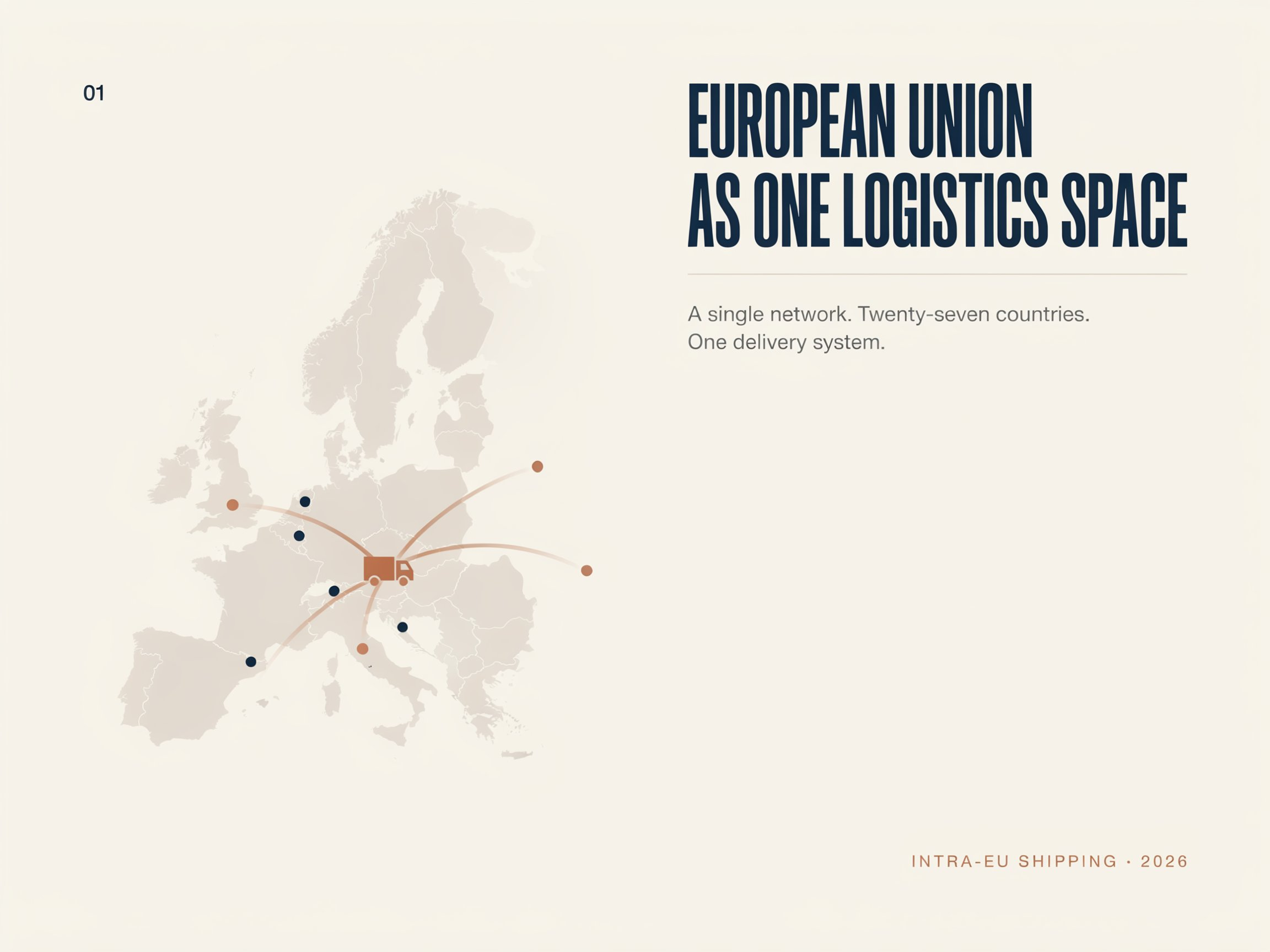
European Union as a Unified Logistics Space
The European Union as a Unified Logistics Space: Delivery Across the EU and Features of the European Transport System
The European Union is not only a political and economic union of states but also a vast logistics space where millions of shipments, goods, and commercial cargoes are moved daily. Thanks to the single market, the development of cross-border trade, and the unification of many regulations, delivery across the EU has become significantly easier, faster, and more predictable. Companies can organize shipments between EU countries with minimal administrative barriers, while private customers gain access to a wide range of courier services, postal operators, and logistics platforms.
The modern European delivery system integrates road, rail, air, and maritime routes. Within Europe, distribution centers, sorting terminals, pickup points, and automated parcel lockers are actively used. This enables the establishment of efficient supply chains for both large online retailers and small sellers operating on marketplaces.
Terms like EU shipping system, intra Europe logistics, DHL Europe network, DPD Europe delivery, PostNL EU shipping, and "unified delivery Europe" reflect different aspects of one large system. This refers to the collective of transport operators, warehousing infrastructure, digital services, customs and tax regulations that facilitate the movement of shipments between European states.
The European Union as a Unified Logistics Space
European logistics is built on the principle of free movement of goods within the single market. For most shipments sent from one EU country to another, the classic customs procedure, as in international delivery to a third country, is not required. This significantly reduces transportation times, decreases the number of documents, and makes delivery costs more understandable for businesses and end recipients.
However, a unified logistics space does not mean the complete absence of differences between states. Each country may have its own requirements for labeling, consumer protection, packaging, taxation, returns, and specific product categories. Therefore, when organizing delivery across the EU, it is essential to consider not only the route but also the legislation of the destination country.
The VAT system is particularly important. In cross-border trade, it is crucial for the seller to determine where the tax obligation arises, whether the distance selling regime applies, and if special schemes for e-commerce need to be used. For small companies, these issues can be complex, which is why fulfillment operators and logistics intermediaries are often employed to help organize storage, order fulfillment, delivery, and returns.
The developed transport network of the European Union includes thousands of kilometers of highways, railway lines, inland waterways, and international air routes. Road transport plays a central role in delivering parcels over distances of up to several thousand kilometers. It provides flexibility, allows shipments to be delivered directly to sorting centers, and easily adapts to regional characteristics.
The Single Market and Cross-Border Movement of Goods
The EU single market creates favorable conditions for companies that sell products in multiple states. A seller does not need to open a separate store or warehouse in each country. They can use one online store, a centralized warehouse, and connect with a European logistics operator capable of delivering orders throughout the region.
Standard address formats, electronic transport documents, automated tracking systems, and integration with e-commerce platforms are of great importance. Thanks to digitalization, the sender can automatically transmit order data to the carrier, print labels, track delivery status, and generate reports for each destination.
Restrictions and Exceptions Within the EU
Despite the absence of classic customs between most countries in the union, there are categories of goods that require special control. These may include alcohol, tobacco products, pharmaceuticals, food products, plants, chemicals, batteries, aerosols, and certain types of electronics. Restrictions also apply to hazardous goods and items whose transport is regulated by national norms.
Additionally, certain territories associated with EU states may have special tax or customs status. Therefore, before shipping, it is necessary to verify whether a specific destination truly falls under the standard delivery scheme within the European Union.
How Delivery Works Across the EU
Delivery within the EU consists of a sequential chain of operations: order acceptance, product preparation, packaging, transportation data processing, handover to the carrier, sorting, transport between terminals, and delivery to the pickup point or recipient's address. Digital tools are used at each stage to track the shipment and monitor compliance with deadlines.
Typically, the shipment first arrives at a local warehouse or pickup point. It is then directed to a regional sorting center, where it undergoes automated processing and is distributed along the required route. If the delivery is to another country, the package is sent to an international hub. Upon arrival in the destination country, it enters the national carrier's network and is handed over to a courier or a pickup point.
Delivery times depend on distance, the chosen rate, delivery format, and the specifics of the particular operator. Within neighboring countries, the shipment can arrive within one to two business days. For remote regions, island territories, and complex routes, more time will be required. Express delivery usually costs more but ensures priority processing and a narrower time window.
The cost of delivery is determined based on weight, dimensions, distance, type of service, insurance, delivery method, and additional services. For businesses, the volume of shipments is also important. Online stores sending dozens or hundreds of packages daily can obtain corporate rates and special conditions.
Door-to-door delivery and pickup points
European buyers actively use both main formats for receiving orders. Courier delivery to the door is convenient for large items and customers who prefer to receive packages at home or work. Pickup points and parcel lockers allow customers to collect their orders at a convenient time without having to adjust to the courier's visit.
The network of pickup points is especially important in densely populated cities. It reduces the number of repeated delivery attempts, eases the burden on couriers, and can lower the cost of the last mile. For online stores, having multiple pickup options increases conversion rates and makes purchases more attractive.
Tracking and notifications
Modern delivery within the EU is almost always accompanied by a tracking system. After the shipment is handed over, the carrier assigns it a unique identifier. With this number, both the sender and recipient can find out where the package is, when it was accepted, at which terminal it was processed, and when delivery is expected.
Notifications can be sent via email, SMS, through a mobile app, or directly in the store's personal account. In some countries, recipients are allowed to change the delivery date, select a nearby address, redirect the shipment to a parcel locker, or a pickup point.
Intra Europe logistics
The concept of intra Europe logistics encompasses all processes related to the movement of goods within the European space. This system includes transportation between warehouses, delivery of orders to customers, restocking retail locations, reverse logistics, inventory management, and processing undelivered shipments.
For businesses, intra-European logistics is not just about choosing a carrier. It is necessary to determine the optimal placement of inventory, select a storage model, calculate the cost of the last mile, organize return processing, and ensure compliance with legal requirements. Mistakes at any stage can lead to delays, increased costs, and reduced customer loyalty.
Centralized and distributed warehousing
In a centralized model, goods are stored in one large warehouse, for example, in Germany, the Netherlands, Belgium, Poland, or the Czech Republic. From this center, orders are dispatched to various European destinations. The advantage of this solution lies in the simplicity of inventory management and reduced costs for renting multiple facilities. However, the downside may be longer delivery times to remote countries and high dependence on a single logistics hub.
The distributed model involves placing goods in several warehouses. It allows products to be closer to the customer, speeds up delivery, and reduces the cost of the last mile. However, inventory management becomes more complex: it requires synchronizing stock levels, forecasting demand, and controlling the movement of goods between locations.
Fulfillment in Europe
European fulfillment centers receive products from sellers, store them in the warehouse, pick orders, package shipments, and hand them over to carriers. Additionally, such operators may handle labeling, kit assembly, return processing, and reporting preparation.
Fulfillment is particularly beneficial for companies that are entering multiple markets simultaneously. Instead of managing warehouses and courier contracts independently, the seller gains a unified logistics process. When choosing a partner, it's important to study the geography of warehouses, connected carriers, storage costs, order processing times, return policies, and integration capabilities with the online store.
DHL Europe network: DHL's European network
DHL Europe network is considered one of the largest logistics systems on the European continent. The company utilizes a network of sorting centers, transport hubs, partner pickup points, and courier routes. This allows DHL to handle both standard parcels and urgent commercial shipments.
One of the advantages of the network is its developed international infrastructure. Shipments go through standardized digital processes, and information about their status is transmitted between divisions and countries. This helps monitor the route even when the parcel changes transport modes multiple times or is handed over to a local partner.
DHL offers various service options: standard delivery, express shipping, delivery for corporate clients, e-commerce solutions, and specialized transport programs. The specific set of services depends on the country of origin, destination country, and type of contract.
Features of DHL delivery in Europe
When working with DHL, it is necessary to determine in advance the allowable dimensions and weight, packaging rules, content restrictions, and document processing procedures. For commercial shipments, accurate data about the product, its value, and purpose may be required. Even within the EU, errors in product descriptions can lead to delays or returns of shipments.
DHL provides electronic tools for creating waybills, printing labels, transmitting order data, and tracking. Integrations with e-commerce platforms and order management systems are available for online stores. This allows for the automation of bulk processing of shipments and reduces the number of manual operations.
When DHL is the best choice
DHL is often chosen by companies that value stability, wide geography, and predictable service levels. The network is suitable for regular international shipments, delivery of goods to corporate clients, urgent parcels, and orders with high tracking requirements.
However, the cost of DHL services may be higher than that of individual regional operators. Therefore, for inexpensive goods and bulk shipments, sellers should compare several rates, taking into account not only the shipping price but also the costs of returns, additional delivery attempts, insurance, and handling of non-standard cargo.
DPD Europe delivery: DPD delivery across European countries
DPD Europe delivery is a delivery network focused on shipping parcels between European countries and within national markets. DPD actively develops courier delivery, pickup points, parcel lockers, and digital services for managing shipments.
One of DPD's strengths is its focus on the last mile. Recipients can receive notifications about the expected time of the courier's visit, choose a convenient delivery option, and redirect the shipment to a pickup point. For online stores, this flexibility helps reduce the number of failed deliveries and increase customer satisfaction.
The DPD system is generally well-suited for small and medium-sized shipments. The carrier serves a wide range of online stores, manufacturers, distributors, and private shippers. Conditions may vary depending on the country, so it is advisable to check local regulations before connecting.
Advantages of DPD for e-commerce
DPD offers tools that allow online stores to integrate delivery into their own platform. Labels can be automatically created, address data can be transmitted, tracking links can be sent to customers, and delivery notifications can be received.
Pickup points and parcel lockers are of significant importance. They make delivery more convenient for customers who do not want to wait for a courier at home. Additionally, centralized pickup can reduce seller costs and lessen the burden on the urban courier network.
What to consider when choosing DPD
Before starting operations, it is essential to study weight and size restrictions, packaging rules, the list of prohibited items, and the return processing procedures. It is also important to find out how the carrier handles shipments that could not be delivered on the first attempt.
Contract rates are usually available for large clients. Their overall effectiveness depends on the number of parcels, destinations, average order value, and return rates. Often, it is more beneficial to compare not just the individual shipping price but the total logistics cost for a single order.
PostNL EU shipping: delivery via PostNL
PostNL EU shipping is particularly in demand for shipments from the Netherlands to other European countries. PostNL is the key postal and logistics operator in the Netherlands, providing solutions for private shippers, online stores, and international e-commerce.
The PostNL system includes the acceptance of shipments, sorting, transportation, international transfer, and delivery in the destination country. Depending on the selected service, the final stage may be carried out by PostNL itself or a partner operator. Therefore, delivery times and formats depend not only on the country of origin but also on local infrastructure.
PostNL actively collaborates with online stores that require bulk shipment of orders to various countries. Important factors include digital shipment processing, integration with e-commerce platforms, and automatic provision of delivery status information.
Features of PostNL for international shipments
Before using PostNL, it is necessary to determine whether the shipment qualifies as a standard postal parcel, commercial cargo, registered shipment, or express service. Different types of services have their own limitations regarding size, weight, insurance, and tracking levels.
An economical format may be used for inexpensive goods, while a service with enhanced tracking and delivery confirmation is suitable for more valuable orders. The choice depends on how critical speed and route control are.
Advantages of PostNL
PostNL can be a convenient solution for sellers shipping products from the Netherlands or using Dutch fulfillment centers. The operator has experience handling a large number of international parcels and allows for regular delivery across European routes.
Possible limitations include differences in delivery times between countries, specifics of transferring to a local partner, and varying levels of tracking detail. Therefore, it is important for sellers to inform customers in advance about the expected delivery time and format.
Unified delivery Europe: how to organize a single process for different countries
The term “unified delivery Europe” is used to describe a model where the seller manages shipments to multiple countries through a single logistics partner, one platform, or a single contract. This scheme is convenient for companies that want to scale sales without creating separate infrastructure in each market.
The unified process may include a common connection to the carrier's API, unified label templates, centralized tracking, automatic cost calculation, a shared personal account, and consolidated reporting. Ideally, the store manager submits the order to the system, and the platform independently determines the appropriate route and generates the necessary documents.
However, universal delivery across Europe does not always mean identical times and rates. Costs depend on the region's remoteness, route density, local fees, delivery formats, and the specifics of the national network. Therefore, the unified system should primarily be viewed as a standardized management method rather than an identical service across all countries.
How to choose a logistics model
Before connecting a carrier, it is essential to analyze the geography of orders, average weight and dimensions of parcels, the share of express shipments, the number of returns, and customer delivery requirements. If orders are concentrated in a few neighboring countries, a regional operator may be suitable. For a broader coverage of Europe, it is wiser to consider an international network or fulfillment platform.
It is necessary to compare:
the cost of standard and express delivery;
delivery times for key destinations;
the availability of pickup points and parcel lockers;
tracking quality;
return policies;
insurance coverage;
restrictions for specific categories of goods;
integration capabilities with the store;
customer support level;
availability of corporate rates.
Delivery automation
Automation helps reduce errors and speed up order processing. An online store can connect to the carrier's API or use an aggregator that combines several services into one interface. In this case, the system automatically transmits data, selects a rate, generates a shipping label, and sends the customer a tracking link.
For large sellers, integrations with ERP, CRM, warehouse management systems, and marketplaces are crucial. This allows for inventory synchronization, automatic order status updates, and return management.
Packaging, Documents, and Product Requirements
Quality packaging is an essential part of European logistics. The parcel must withstand mechanical stress, sorting, vibration, temperature fluctuations, and movement between transport hubs. Fragile items need to be protected with cushioning materials, and voids inside the box should be filled to prevent the products from shifting during transport.
The packaging must clearly display the recipient's address, sender's information, and the carrier's barcode. An unreadable label or incorrect address format can lead to delays. Some products will require additional markings: information about fragility, orientation of the package, presence of lithium batteries, or other special characteristics.
Within the EU, correct commercial and transport data is sufficient for many standard shipments. However, if the product has a special status, it is important to check the requirements in advance. For example, liquids, cosmetics, batteries, medical products, and food items can only be transported under specific conditions.
Return Logistics
Returns are an important part of trade within the EU. The buyer must understand how to initiate a return, who pays for the return shipping, the timeframe for accepting the product, and how the order cost will be refunded. A lack of a transparent procedure decreases trust and increases the number of inquiries to customer support.
The seller needs to determine the return address in advance. This could be a central warehouse, a local fulfillment center, or a location serviced by a partner. After receiving the product, it is important to check its condition, update the order status, and quickly process the refund.
Main Delivery Issues in the EU and Solutions
Even developed European logistics face challenges. Delivery times can be affected by seasonal peaks, weather conditions, strikes, overloads at sorting centers, address errors, and the absence of the recipient. During sales and holidays, the volume of shipments increases sharply, which can sometimes adjust standard delivery times.
Another common issue is the discrepancy between actual dimensions and those stated in the shipping documents. If the box is heavier or larger than declared, the carrier may apply an additional charge or change the handling method of the shipment. To avoid this, products should be weighed and measured in their final packaging.
Address errors also lead to delays. It is advisable to use address verification, mandatory inclusion of postal codes, house numbers, apartment or office numbers, as well as the recipient's contact phone number. For international orders, local address formatting should be taken into account.
How to Reduce Logistics Costs
Savings begin with analyzing the entire supply chain, not just the carrier's rate. Sometimes a cheaper rate leads to more returns or redeliveries, ultimately increasing costs. It is necessary to consider the costs of packaging, storage, order processing, delivery to the warehouse, return shipping, and customer support.
Ways to reduce costs include:
placing inventory closer to key markets;
using pickup points;
standardizing packaging;
contractual rates;
consolidating shipments;
automated label printing;
reducing address errors;
accurate product descriptions;
analyzing actual delivery times for each carrier.
Future Prospects for European Logistics
European delivery continues to transition to a more digital, eco-friendly, and flexible model. Carriers are developing electric transport, urban micro-warehouses, automated sorting lines, and a network of parcel lockers. More processes are being digitized, from order placement to delivery confirmation.
There is a growing demand for low-carbon delivery options. Online stores offer customers the choice of a slower but more environmentally friendly shipping option, consolidate orders, and use packaging made from recycled materials. In cities, cargo bikes, electric vans, and local consolidation points are being developed.
A key trend remains the personalization of delivery. Recipients want to choose the time, place, and method of receiving their orders. Therefore, carriers are investing in mobile applications, interactive notifications, parcel lockers, and systems for predicting arrival times.
In the future, unified delivery in Europe will increasingly depend on automation, data quality, and the ability of different logistics systems to interact with each other. For businesses, this means the necessity of building a reliable infrastructure in advance: connecting digital accounting, monitoring packaging quality, analyzing carrier performance, and regularly reviewing logistics strategy.
The European Union is one of the most developed logistics regions in the world. The single market, dense transportation network, absence of traditional internal customs borders for most goods, and high competition among carriers create favorable conditions for trade between countries.
Delivery within the EU can be based on the DHL Europe network, DPD Europe delivery, PostNL EU shipping, national postal operators, regional courier services, or fulfillment platforms. The choice depends on the sales geography, product characteristics, required speed, budget, and customer expectations.
For successful operations, it is important to view delivery as a comprehensive system. It is necessary to consider warehousing, packaging, transportation, tracking, last mile, returns, tax regulations, and customer support. Well-organized intra Europe logistics helps reduce costs, speed up order fulfillment, and scale sales in the European market. A unified digital management system makes delivery across Europe more transparent, predictable, and convenient for both businesses and end customers.