

 RU
 UA
 DE
 FR
 ES
 CN
 SA
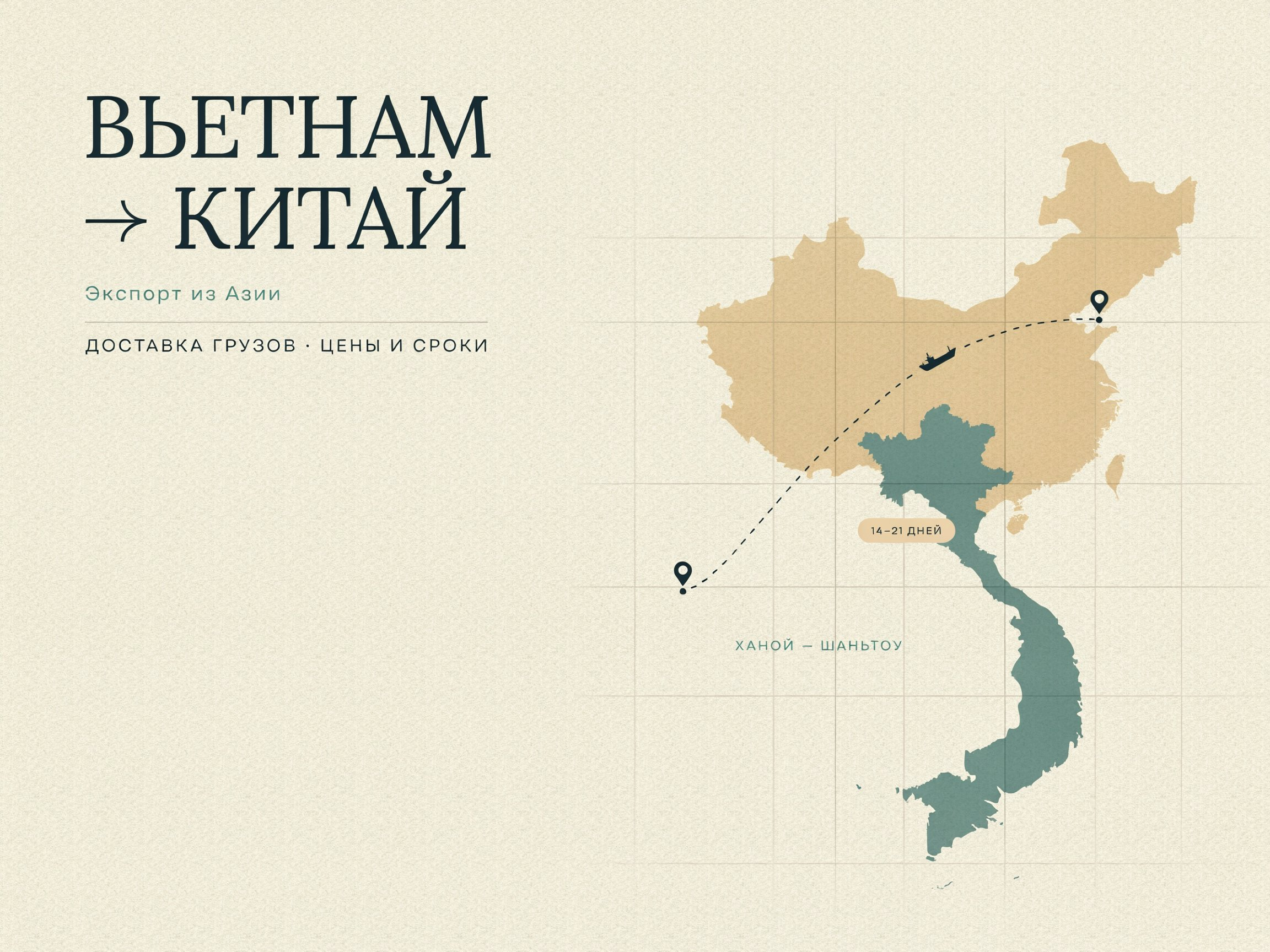
Cargo Delivery from Vietnam to China
Freight Delivery from Vietnam to China: Companies, Prices, Timelines, and Export Documentation
Vietnam and China are key players in Asian trade. Industrial goods, electronics, textiles, footwear, furniture, equipment, agricultural products, components, and raw materials are regularly transported between the two countries. The geographical proximity makes the Vietnam-China route popular among manufacturers, wholesalers, online stores, and international distributors.
Organizing international transportation requires careful planning. It is essential to choose the right mode of transport, prepare export documents, check product requirements, calculate customs duties, and determine delivery timelines in advance. Mistakes at any stage can lead to delays, additional costs, or the return of the cargo to the sender.
This article will detail how freight delivery from Vietnam to China is organized, how long transportation takes, what transportation methods exist, what factors influence prices, and how to properly arrange exports from Vietnam.
Features of Freight Transportation Between Vietnam and China
Vietnam and China share a land border, making road and rail transport available for this route. Additionally, maritime routes are actively used between the countries, and air freight is utilized for urgent shipments. This variety of options allows for the selection of an optimal logistics scheme for almost any type of cargo.
Several factors influence the choice of transportation method:
the weight and volume of the shipment;
the nature of the goods;
the urgency of delivery;
temperature control requirements;
the presence of hazardous or special cargo;
the client's budget;
the point of departure and final destination;
the need to consolidate multiple shipments;
Incoterms delivery conditions.
For example, a small shipment of expensive electronics is best sent by air. A large shipment of textiles or furniture is more cost-effective to transport by sea. If the cargo needs to be delivered faster than sea transport allows, but the cost of air freight is too high, road or rail delivery is often chosen.
Popular Transportation Routes
The main export centers in Vietnam are located in the areas of Hanoi, Ho Chi Minh City, Haiphong, Da Nang, and provinces near the Chinese border. Significant logistics hubs in China include Shenzhen, Guangzhou, Nanning, Beijing, Shanghai, Kunming, and other major cities.
The most in-demand routes are:
Hanoi – Nanning;
Haiphong – Shenzhen;
Ho Chi Minh City – Guangzhou;
Ho Chi Minh City – Shanghai;
Haiphong – Shanghai;
Hanoi – Kunming;
Da Nang – Guangzhou;
border crossings Vietnam – China.
If the cargo is sent from the southern regions of Vietnam, it is often first transported by road or rail to the northern part of the country. The shipment is then directed through border checkpoints or loaded onto a sea vessel.
What Goods Are Transported from Vietnam to China
The trade turnover between the two countries includes a wide range of products. The most commonly delivered items are:
clothing, footwear, and textiles;
electronics and household appliances;
furniture and interior items;
industrial equipment;
auto parts and components;
coffee, tea, nuts, and spices;
seafood and agricultural products;
wooden products;
plastic products;
packaging materials;
construction goods;
cosmetics and household chemicals.
Each category has its own requirements. Food products may require sanitary, phytosanitary, and veterinary documents. Electronics sometimes need compliance certificates. The transportation of batteries, chemicals, aerosols, and other hazardous goods is only permitted under special regulations.
Main Methods of Delivering Cargo from Vietnam to China
The choice of transport not only determines the speed of delivery but also the final cost, the level of control over the cargo, and the list of necessary documents. In practice, there are four main options: road, rail, sea, and air delivery.
Road Freight Transportation Vietnam – China
Road delivery is particularly in demand on routes between the northern provinces of Vietnam and the southern regions of China. A truck can pick up goods from the supplier's warehouse, go through export clearance, cross the border, and deliver the shipment directly to the recipient.
The main advantages of road transport include:
the ability to deliver "from door to door";
flexible route selection;
no need to transship cargo at the port;
convenience for small and medium-sized shipments;
relatively short delivery times;
the possibility of transporting consolidated cargo.
Road transport is suitable for textiles, footwear, furniture, household appliances, equipment, packaging, and other goods that do not require long-term storage in transit. Refrigerated trucks can be used for perishable products, but the cost of such transportation will be higher.
Delivery Times for Road Transport
On average, road transport from Vietnam to China takes from 2 to 7 days. When transporting between nearby border cities, the time may be just a few days. If the shipment is coming from Ho Chi Minh City or another remote region to central China, the duration increases.
The actual delivery times are influenced by:
the congestion at border crossings;
weather conditions;
the quality of export documents;
customs control;
holiday periods;
the need for transshipment;
the route within China;
any restrictions on the movement of freight transport.
It is important to note that the specified times usually reflect the transport stage. Additional time must be added for consolidation, document processing, customs clearance, and delivery to the recipient's warehouse.
Rail Delivery from Vietnam to China
Rail transport is suitable for regular commercial shipments, heavy cargo, and batches where a balance between cost and speed is important. Rail can be used as a standalone mode of transport or as part of a multimodal scheme.
The advantages of rail delivery include:
schedule stability;
high load capacity;
less dependence on road conditions;
affordable cost;
the possibility of transporting containers;
increased safety during transportation.
Rail transport is often chosen for transporting equipment, raw materials, components, textiles, construction materials, and consumer goods. However, the route may include several terminals, so it is important to clarify in advance whether the delivery from the sender's warehouse to the station and from the station to the recipient is included in the quoted price.
How Long Does Cargo Take by Rail
Depending on the route, rail delivery takes approximately 5–12 days. If the shipment is sent from southern Vietnam and requires preliminary delivery to a northern railway station, the total time will be longer.
The duration of transport is influenced by:
the train schedule;
the availability of container space;
border procedures;
the need for gauge change or transshipment;
customs clearance;
the final destination city.
Rail delivery is rarely the fastest option, but it often proves to be more cost-effective than air transport for heavy or bulky shipments.
Sea Freight from Vietnam to China
Sea transport is traditionally considered the optimal solution for large shipments and container consignments. The main sea ports in Vietnam include Hai Phong, Ho Chi Minh City, Cai Mep, and Da Nang. In China, cargo can arrive at the ports of Shenzhen, Shanghai, Guangzhou, Ningbo, Xiamen, and other cities.
Sea delivery comes in two main types:
FCL – a separate container for one client;
LCL – a consolidated container containing cargo from several senders.
FCL is advantageous for large volumes when the cargo can fully or mostly fill a container. LCL is used for smaller shipments that do not require a whole container. In this case, the cost is calculated based on volume or weight, and the cargo undergoes consolidation at the warehouse.
Sea Freight Times
Sea delivery from Vietnam to China typically takes from 5 to 20 days, excluding specific procedures. However, the total time can reach 2–4 weeks when considering:
container submission;
packaging and loading;
delivery to the port;
export clearance;
waiting for the vessel;
transit;
unloading;
import customs;
delivery to the recipient's warehouse.
For sea transport, it is especially important to reserve a spot on the vessel in advance. During peak demand periods, before national holidays, and during seasonal sales, available capacity can quickly run out.
Air Delivery Vietnam — China
Air freight is used for urgent, expensive, compact, and relatively light cargo. This method minimizes transit time and reduces the risk of prolonged storage of goods in transit.
Air delivery is suitable for:
product samples;
components;
electronics;
medical devices;
documents;
expensive accessories;
urgent spare parts;
goods with a short shelf life.
The main disadvantage of air freight is the high cost. The price depends not only on the actual weight but also on the volumetric weight. If the boxes take up a lot of space, the carrier may calculate the rate based on the volumetric measurement.
How long does air delivery take
The flight itself can take just a few hours, but the complete logistics cycle usually lasts 1–4 business days. This period includes cargo pickup, consolidation, export clearance, airport processing, air transport, import customs, and delivery to the recipient.
Express air delivery is not available for all goods. Before booking, it is necessary to check restrictions on batteries, liquids, chemical products, magnetic materials, and other categories.
Shipping Costs from Vietnam to China
The exact cost of transportation cannot be determined solely by the country of origin and destination. Detailed cargo parameters and delivery conditions are required for calculation.
Factors affecting the price include:
weight;
volume;
number of packages;
type of packaging;
product category;
chosen mode of transport;
distance from the warehouse to the terminal;
need for cargo pickup;
loading and unloading operations;
customs clearance;
insurance;
delivery within China;
urgency;
seasonality;
currency fluctuations;
Incoterms conditions.
Estimated Cost Comparison
In most cases, road transport is more expensive than sea transport for large volumes, but it allows for faster delivery and direct shipment. Sea transport remains the most cost-effective for container shipments. Rail transport occupies an intermediate position in terms of speed and price. Air delivery is the fastest but usually the most expensive option.
The distribution can be roughly represented as follows:
| Mode of Transport | Average Time | Cost Level |
|---|---:|---:|
| Road | 2–7 days | Average |
| Rail | 5–12 days | Average |
| Sea | 5–20 days | Low or Average |
| Air | 1–4 days | High |
These values are approximate. The final rate is calculated individually after receiving information about the cargo, route, and required services.
Why Prices Differ Among Carriers
Different companies may quote different prices for the same shipment. This is explained by differences in the composition of the tariff. One rate may include only international freight, while another may include cargo pickup, export declaration, warehouse processing, insurance, door-to-door delivery, and customs support.
Before signing a contract, it is essential to clarify:
whether export customs is included;
whether port and terminal fees are included;
whether loading is paid for;
whether delivery to the final address is provided;
who pays for import duties;
whether insurance is included;
whether there are additional charges for storage;
whether inspection fees are included;
whether the price is fixed for the entire transportation period.
Main Companies Organizing Cargo Transport Between Vietnam and China
In the Vietnam–China route, international transport and logistics companies, freight forwarders, brokers, shipping lines, air carriers, and local carriers operate. The specific choice depends on the nature of the cargo, budget, and required level of service.
Large logistics operators typically offer comprehensive services:
cargo pickup from the supplier;
consolidation at the warehouse;
packaging inspection;
export clearance;
international transportation;
import support;
delivery to the warehouse;
insurance;
cargo tracking;
report preparation.
International Logistics Operators
Among the well-known international companies that can service Asian routes are DHL Global Forwarding, DSV, Kuehne+Nagel, DB Schenker, Expeditors, Sinotrans, CEVA Logistics, and other major forwarders. The possibility of organizing a specific route and the type of cargo should be clarified directly with the chosen operator.
The advantages of large companies include:
an extensive agency network;
standardized processes;
access to sea, rail, and air routes;
corporate tracking systems;
availability of customs clearance specialists;
the ability to work with large contracts.
A disadvantage may be the higher cost compared to smaller forwarders. Additionally, a large company does not always offer the most flexible solutions for small shipments.
Local Forwarders and Freight Brokers
Local companies in Vietnam and China often offer more favorable rates and have a better understanding of the specifics of particular border crossings, ports, and warehouses. They can organize the delivery of consolidated cargo, pick up goods from small suppliers, and assist with documentation.
When choosing a local forwarder, it is important to check:
the presence of a legal entity;
experience in the direction;
real customer reviews;
the contract;
liability for the cargo;
insurance conditions;
transparency of the tariff;
list of included services;
the procedure in case of delays or damage.
A low price does not always mean a benefit. If a carrier offers to arrange cargo without documents or promises a "guaranteed pass" without checking the goods, this can lead to serious risks.
How to Arrange Export from Vietnam to China
Export clearance is a set of procedures that confirm the legality of exporting goods from Vietnam. Usually, the seller or their authorized customs representative is responsible for preparing the declaration, but the buyer also needs to monitor the documents.
Main Export Documents
For a standard commercial shipment, the following may be required:
foreign trade contract;
commercial invoice;
packing list;
transportation waybill;
export declaration;
certificate of origin;
export license, if required;
permits for specific categories of goods;
quality and compliance certificates;
sanitary, phytosanitary, or veterinary documents;
packaging documents;
insurance policy.
The exact list depends on the goods, their HS code, the country of destination, and the requirements of Chinese regulatory authorities.
Invoice and Packing List
The invoice contains information about the seller, buyer, description of the goods, quantity, price, currency, delivery terms, and total value of the shipment. The data in the invoice must match the information in the contract and other documents.
The packing list describes the actual placement of the cargo:
number of boxes;
marking;
gross and net weight;
dimensions of packages;
contents of each package;
type of pallets or containers.
Errors in weight, quantity, and description of the goods can raise additional questions from customs and lead to adjustments in the declaration.
Export Customs Declaration
The export declaration is submitted to the customs authorities of Vietnam electronically or through an authorized representative. It specifies the product code, value, quantity, country of destination, information about the sender and recipient, as well as details about the vehicle.
Before submitting the declaration, it is necessary to check:
the correctness of the HS code;
the presence of permit documents;
compliance of the price with the contract;
correctness of the description;
matching weight and quantity;
data from the transport document;
delivery terms.
If the goods belong to a controlled category, customs may require additional permits or conduct an inspection.
Import Clearance in China
After the cargo arrives, the Chinese side must complete the import procedures. This is usually done by the recipient, their customs broker, or a logistics company.
The following may be required for import:
contract;
invoice;
packing list;
bill of lading or transport document;
certificate of origin;
permits and licenses;
compliance declaration;
sanitary and phytosanitary documents;
importer registration details;
documents on the composition and characteristics of the goods.
Chinese regulations depend on the product category. Food products, cosmetics, medical devices, electronics, chemical products, and equipment may be subject to special requirements.
Customs Duties and Taxes
When importing goods into China, the following may be charged:
import duty;
value-added tax;
excise tax, if applicable;
processing fees;
storage and handling charges;
inspection or certification costs.
The amount of fees depends on the HS code, customs value, origin of the goods, and applicable trade agreements. To calculate costs in advance, it is necessary to determine the correct classification code and check the current rates.
Incoterms Conditions for Shipments Vietnam — China
The foreign trade contract must include agreed delivery terms. The most common are EXW, FCA, FOB, CIF, DAP, and DDP.
EXW
Under EXW, the seller provides the goods at their warehouse. The buyer organizes pickup, export clearance, international transportation, import clearance, and delivery. This condition can be inconvenient if the buyer does not have a representative in Vietnam.
FOB
Under FOB, the seller delivers the cargo to the port, completes export clearance, and loads the goods onto the vessel. After this, the main costs and risks transfer to the buyer. This condition is primarily used for maritime transport.
CIF
Under CIF, the seller pays for transportation to the destination port and insurance; however, import clearance and further delivery usually remain the buyer's responsibility.
DAP
Under DAP, the seller organizes delivery to the agreed address, but import duties and taxes are generally paid by the buyer.
DDP
Under DDP, the seller assumes almost all costs, including import clearance and payments. However, the application of DDP is only possible if the seller or their representative has the legal ability to perform import procedures in China.
Choosing the wrong delivery term can lead to unexpected expenses and disputes between the parties. Therefore, Incoterms should be agreed upon before placing an order.
How to Choose the Optimal Delivery Method
To select the appropriate option, it is necessary to answer several questions:
What is the exact weight and volume of the cargo?
Is urgent delivery required?
Can the goods be transported by regular transport?
Is a temperature-controlled environment needed?
Are there any export or import restrictions on the products?
What budget is allocated?
Who is responsible for customs clearance?
Is door-to-door delivery needed?
Is there an option to use a full container?
How critical are delays?
For large shipments, sea or rail transport is often chosen. For medium-sized cargo, road transport may be suitable. Small urgent shipments are rationally sent by air.
Consolidated Cargo
Consolidated shipping allows you not to pay for a full container or truck. The cargo is combined with shipments from other clients, which distributes costs among several shippers.
Advantages of consolidated cargo:
cost savings for small volumes;
possibility of regular shipments;
no need to wait for your own container to fill;
a wide selection of routes.
Disadvantages:
additional consolidation;
more loading and unloading operations;
increased risk of packaging damage;
less predictable timelines;
possible delays due to other shipments.
For fragile or expensive goods, it is necessary to use sturdy packaging and clarify the carrier's liability rules in advance.
Cargo Insurance During Transport
Even when choosing a reliable transportation company, cargo can be damaged, lost, or delayed. Insurance helps reduce financial risks during international shipping.
The insurance policy may cover:
total loss;
partial damage;
transport accident;
fire;
natural disasters;
theft;
damage during loading;
specific additional risks.
Before arranging insurance, it is essential to check for exclusions. Some policies do not cover poor packaging, natural properties of the goods, temperature violations, or transportation of products without the necessary documents.
The insured amount is usually calculated based on the value of the goods, freight, and additional expenses. For expensive shipments, it is advisable to arrange insurance before transportation begins.
Packing and Labeling Cargo
Quality packaging reduces the likelihood of damage during transshipment, vibration, moisture exposure, and long-term storage. Requirements depend on the type of product.
Packaging may include:
cardboard boxes;
wooden crates;
pallets;
plastic containers;
metal containers;
moisture-proof film;
cushioning materials;
thermal packaging;
specialized containers.
It is recommended to indicate on each package:
recipient's name;
batch number;
number of packages;
weight;
dimensions;
destination country;
special handling marks;
fragility information;
orientation arrows;
temperature requirements.
Wooden packaging for international transport may require special treatment and ISPM 15 marking. The absence of necessary markings can lead to delays at the border.
Typical Reasons for Cargo Delays Vietnam — China
Even with the right route, delivery can be delayed. The most common reasons include:
invoice errors;
discrepancies in document data;
incorrect HS code;
lack of a license;
issues with the certificate of origin;
labeling discrepancies;
packaging damage;
border crossing congestion;
seasonal volume increases;
holidays;
customs inspections;
incomplete payment of fees;
delay at the consolidation warehouse;
changes in the schedule of the vessel or train.
To reduce the likelihood of delays, it is advisable to check documents in advance, prepare an accurate description of the goods, and not leave arrangements until the last moment.
How to Track Cargo
Most professional carriers provide a tracking number. Depending on the type of transport, this may be:
bill of lading number;
container number;
booking number;
waybill number;
air waybill number;
railway shipment number.
For sea transport, tracking is usually done by container number or bill of lading. For road shipments, the carrier may provide information about the vehicle's location and border crossing status.
It is important to understand that status updates do not always occur in real-time. Information may appear after arrival at the terminal, customs clearance, or unloading at the destination.
Practical Recommendations for Importers and Exporters
Before starting transportation, it is recommended to create a detailed plan. It should include:
Verification of the counterparty.
Agreement on the description and characteristics of the goods.
Determination of the HS code.
Selection of Incoterms conditions.
Preparation of export documents.
Verification of China's import requirements.
Selection of transport.
Calculation of total logistics costs.
Arranging insurance.
Agreement on timelines and responsibilities of the parties.
Do not rely solely on the cheapest rate. It is important to compare the total cost, including terminal fees, documentation, storage, door-to-door delivery, and possible surcharges.
It is also advisable to clarify in advance who will be responsible for:
export declaration;
loading;
delivery to the port or terminal;
freight payment;
import clearance;
delivery within China;
correction of documentation errors;
resolution of disputes.
Shipping goods from Vietnam to China can be done by road, rail, sea, or air transport. The choice depends on the weight and volume of the shipment, urgency, product characteristics, budget, and terms of the foreign trade contract.
On average, road transport takes 2–7 days, rail transport takes 5–12 days, sea transport takes 5–20 days, and air delivery takes 1 to 4 working days, considering the main logistics procedures. However, the actual time may increase due to customs clearance, consolidation, transloading, and delivery to the final warehouse.
The cost of shipping from Vietnam to China is calculated individually. To obtain an accurate estimate, it is necessary to provide information about the product, weight, volume, route, type of packaging, and required services. Special attention should be paid to export and import documents, HS code, certificates, labeling, and Incoterms conditions.
Reliable logistics begins with detailed planning. By checking product requirements in advance, selecting the appropriate mode of transport, and agreeing on responsibilities among the parties involved, costs can be reduced, delays can be avoided, and safe delivery of goods from Vietnam to China can be ensured.